
The short answer: annuities do not pay dividends the way stocks do. They generate income through entirely different mechanisms — guaranteed interest, index-linked credits, or investment sub-account returns — and that distinction shapes everything from how you're taxed to how you plan for lifetime income.
This guide breaks down exactly how annuities generate income, how that compares to stock dividends, and what it means for building a reliable retirement income strategy.
Key Takeaways
- Annuities generate income through interest (fixed), index-linked credits (indexed), or sub-account returns (variable) — not dividends
- Inside variable annuities, dividend-paying funds compound tax-deferred — those gains aren't distributed as dividends
- Annuity distributions are taxed as ordinary income; qualified stock dividends typically receive lower capital gains rates
- Contractually guaranteed income is a key annuity advantage over dividend stocks, which can cut or suspend payments
- The right annuity type and payout structure depends on your retirement goals, tax situation, and time horizon
Do Annuities Pay Dividends?
No. Annuities are insurance contracts, not equity investments. When you buy an annuity, you're transferring capital to an insurance company in exchange for future income — not purchasing an ownership stake with profit-sharing rights. There are no dividend checks.
Stock dividends, by contrast, are distributions from a company's retained earnings to shareholders, as defined under IRS Publication 550. Qualified dividends receive preferential tax rates of 0%, 15%, or 20% depending on your income bracket. Annuities work nothing like this.
The Variable Annuity Exception
Variable annuities invest your premium in sub-accounts that function like mutual funds — and some of those sub-accounts hold dividend-paying stocks. So dividends do occur inside certain annuity contracts. But they're never paid out to you directly as dividend income.
Instead, those dividends are reinvested within the annuity and grow tax-deferred until you take distributions. At that point, they're taxed as ordinary income under IRS Publication 575 — not at capital gains rates.
Why the Confusion Persists
IRS publications and some insurance company statements reference "dividends, interest, and capital gains" accumulating inside annuity contracts. That language describes internal earnings the contract shields from annual taxation. The IRS is explaining what grows inside the contract — not what gets sent to you.
Three key differences help clarify what annuities actually deliver versus stock dividends:
- Timing: Annuity income is distributed on a schedule set by your contract, not declared by a board quarterly
- Taxation: Annuity distributions are taxed as ordinary income; qualified dividends get preferential rates
- Structure: Annuity payouts are based on actuarial calculations and contract terms, not company profitability
What annuities do deliver is structured, predictable income during the payout phase. For retirees prioritizing income certainty over growth participation, that distinction matters more than whether dividends are involved.
How Annuities Generate Income by Type
How an annuity generates income depends almost entirely on which type you hold. Each has a distinct crediting mechanism.
Fixed Annuities
Fixed annuities earn a guaranteed interest rate set by the insurer for a specified contract term. This is the closest thing to "predictable income" in the annuity world, though it's interest credited to your contract value — not a dividend.
Multi-Year Guaranteed Annuities (MYGAs) lock in a rate for a defined period. Brokerage Consulting offers clients MYGA terms of 3, 5, 7, and 10 years, allowing you to align the contract duration with your retirement income timeline. In normal yield-curve environments, longer terms typically carry higher rates.
Because the rate and term are both contractually guaranteed, MYGAs function similarly to CDs — but with tax-deferred growth rather than annual taxation on interest.
Fixed Indexed Annuities
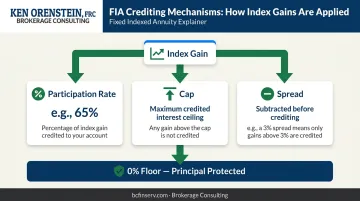
Fixed indexed annuities (FIAs) credit interest based on the performance of an external market index, such as the S&P 500. The index gain isn't passed through directly — it's filtered through three crediting structures:
- Participation rate — the percentage of index gains credited to your contract (for example, 65%)
- Cap — the ceiling on how much index interest you can receive in a given period
- Spread — a fixed percentage subtracted from index gains before crediting
The floor, typically 0%, protects your principal: if the index drops, you receive no credit but lose nothing. This means FIAs participate in some market growth without direct market investment and without any dividend pass-through from underlying stocks.
Brokerage Consulting evaluates crediting methods including annual point-to-point, monthly point-to-point, monthly average, and monthly sum — each produces different results depending on how the index behaves over the measurement period.
Variable Annuities
Variable annuities invest in sub-accounts that can include equity funds holding dividend-paying stocks. Any dividends generated inside those sub-accounts are reinvested within the annuity, not distributed to you. The contract value grows (or shrinks) based on sub-account performance, and you bear the investment risk.
Guaranteed Lifetime Withdrawal Benefit (GLWB) and Guaranteed Minimum Income Benefit (GMIB) riders can add a floor of guaranteed income. These riders carry added costs worth understanding before committing:
- Income rider fee: typically 1.0–1.5% annually on the income base
- Mortality and expense (M&E) charges: layered on top of rider fees
- Total all-in cost: can exceed 3% per year across all charges
Brokerage Consulting reviews these cost layers against projected income benefits to determine whether a rider-enhanced variable annuity makes sense for your situation.
How Annuity Payouts Work
Once an annuity enters the distribution phase — immediately for SPIAs, or after a deferral period — income payments replace what some investors expect from a dividend stream. The structure of those payments varies by option selected.
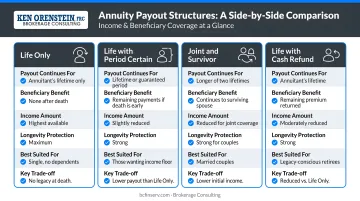
Payout Structures
| Option | Description |
|---|---|
| Life-only | Maximum monthly income for your lifetime; no residual benefit if you die early |
| Period certain | Guaranteed payments for a fixed term (10 or 20 years); beneficiary receives remaining payments if you die during the period |
| Life with period certain | Lifetime income plus a minimum guarantee period; combines longevity protection with beneficiary coverage |
| Joint-and-survivor | Continues payments to a surviving spouse; continuation options typically at 50%, 66.67%, 75%, or 100% of original payment |
As a concrete reference point: according to CANNEX PAY Index data from April 2026, a $100,000 immediate income annuity could generate approximately $617/month, representing a 7.41% yield based on average market rates at that time. Actual quotes vary by age, gender, payout option, and current interest rates.
Annuitization vs. Systematic Withdrawals
The choice between these two approaches has lasting consequences:
- Annuitization converts your contract irrevocably to an income stream. You give up access to the principal, but gain contractually guaranteed payments — potentially for life.
- Systematic withdrawals let you retain control of the principal but carry the risk of depleting the account if you live longer than projected or markets underperform.
- Tax and RMD implications differ sharply: annuitized contracts satisfy RMD requirements once payments begin, while systematic withdrawals from qualified accounts require careful annual calculation to avoid IRS penalties.
Federal employees managing FERS pension, Social Security, TSP distributions, and private annuities face a sequencing decision that compounds over time. Getting the order wrong can trigger unnecessary taxes or RMD penalties. Brokerage Consulting works directly with federal retirees on income timing — including QLAC strategies to defer required distributions within an IRA — through a no-cost initial consultation.
Annuities vs. Dividend Stocks: Income, Risk, and Tax
Side-by-Side Comparison
| Factor | Annuities | Dividend Stocks |
|---|---|---|
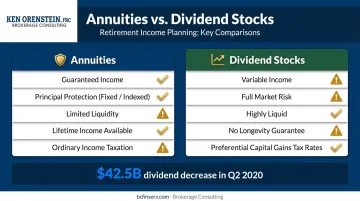
| Income predictability | Contractually guaranteed (fixed/indexed); variable with sub-accounts | Variable; companies set dividend policy |
| Income certainty | Guaranteed by insurer's claims-paying ability | Can be cut, suspended, or eliminated |
| Principal risk | Protected (fixed/indexed); market risk (variable) | Full market risk |
| Liquidity | Limited during surrender period | Highly liquid |
| Longevity protection | Lifetime income options available | No income guarantee regardless of how long you live |
During Q2 2020, S&P Dow Jones Indices reported a $42.5 billion decrease in U.S. indicated dividend payments — the worst quarter since Q1 2009. Annuity payments, by contrast, are contractual obligations backed by the insurer's financial strength, not discretionary corporate decisions.
The Tax Gap
This is where the comparison gets meaningful for higher-income retirees. Qualified stock dividends are taxed at capital gains rates — 0%, 15%, or 20% depending on your bracket. Annuity distributions are taxed as ordinary income, which for many retirees means a higher effective rate on the same dollar amount.
That said, tax-deferred compounding inside an annuity can offset this over a long accumulation period. The right answer depends on your tax bracket, time horizon, withdrawal sequencing, and income sources — a licensed advisor can help you model which structure works in your favor.
The Longevity Risk Gap
Dividend stocks can grow income over time through reinvestment, but they offer no guarantee of lifetime income. If markets drop sharply early in retirement while you're drawing from the portfolio, the damage can be lasting — this is called sequence-of-returns risk, and it's one of the most underestimated threats to a stock-based income strategy.
Annuities with lifetime income riders or annuitization directly address the risk of outliving your assets. That protection is especially relevant for retirees without a pension, and for federal employees looking to supplement FERS income beyond what TSP or dividend stocks alone can reliably deliver.
Frequently Asked Questions
Do annuities pay interest or dividends?
Annuities do not pay dividends. Fixed annuities earn interest credited to the contract; indexed annuities earn index-linked credits; variable annuities reflect sub-account performance. Income is distributed during the payout phase as periodic payments — not traditional dividends.
Can you receive dividends from a variable annuity?
Variable annuity sub-accounts may hold dividend-paying funds, but those dividends are reinvested inside the contract tax-deferred. They are never paid out directly to you as dividend income.
How is annuity income taxed compared to dividends?
Annuity distributions are taxed as ordinary income. Qualified stock dividends receive preferential capital gains rates of 0%, 15%, or 20%. For higher-income retirees, this difference can be substantial. Consult a tax advisor for guidance specific to your situation.
What is the difference between an annuity payout and a dividend?
Dividends are discretionary profit-sharing payments from a company to shareholders and can be cut at any time. Annuity income payments are contractually guaranteed based on the terms of the insurance contract and the insurer's claims-paying ability.
Do fixed annuities earn interest or dividends?
Fixed annuities earn interest at a rate set by the insurer — not dividends. That interest is credited to the contract value and grows tax-deferred until distributions begin.
Can annuities replace dividend income in retirement?
Annuities can deliver a reliable income stream in retirement, and guaranteed lifetime income options give them an advantage dividends cannot match: income you cannot outlive. For retirees without a pension, that distinction matters.
Conclusion
Annuities don't pay dividends in the traditional sense, but they're built for exactly what many dividend investors want from retirement: predictability and reliability. The right annuity type and payout structure can deliver guaranteed income that complements, or in some cases replaces, what investors have historically sought from dividend stocks.
For federal employees navigating FERS, TSP distributions, and Social Security alongside private investments, knowing how annuity income fits into the full picture matters. Ken Orenstein at Brokerage Consulting works as a Federal Retirement Consultant to evaluate which annuity structure makes sense given your income sources, tax situation, and retirement timeline.
A no-cost consultation is available in three ways:
- Phone or virtual — call (888) 315-3608
- In person — visit Brokerage Consulting in Flemington, NJ
- Online — request a quote at bcfinserv.com/request-a-quote