
That narrative is now being revised. LIMRA reported $121.2 billion in total U.S. annuity sales in Q3 2025 — the first quarter ever to exceed $120 billion — with traditional variable annuity (VA) sales hitting $17 billion in that quarter alone, up 13% year over year. For the full year, LIMRA's final 2025 data puts total annuity sales at $464.1 billion, a fourth consecutive record.
Whether you are a pre-retiree weighing your options, a federal employee planning a TSP rollover, or an investor evaluating guaranteed income strategies, these numbers raise a real question: what is driving this resurgence, and does it have any bearing on your retirement plan?
Key Takeaways
- Traditional VA sales hit $63.1B for full-year 2025 (up 8% YoY), with Q3 2025 alone reaching $17B — a 13% year-over-year gain
- Per Wink's research, VA sales surged 53% between Q4 2023 and Q4 2024, signaling a broad market shift
- Equity market confidence, product redesign, and independent broker-dealer growth are the primary drivers
- All-in VA costs can reach 2% or more annually; always compare total fees before purchasing
- Suitability depends on time horizon, risk tolerance, and whether you have maximized tax-advantaged accounts first
Variable Annuity Sales Are Breaking Records — Here Is the Data
The Current Numbers
The sales figures coming out of LIMRA are consistent. Q3 2025 marked the eighth consecutive quarter above $100 billion in total U.S. annuity sales, and the first to cross $120 billion. Traditional VA sales for the first three quarters of 2025 totaled $47.2 billion — up 7% year over year.
Wink's data shows traditional VA sales rose 53% between Q4 2023 and Q4 2024, reaching $18 billion in that single quarter. That 53% jump signals demand accelerated sharply before 2025's more measured 7% annual growth confirmed the trend was real, not an anomaly.
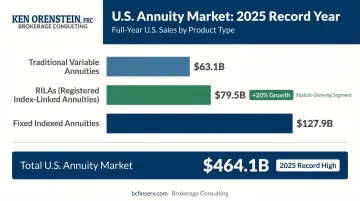
Full-year 2025 results across the broader annuity market:
- Traditional VAs: $63.1 billion
- RILAs (fastest-growing registered product): $79.5 billion, up 20%
- Fixed indexed annuities: $127.9 billion
- Total U.S. annuity market: $464.1 billion — the largest on record
Historical Context
Traditional VA sales peaked at $184 billion in 2007, then declined for over a decade. The recent trajectory shows a clear reversal:
| Year | Traditional VA Sales |
|---|---|
| 2022 | $61.7 billion |
| 2023 | $51.4 billion |
| 2024 | $60.9 billion |
| 2025 | $63.1 billion |
VAs are not back to their 2007 peak. The multi-year decline has reversed, though.
Who Is Leading VA Sales
The top three traditional VA sellers by year-to-date volume through Q3 2025 (per LIMRA):
- Jackson National Life — $9.6 billion
- Equitable Financial — $5.5 billion
- Lincoln Financial Group — $4.6 billion
Fee structures, living benefit options, and subaccount menus differ meaningfully among these carriers. Jackson's SEC-filed Perspective II prospectus, for example, lists a core contract charge of 1.40% annually. Buyers comparing carriers should look at the full cost structure, not just the headline product name.
What Is Driving the Surge in Market Confidence?
Equity Markets Reduced Resistance
The simplest explanation is also the most direct: when stock markets perform well, consumers are more willing to link retirement savings to investment subaccounts. LIMRA's January 2025 industry outlook specifically attributed the 2024 VA rebound to double-digit equity market growth and increased interest from registered investment advisors.
VA sales historically track investor sentiment. Fear of losses suppresses demand; confidence in markets restores it.
Product Design Has Improved
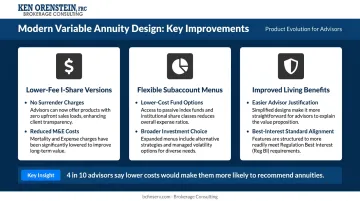
The VA products on the market today look different from those sold a decade ago. Carriers have introduced:
- Lower-fee I-share (fee-based) versions with no surrender charges and reduced mortality and expense costs
- More flexible subaccount menus with lower-cost underlying fund options
- Improved living benefit structures that are easier for advisors to explain and defend under best-interest standards
LIMRA research noted that independent broker-dealers represented more than half of all registered annuity product sales in Q3 2025, driven in part by product designs that make recommendations easier to justify under best-interest standards. Four in ten advisors surveyed said lower costs would make them more likely to recommend annuities. Carriers took notice and adjusted.
Longevity Anxiety Is Driving Sustained Demand
Allianz Life's 2025 Annual Retirement Study found that 64% of Americans worry more about running out of money than death — including 70% of Gen X and 61% of Baby Boomers. That longevity anxiety, combined with a massive cohort of Boomers and Gen Xers now in or near retirement, creates sustained demand for products that combine growth potential with income guarantees.
The Rate Environment Rotated Demand
Rising interest rates made fixed-rate and MYGA products highly competitive from 2022 through 2024. As the Fed signaled potential rate cuts, some investors and advisors began rotating toward variable products to capture equity upside. That rotation drove faster growth rates in VAs and RILAs relative to fixed-rate deferred products over the same period.
What Is a Variable Annuity and How Does It Work?
A variable annuity is a contract issued by an insurance company where premium payments are allocated into investment subaccounts — portfolios of stocks, bonds, or other assets chosen by the owner. Unlike fixed annuities, which credit a guaranteed rate, the account value fluctuates with subaccount performance.
Accumulation Phase vs. Distribution Phase
During the accumulation phase, invested premiums grow tax-deferred inside the subaccounts. No annual tax reporting is required on gains — earnings compound without the drag of annual taxation. This advantage is most valuable for investors in higher tax brackets with time horizons long enough to let compounding work.
During the distribution phase, the contract converts to income through one of two paths:
- Annuitization — surrendering the account value in exchange for a guaranteed income stream
- Systematic withdrawals — drawing income while the subaccounts remain invested
Living Benefits and Optional Riders
The most commonly attached rider is the Guaranteed Lifetime Withdrawal Benefit (GLWB). Here is how it works:
- A benefit base (separate from the actual account value) accumulates, often at a guaranteed roll-up rate
- The owner is entitled to withdraw a guaranteed percentage of that benefit base annually for life, regardless of investment performance
- If the account value drops to zero due to withdrawals or poor performance, the guarantee continues
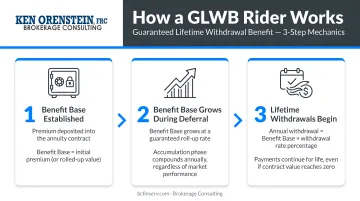
Two figures matter here, and they are not the same: the benefit base drives the guaranteed income calculation, while the account value is what you could actually surrender for cash. Conflating them is one of the most common buyer mistakes.
That clarity matters when evaluating cost. Living benefit riders typically add 0.5% to 1.0% or more annually on top of base contract fees. Deciding whether that ongoing charge is worth it comes down to three factors: your income need, your time horizon, and how much certainty you want that income to be protected — regardless of how markets perform.
Fees, Charges, and Income Potential Explained
Do Variable Annuities Have a Sales Charge?
Many traditional VAs carry a contingent deferred sales charge (CDSC), also called a surrender charge. This fee applies to withdrawals made within the surrender period, which the SEC notes is typically six to eight years, sometimes extending to ten.
Fee-based (I-share) VAs generally eliminate surrender charges but carry their own annual cost structure. The key distinction:
| VA Type | Surrender Charge | Typical M&E |
|---|---|---|
| Commission-based (B-share) | Yes, 6-10 year period | ~1.25%–1.40% annually |
| Fee-based (I-share) | Generally none | Lower base, advisor fee separate |
Ongoing Annual Costs
Mortality and expense (M&E) charges are the main recurring cost in a traditional VA. The SEC's general guidance cites M&E charges around 1.25% annually; Jackson's prospectus example shows 1.40%. Additional layers include:
- Subaccount fund expenses (varies by investment option)
- Administrative fees
- Optional rider charges (0.5%–1.0%+ for GLWBs)
FINRA's older Notice 04-45 estimated average total VA annual expenses at 1.3% to 2.2% — and contracts with multiple riders can push costs well beyond that ceiling. Before purchasing, ask for the total annual expense figure across all layers, not just the M&E charge.
How Much Monthly Income Can a $100,000 Annuity Generate?
For a 65-year-old converting $100,000 through annuitization, current illustrative figures from ImmediateAnnuities.com (May 2026) show:
- Male, life-only payout: approximately $623/month (average), up to $685 (best rate)
- Female, life-only payout: approximately $596/month (average), up to $634 (best rate)
These figures apply to a single premium immediate annuity (SPIA) as a reference point, since variable annuity payouts fluctuate with subaccount performance rather than remaining fixed. The income you actually receive from a VA depends on contract performance before annuitization, the payout option selected, and any living benefit rider terms — treat these numbers as illustrative estimates, not guarantees.
Should You Buy a Variable Annuity in Today's Market?
Who a VA Is Best Suited For
A variable annuity makes the most sense when several conditions align:
- Long time horizon — 10 or more years before income is needed, allowing market recovery time
- Higher risk tolerance — comfort with account value fluctuating with markets
- Tax-deferred growth need — already maximized IRA and 401(k) contributions
- Income guarantee appeal — want equity upside with an optional lifetime income floor
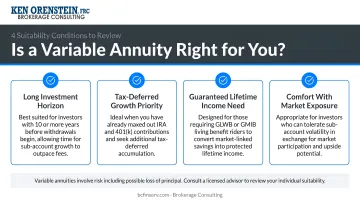
The SEC is direct on this point: variable annuities are designed as long-term retirement investments, not short-term vehicles. Investors should generally maximize tax-advantaged accounts before considering a VA in a taxable or rollover context.
Who Should Pause Before Buying
Not every investor who can buy a VA should. Consider alternatives if:
- Retirement is close — limited time to recover from subaccount losses before income is needed
- Liquidity matters — the surrender period restricts access to funds you may need
- Fee sensitivity is high — all-in costs of 2%+ annually can significantly reduce net returns over time
For many clients, RILAs (which cap downside loss via buffers while limiting upside) or FIAs (principal protection with index-linked crediting) are worth comparing directly against a traditional VA before committing.
Making that comparison is easier with a structured review. Ken Orenstein at Brokerage Consulting offers no-cost consultations — by phone, virtual, or in-person — covering income rider comparisons, 1035 exchange analysis, and how any annuity fits into a broader retirement income plan.
For federal employees, the review can also address how a VA aligns with FERS pension income, Social Security timing, and TSP distribution strategy. Reach Ken at (888) 315-3608 or bcfinserv.com.
Frequently Asked Questions
Frequently Asked Questions
How do you sell a variable annuity?
Selling a VA requires both a securities license (Series 6 or 7) and a state insurance license, because subaccounts are classified as securities. The advisor presents a product recommendation based on the client's suitability profile, and the contract is issued by the carrier after compliance review. Under SEC Regulation Best Interest, broker-dealer recommendations must be in the client's best interest, not merely suitable.
Do variable annuities have a sales charge?
Many traditional VAs carry a contingent deferred sales charge that phases out over six to ten years. Fee-based I-share versions typically eliminate this charge. All VAs also carry ongoing annual fees including M&E charges, subaccount fund expenses, and optional rider costs. Always request the total annual expense across all layers.
How much monthly income can a $100,000 annuity generate?
For a 65-year-old, current illustrative SPIA payout rates suggest roughly $596–$685 per month depending on gender and carrier. Variable annuity income will differ based on subaccount performance before distribution and the payout option selected; income is not fixed and will fluctuate with investment results.
What is a fixed annuity in sales?
A fixed annuity guarantees a specific interest rate for a set period (as with MYGAs) or provides income based on fixed payment schedules, unlike variable annuities where returns depend on subaccount performance. Fixed annuity sales dominated the U.S. annuity market from 2022 to 2024 as rising interest rates made guaranteed rates especially attractive.
Are variable annuities a good investment for retirement?
VAs can work well for long-horizon investors seeking tax-deferred market growth with optional lifetime income guarantees. The high fee structures and product complexity mean suitability must be evaluated contract by contract, weighing your time horizon, risk tolerance, and the product's actual cost structure.
What is driving the current surge in variable annuity sales?
Key drivers include improved investor confidence in equities, lower-cost fee-based product designs, and strong independent broker-dealer distribution. A large cohort of Baby Boomers and Gen X investors seeking both growth and guaranteed lifetime income has also fueled demand. Anticipated Fed rate cuts rotated some buyers away from fixed-rate products toward registered annuities.