Introduction
A market crash in your first year of retirement hits differently than it does at 45. When you're withdrawing from your portfolio as it declines, you face a double threat: shrinking account values and fewer shares left to participate in the eventual recovery. Unlike the accumulation phase—when you have decades to ride out volatility—retirement income planning means withdrawing principal while markets fluctuate, a timing risk with consequences you can't simply wait out.
This comparison matters most at the moment you're transitioning from paycheck to portfolio. Sequence of returns risk, longevity risk, and the psychological toll of watching savings decline without a salary to offset losses create a fundamentally different decision framework for retirees. Both fixed indexed annuities and stock market investing serve real purposes — the question is which tool fits which job.
Below, you'll see how FIAs and stocks compare on protection, growth, income, and flexibility — and how to match each to your income needs, risk tolerance, and retirement timeline.
TLDR:
- FIAs protect principal from market losses and link growth to an index like the S&P 500 — but cap your upside
- Stocks offer higher long-term growth but expose you to full volatility, including early-retirement losses
- FIAs can guarantee lifetime income; stocks depend on performance and withdrawal discipline
- Your decision hinges on income gaps, principal protection needs, and tolerance for 20–40% losses
- Most retirees benefit from both: FIAs for guaranteed income floors, stocks for long-term inflation protection
FIA vs. Stock Market: Quick Comparison
Here's how fixed indexed annuities and direct stock market investing stack up across the factors that matter most in retirement.
| Feature | Fixed Indexed Annuity (FIA) | Stock Market |
|---|---|---|
| Principal Protection | Contractually guaranteed — no loss due to market downturns | No protection; crashes can exceed 50% losses |
| Return Potential | Capped upside, typically 8–11% annually or via participation rates (e.g., 60% of index gains); dividends excluded | Unlimited upside with dividends included; 9.92% geometric average annual return from 1928–2024 |
| Liquidity | Restricted by 7–10 year surrender periods; typically 10% free annual withdrawals allowed | Highly liquid — buy or sell anytime during market hours, no penalty |
| Tax Treatment | Tax-deferred growth; withdrawals taxed as ordinary income | Dividends taxed annually; long-term capital gains at 0%, 15%, or 20% depending on income |
| Guaranteed Income | Optional income riders deliver contractual lifetime income, similar to a private pension | No income guarantee — depends entirely on portfolio performance and withdrawal discipline |
What Is a Fixed Indexed Annuity?
A fixed indexed annuity is an insurance contract issued by a life insurance company. It is not a security, and your money is never directly invested in the stock market. Instead, the insurance company uses call options on a market index (typically the S&P 500) to credit a portion of market gains to your account on each contract anniversary. According to the American Academy of Actuaries, when markets fall, you earn zero—but you don't lose a penny of principal or previously locked-in gains.
How Caps and Participation Rates Limit Upside:
Insurance companies restrict how much market upside you receive through two main mechanisms:
- Cap rates (e.g., 10% annually) set the maximum gain credited in any year
- Participation rates (e.g., 60% of S&P gains) mean you receive only a fraction of the index return
- Dividend exclusion: S&P 500 gains used in FIA calculations typically exclude dividends, which historically account for roughly 38% of the index's total compounded return
Realistic Return Expectations:
Fixed indexed annuities were first introduced in February 1995 specifically to compete with CD returns, not market returns. In strong market years, you'll capture enhanced CD-type performance; in flat or down years, your floor is zero. While the S&P 500 delivered a 9.92% geometric average annual return from 1928-2024, FIAs with caps, participation limits, and excluded dividends will underperform full market participation over long bull markets.
Income Riders Explained:
Where FIAs offer a different value from pure return potential is in guaranteed income. Many FIAs let you attach an income rider — a benefit that guarantees a future lifetime income stream regardless of account performance. When activated, it functions like a private pension you control.
According to NAIC specimen documentation, typical rider terms include:
- Guaranteed simple interest growth on your income base (e.g., 4.00% annually)
- Annual rider charges (commonly starting at 0.50%, rising to 1.00%)
- Lifetime income withdrawal percentages set at activation based on your age
Use Cases for FIAs in Retirement:
That guaranteed income structure makes FIAs particularly well-suited for certain retirement scenarios. They work best for retirees who need to:
- Protect a specific portion of savings from market loss
- Cover the income gap between Social Security or pension income and monthly expenses
- Replicate pension-like income after transitioning from FERS/CSRS structures using TSP or retirement lump sums
What Is Stock Market Investing for Retirees?
In retirement, stock market investing typically means holding a diversified portfolio of equities (individual stocks, ETFs, or mutual funds) with a systematic withdrawal strategy such as the 4% rule. Unlike FIAs, stocks offer no floor—but also no ceiling. The S&P 500's long-term average return is 9.92% compounded annually from 1928–2024.
Key Benefits in Retirement
- Long-term growth potential that outpaces inflation over time
- Dividend income from equities that can supplement withdrawals
- Complete liquidity — rebalance, access funds, or change strategy anytime without penalty
- Long-term capital gains rates of 0%, 15%, or 20% are typically lower than ordinary income tax rates applied to annuity withdrawals
The Critical Risk: Sequence of Returns
A 30-40% market decline in year one of retirement, combined with ongoing withdrawals, can permanently damage a portfolio — even if a 40-year-old accumulator could recover from the same drop over time.
Research by Michael Kitces shows the correlation between first-decade real returns and sustainable withdrawal rates is 0.79-0.81, with peak predictive power around years 9-10. A bad first decade can permanently reduce what you can safely withdraw, even if 30-year average returns look healthy. Early high inflation alone can increase nominal withdrawals by nearly 37% over 30 years compared to late high inflation.
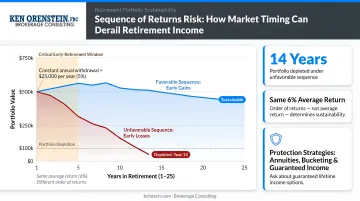
This is why sequence risk changes the calculus entirely — and why the stock market's long-term return figures don't tell the full story for retirees.
Key Differences: FIA vs. Stock Market for Retirees
Downside Protection vs. Full Market Exposure
FIAs contractually guarantee your account will never decrease due to market performance—gains lock in each year and cannot be reversed by future downturns. Stocks carry no such guarantee.
Historical market declines illustrate the exposure difference:
- Dot-com crash: S&P 500 declined 49.1% over 31 months (March 2000 to October 2002)
- Global Financial Crisis: S&P 500 dropped 56.8% over 17 months (October 2007 to March 2009)
- COVID crash: S&P 500 fell 33.9% in just one month (February to March 2020)
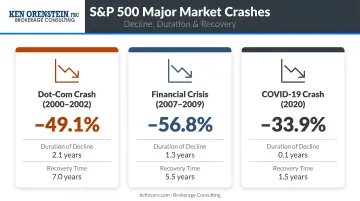
During each of these periods, FIA holders earned 0%—while stock portfolios experienced devastating losses that required years to recover.
The Return Trade-Off
In a year the S&P 500 gains 25%, a 10% capped FIA captures only 10%. Over a long bull market, this compounding gap becomes significant. Conversely, in a year the market falls 30%, the FIA earns 0% while a stock portfolio loses that full 30%.
FIA protection comes at the cost of limited participation in strong bull markets. Dividends contribute roughly 38% of total S&P 500 returns on a compounded basis. Because FIAs exclude dividends entirely, the return gap widens further in strong equity environments.
Tax Treatment Differences
FIA withdrawals are taxed as ordinary income (same as wages or pension income), while long-term stock gains qualify for capital gains tax rates of 0%, 15%, or 20% depending on income—generally lower for most retirees. FIA growth is tax-deferred, though, which delivers meaningful compounding benefits during accumulation.
Which structure wins depends heavily on your income bracket and withdrawal timing. Retirees in the 0% capital gains bracket (single filers up to $48,350 or married filing jointly up to $96,700 in 2025) get a clear tax edge from stocks. For higher earners, FIA tax deferral can offset the ordinary income treatment on the back end.
Liquidity Constraints
Stocks can be sold anytime during market hours—critical for unexpected healthcare costs, home repairs, or family needs. FIAs lock principal during surrender periods (commonly 7-10 years), with only approximately 10% annual penalty-free withdrawals.
Any funds you may need within the surrender period should stay outside an FIA—liquidity risk is real and often underestimated.
Fees and Costs Reality Check
Fee structures differ sharply between the two options—and within annuity types as well.
| Cost Factor | Fixed Indexed Annuity | Stock Index ETF |
|---|---|---|
| Base management fee | Often $0 (spread-based model) | As low as 0.03% (e.g., Vanguard VOO) |
| Optional income rider | 0.50%–1.00% annually | N/A |
| Variable annuity fees* | 1.3%–2.2% annually | N/A |
*Variable annuities are securities with market-linked subaccounts—a fundamentally different product from FIAs. Fixed indexed annuities are insurance contracts, not securities, and carry a much lower cost structure.
Which Is Right for You? A Retiree's Guide
Answer These Questions First
1. Can you afford to lose 20-40% of this money without changing your lifestyle or increasing withdrawals?
- If no, those funds belong in a principal-protected vehicle
2. Do you have an income gap—a shortfall between what Social Security and any pension provides and what your monthly expenses require?
- If yes, a FIA with an income rider may be the most efficient way to fill that gap contractually
3. Will you need access to this money within the next 7-10 years?
- If yes, a FIA's surrender period is a serious constraint
Choose a FIA When:
- You are retired or within 5 years of retirement
- A portion of your savings is earmarked for essential income, not discretionary growth
- You experienced serious financial stress during 2008 or 2020 market crashes and cannot absorb similar losses
- You need to convert a lump sum (from TSP, 401(k), or IRA) into predictable monthly income without relying on market performance
Choose Stock Market Investing When:
- You have a 10+ year time horizon before needing the funds
- Your essential retirement expenses are already fully covered by guaranteed sources (Social Security, pension, or FIA income)
- You have the emotional discipline and financial resilience to hold through market downturns without panic-selling
- You want growth that can outpace inflation over the long term
The "Both/And" Approach Most Retirees Need
Most retirees don't face a binary choice. A practical retirement income plan uses FIAs to establish a protected floor covering essential expenses — groceries, housing, healthcare — while keeping a separate portion in diversified equities for long-term growth and inflation protection.
A simple way to think about the split:
- Protected layer: FIA income covers non-negotiable monthly expenses
- Growth layer: Equity portfolio handles discretionary spending and long-term purchasing power

Getting the allocation right depends on your specific income sources, expenses, timeline, and risk tolerance. Ken Orenstein at Brokerage Consulting works with retirees and federal employees to map out exactly this kind of income structure — reach him at (888) 315-3608 or korenstein@brookstoneadvisor.com.
Conclusion
The right choice isn't FIA vs. stocks — it's finding the right proportion of each for the right purpose. FIAs protect against market losses; stocks build long-term wealth. The goal is matching the tool to the job, not picking a winner.
Start with these three steps before making any decision:
- Map your income floor — calculate guaranteed income from Social Security and pensions, then identify any monthly shortfall
- Assess your risk tolerance honestly — based on how you actually responded during past market downturns, not how you think you would
- Speak with a qualified retirement advisor — one who can evaluate both options objectively for your specific situation
A personalized assessment makes the difference between a plan that looks good on paper and one that holds up when markets get rough.
Frequently Asked Questions
Are fixed indexed annuities better than the stock market for retirees?
Neither is universally better. FIAs excel at principal protection and guaranteed income, while stocks offer superior long-term growth potential. The right answer depends on your income needs, time horizon, and whether you can withstand significant market losses without changing your lifestyle.
What do financial experts like Suze Orman and Warren Buffett say about fixed indexed annuities?
Suze Orman acknowledges FIAs can protect against downside risk but opposes holding them inside retirement accounts. Warren Buffett favors a stock-heavy approach for his estate's beneficiary. Expert views are divided, and the terms of your specific contract matter far more than any broad endorsement or criticism.
How much would a $100,000 fixed indexed annuity pay per month?
Monthly payouts depend on your age at activation, deferral period, specific income rider terms, and current payout rates set by the carrier. These variables create significant payout differences across contracts and companies. Consult a financial advisor or use a live annuity calculator for personalized estimates based on current rates.
Can you lose money in a fixed indexed annuity?
FIAs protect principal from market losses—your account value cannot decline due to market performance. However, optional rider fees (if applicable) reduce net returns, and surrender charges for excess early withdrawals can reduce your effective return if you need funds during the surrender period.
What is the biggest downside of a fixed indexed annuity compared to stocks?
The main downsides are capped upside growth, limited liquidity during surrender periods, and product complexity. FIAs exclude dividends and cap returns, so they underperform full market participation over sustained bull runs.
Should retirees put all their retirement savings into a fixed indexed annuity?
No. Most retirees benefit from using FIAs for a protected income portion while keeping other assets in more liquid or growth-oriented vehicles. Putting all savings in any single product eliminates flexibility, reduces inflation protection, and creates unnecessary concentration risk. Diversification across guaranteed income sources, liquid reserves, and growth assets provides the most resilient retirement plan.