
This scenario catches many policyholders off guard. The mechanics of deferred premiums are rarely explained at the point of sale, yet they directly affect how much you pay and what happens if you miss an installment.
This guide covers what deferred premiums actually are, how payment frequency affects your total annual cost, and how to decide which payment mode fits your financial situation.
Key Takeaways
- A deferred premium is simply the unpaid portion of your annual insurance premium when you choose installment payments
- Monthly and quarterly payment modes cost more than annual payment due to modal loading fees added by carriers
- Missing an installment payment can trigger a grace period, and repeated missed payments can eventually cause a policy lapse
- Annual payment saves money long-term; installment plans ease short-term cash flow at a higher total cost
- The right choice depends on your income pattern, not just convenience
What Are Deferred Premiums? A Clear Definition
A deferred premium is an insurance premium that is scheduled but not yet due: specifically, the portion of the full annual premium that remains unpaid at any point in the policy year because you chose installment billing instead of a lump-sum payment.
The word "deferred" simply means delayed. When you select monthly, quarterly, or semi-annual payments, your insurer calculates the full annual premium and divides it across your chosen schedule. At any given moment, a share of what you technically owe hasn't been collected yet. That outstanding balance is the "deferred" amount.
One Term, Two Very Different Concepts
The phrase "deferred premium" sounds similar to a flexible premium deferred annuity — but the two refer to completely different things:
- Deferred premium (insurance context): A payment scheduling arrangement where the annual premium is paid in installments (monthly, quarterly, or semi-annually) rather than upfront — applies to life, health, and casualty policies
- Flexible premium deferred annuity: A separate financial product that accumulates funds tax-deferred, with income payments starting at a future date the owner selects
Both involve the word "deferred" and connect to insurance products — which is exactly why the distinction matters before making any planning decisions.
Which Policies Use Deferred Premium Arrangements?
According to the ACLI, individual life insurance premiums may be payable annually, semi-annually, quarterly, or monthly. The arrangement is also standard in health insurance and casualty coverages. Per IRMI's definition, deferred premiums are periodic premium payments — usually monthly, at no interest — used most frequently with casualty coverages, though the structure appears across product lines including employer-sponsored group life plans.
How Deferred Premiums Work: Payment Frequency Options
Insurers typically offer four standard payment modes: annual, semi-annual, quarterly, and monthly. Each starts with the same calculated annual premium — but the amount you actually pay varies based on the mode you select.
What Happens Behind the Scenes
When an insurer grants coverage with installment billing, they're technically providing full protection before collecting the full premium. The uncollected portion sits on their books as a "deferred premium asset" — an admitted asset used to offset reserve calculations under statutory accounting rules.
This is why insurers don't treat payment mode selection as a neutral administrative choice. There's real financial exposure on their end.
The Modal Factor: Why Installments Cost More
Insurers apply what are called modal factors — multipliers that translate the annual premium into installment amounts. These factors are consistently higher than a simple mathematical fraction.
Banner Life's published product specifications illustrate this clearly:
| Payment Mode | Modal Factor | Applied to $1,200 Annual Premium |
|---|---|---|
| Annual | 1.000 | $1,200.00 |
| Semi-Annual | 0.510 | $612.00 × 2 = $1,224.00 |
| Quarterly | 0.260 | $312.00 × 4 = $1,248.00 |
| Monthly (EFT) | 0.087 | $104.40 × 12 = $1,252.80 |

A true 1/12 split of $1,200 would be $100.00; the monthly EFT factor produces $104.40 instead. As Northwestern Mutual states directly, modal premiums are greater than simple fractions of annual premiums because of added collection costs and the insurer's lost use of the full premium at policy inception.
Coverage During the Deferral Period
One point that surprises many policyholders: coverage remains fully active throughout the payment cycle, even before the full annual premium is collected. You're not partially insured because you've only paid three months of a twelve-month premium.
Key implications of this arrangement:
- You're fully covered from day one, regardless of where you are in the payment cycle
- The insurer carries the financial risk of unpaid installments as an admitted asset
- That risk is why installment billing costs more than paying annually upfront
The True Cost of Deferred Premiums
Monthly billing is convenient, but it costs more than annual payment. That extra cost comes from three sources:
- Transaction processing costs — handling 12 payments instead of 1 carries real administrative overhead
- Lost investment income — insurers invest collected premiums; installment billing delays that income
- Modal loading — the margin built into the factor itself to compensate for both of the above
How Much Does It Actually Add Up To?
Using Banner Life's published modal factors on a $1,200 annual premium, the annual cost difference between monthly EFT and annual payment is $52.80 — roughly a 4.4% premium increase just for the convenience of monthly billing. Over ten years on that same policy, that's over $500 in extra premiums paid for the same coverage.
A 1994 actuarial study published in the Journal of Actuarial Practice found that monthly payment mode carried a nominal annual excess premium rate of 10.64% compared to annual payment in their 1992 sample. That figure is historical, but it confirms modal loading has never been a rounding error — it's a deliberate cost built into the product structure.
Flat Fee vs. Percentage-Based Loading
Insurers use two approaches:
- Flat installment fee — a fixed dollar charge added to each payment (common in auto and some health policies)
- Percentage-based modal factor — a multiplier applied to the base premium (standard in life insurance)
Before selecting a payment mode, ask your insurer specifically which method applies and request the total annual cost in writing for each option. State regulators in Maryland and Pennsylvania both advise consumers to ask whether installment plans carry extra fees before enrolling.
The Lapse Risk Nobody Mentions
Annual payers face one premium due date per year. Monthly payers face twelve. Each installment is a point of failure.
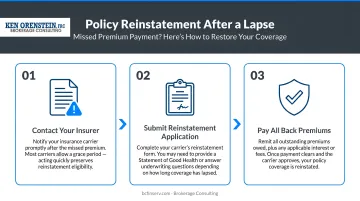
NAIC model life insurance language establishes a 31-day grace period after a missed payment, consistent with California DOI guidance that grace periods are typically 31 days. After that window closes without payment, the policy may lapse. Reinstatement is harder than most policyholders expect. Reinstatement typically requires:
- All overdue premiums plus interest
- Evidence of insurability (medical underwriting)
- Carrier approval — which is not guaranteed
Actuarial persistency data consistently shows annual payers retain their policies at higher rates than monthly payers. More payment events simply mean more chances for a policy to lapse.
Benefits and Drawbacks of Deferred Premiums
Deferred premiums offer real advantages for cash-flow-conscious policyholders — but they come with trade-offs worth understanding before you commit.
Benefits
- Lower barrier to entry — installment options make coverage accessible to households that can't absorb a large upfront premium
- Payments align with monthly income cycles, easing month-to-month budget planning
- Works well for hourly workers, retirees on fixed monthly income, or anyone who needs predictable recurring outflows
Drawbacks
- Higher total annual cost — modal loading fees mean you pay more over the year than annual payers
- Twelve payment deadlines instead of one creates twelve opportunities for a missed payment and potential lapse
- Administrative friction — monitoring automatic payments, updating payment methods, and tracking due dates adds ongoing complexity
- If a life insurance policy lapses due to a missed installment, reinstating coverage may require new medical underwriting — often at an older age when you're harder to insure
When Deferred Premiums Make Sense — and When They Don't
Good Fit: Monthly Income, Monthly Expenses
Installment payment makes practical sense for:
- Hourly workers whose income doesn't naturally accumulate into a lump sum
- Federal employees paid bi-weekly (26 pay periods per year) who budget around paycheck cycles — FEGLI itself operates on payroll deduction for exactly this reason
- Retirees on fixed monthly benefits who need expenses to align with Social Security or pension deposits
- Anyone who would genuinely need to draw down savings to cover an annual premium
For these individuals, paying a modest modal fee to preserve cash flow is a reasonable trade-off.
Poor Fit: Paying Extra for Convenience You Don't Need
If you have the liquid savings to cover an annual premium comfortably, the math is straightforward. Using the $1,200 example with monthly EFT modal loading:
- Annual savings per year: $52.80
- 10-year savings: $528
- 20-year savings: $1,056
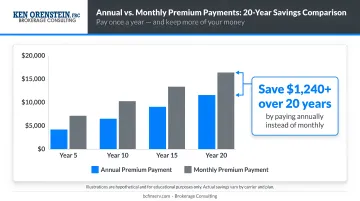
That's real money for identical coverage. The only benefit foregone is the convenience of smaller monthly withdrawals — and for someone with adequate reserves, that convenience has no practical value.
The Bigger Picture
Those savings figures matter, but payment mode is only one piece of the picture. The right choice connects to income stability, emergency reserves, existing debt, and how your overall financial plan is structured.
Ken Orenstein at Brokerage Consulting works with federal employees, retirees, and individuals to evaluate payment options as part of a broader, tax-efficient retirement strategy. That means looking at the full context — not just whichever option the application form defaults to.
Common Mistakes Policyholders Make with Deferred Premiums
Assuming all payment modes cost the same. Monthly billing feels convenient, but it costs more. Modal factors are designed to be higher than 1/12 of the annual premium — not equal to it. Always request the full-year cost for each payment mode in writing before you decide.
Ignoring grace period terms across policy types. The 31-day grace period applies to life insurance under NAIC model language, but provisions vary by policy type and state. Pennsylvania, for example, does not require a grace period for premium payments on auto policies at all. Don't assume identical terms across every policy you hold.
Setting up autopay and walking away. Automatic payment reduces lapse risk — it doesn't eliminate it. A card expiration, account change, or failed transaction can go unnoticed for weeks. Verify successful processing monthly and keep your payment information current with your insurer.
Treating a lapse as easily reversible. Reinstating a lapsed life insurance policy often requires more than just catching up on payments. Carriers may require new medical underwriting, and a health condition that developed after the original issue date could mean higher rates — or denial.
Frequently Asked Questions
What does deferred premium mean?
A deferred premium is the portion of your annual insurance premium not yet collected because you chose installment billing. At any point in the year, the unpaid balance — whether two months or six months of installments — represents the "deferred" amount owed.
Are deferred premiums a good idea?
They can be, for policyholders who need cash flow flexibility. Installment payments typically cost more annually than a single lump-sum payment due to modal loading fees. Whether it's worth it depends on your income pattern and how much the added cost outweighs the flexibility benefit.
How do deferred premiums affect the total cost of my insurance policy?
Paying in installments adds cost through modal loading fees, which are multipliers insurers apply to cover processing costs and lost investment income on uncollected premiums. The result is a higher total annual premium than you'd pay with a single upfront payment for identical coverage.
What happens if I miss a deferred premium payment?
Missing a payment typically triggers a grace period of around 31 days under NAIC model life insurance language. If payment isn't received within that window, the policy may lapse. To reinstate a lapsed policy, you'll typically owe back premiums, interest, and new medical underwriting.
What is the difference between a deferred premium and a deferred premium annuity?
A deferred premium is a payment scheduling arrangement on any insurance policy — you pay in installments rather than upfront. A flexible premium deferred annuity is a separate financial product where contributions accumulate tax-deferred over time, with income beginning at a future date. The two describe entirely different concepts despite the similar terminology.
Which types of insurance policies most commonly offer deferred premium payment options?
Life insurance, health insurance, and casualty coverages all commonly offer installment payment options. Monthly deferred premiums are especially prevalent in employer-sponsored group life and benefit plans, where payroll deduction makes installment billing the default structure.