
Introduction
Nearly 48% of retirees spend less than they could because they're afraid of running out of money — and that fear is costing them real quality of life. Meanwhile, according to the 2026 EBRI Retirement Confidence Survey, only 57% of workers believe their savings will last their entire lifetime.
Annuities exist precisely to answer that anxiety. They're contracts between a policyholder and an insurance company that convert a lump sum — or a series of premiums — into a structured stream of income, typically during retirement.
But the contract is only part of the picture. How your payments are structured, what they'll cost you, and what happens to the money when you die are decisions that can mean thousands of dollars in difference over a 20-year retirement. This guide breaks down everything you need to know:
- The two phases every annuity goes through
- The six main payout options and what each one costs you
- What drives your monthly payment amount (with real numbers)
- How annuity interest is taxed during the payout phase
- Fees, surrender charges, and early withdrawal penalties
- What happens to your annuity when you die
Key Takeaways
- Annuities have two phases: accumulation (growth) and distribution (income)
- Your payout option determines how long payments last and whether heirs receive anything
- Monthly payment amounts depend on premium size, age, payout option, and interest rates at annuitization
- Annuity earnings are taxed as ordinary income, not capital gains
- Surrender charges and the 10% IRS early withdrawal penalty (before age 59½) can cut into your payout if you withdraw early
How Annuity Payments Work: The Two Phases
Every annuity — regardless of type — moves through two distinct phases before income reaches your bank account.
The Accumulation Phase
During accumulation, you contribute premiums (either as a lump sum or periodic payments), and the contract grows tax-deferred. According to the NAIC, this is when the annuity's value changes based on product type — but no income payments are made yet.
Tax deferral is the key advantage here: you owe nothing to the IRS until distributions begin. This allows the contract value to compound without the annual drag of income taxes, which makes a measurable difference over a 10- to 20-year accumulation window.
For pre-retirees focused on accumulation, Fixed Indexed Annuities (FIAs) and Fixed Annuities with guaranteed income riders are among the most commonly used structures at Brokerage Consulting — both designed to lock in a future income amount today while roll-up rates build the income base until retirement.
The Distribution (Payout) Phase
The payout phase begins when you start receiving income. That transition happens in one of two ways:
- Annuitization — converting the contract value into a structured, irrevocable income stream
- Scheduled withdrawals — drawing from the account on a set schedule without annuitizing
The specific window during which payments are made is called the annuity period, and its length is determined by the payout option you select.
Immediate vs. Deferred Annuities
That payout option also determines when income begins — which is what separates the two broad annuity categories:
| Type | When Payments Begin | Best For |
|---|---|---|
| Immediate (SPIA) | Within 12 months of a single premium | Retirees needing income now |
| Deferred | Years later, after a growth period | Pre-retirees still building assets |
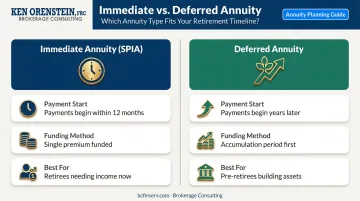
Per IRS Publication 575, an immediate annuity is defined as a single-premium contract with substantially equal payments starting within one year of purchase. SPIAs are the go-to tool for clients who've received a lump sum — whether from a 401(k) rollover, pension buyout, or inheritance — and need to convert it into reliable monthly income right away.
Most annuities pay monthly by default, but contracts can be structured for quarterly, semi-annual, or annual payments. Once set, payment frequency typically cannot be changed.
Annuity Payout Options: Choosing How Long Payments Last
The payout option you choose is one of the most consequential decisions in the annuity process. It determines how long income continues, whether a beneficiary receives anything after your death, and — most tangibly — your monthly payment amount.
Period Certain
Payments are guaranteed for a fixed number of years (commonly 10 or 20), regardless of whether you're alive. If you die before the period ends, the remaining payments go to your named beneficiary.
Best use: bridging an income gap before Social Security or RMDs begin, when lifetime coverage isn't the priority.
Single Life (Life Only)
Payments continue for your lifetime and stop completely at death — no continuation to heirs. Because the insurer's liability ends at your death, this option produces the highest monthly payment of any payout structure.
Best use: maximizing personal income when leaving assets to heirs is not a goal.
Life with Period Certain
Combines lifetime income with a minimum guaranteed payment window. If you die before the period certain ends, payments continue to your beneficiary for the remainder of that window.
This is the most popular balance between personal income protection and heir protection — you get lifetime coverage with a safety net for your beneficiaries.
Best use: retirees who want guaranteed lifetime income but also want to protect a spouse or dependent if they die early in the contract.
Joint and Survivor
Covers two individuals — typically spouses. Payments continue as long as either person is alive. After one dies, the survivor continues receiving payments, often at a reduced percentage (50%, 75%, or 100% of the original amount).
Monthly payments are lower than single-life options because the insurer faces a potentially longer payout period. The survivorship percentage you select — 50%, 75%, or 100% — directly sets the tradeoff between your current monthly income and your spouse's financial protection after you're gone.
Best use: married couples who depend on combined annuity income and need the surviving spouse covered.
Lump Sum
Instead of annuitizing, you take the full account value in a single payment. This gives you immediate access to the entire balance but can trigger significant income tax liability in one year and eliminates the guaranteed lifetime income the contract was designed to provide.
Best use: situations where liquidity is the priority and the tax impact has been planned for in advance — typically in coordination with a tax advisor.
Systematic Withdrawal
You withdraw a set dollar amount or percentage on a regular schedule without annuitizing. This maintains flexibility but carries real risk: if withdrawals are too aggressive or you outlive your projections, the account can be depleted.
Best use: those who want income flexibility and are confident in their withdrawal rate relative to their expected lifespan and portfolio performance.
What Determines Your Monthly Annuity Payment Amount
Four variables drive how much you receive each month. Knowing how they interact turns a complicated product into a predictable income plan.
Premium Size
More money in means more money out. A larger initial premium produces proportionally higher monthly payments. Here's a real-world illustration from Annuity.org based on April 2026 rates for a $300,000 single premium immediate annuity:
| Age | Sex | Single Life | Life + 10-Year Certain | Life + 20-Year Certain | Joint Life |
|---|---|---|---|---|---|
| 60 | Male | $1,590/mo | $1,554/mo | $1,485/mo | $1,446/mo |
| 60 | Female | $1,509/mo | $1,476/mo | $1,419/mo | $1,365/mo |
| 65 | Male | $1,875/mo | $1,824/mo | $1,719/mo | $1,608/mo |
| 65 | Female | $1,770/mo | $1,728/mo | $1,644/mo | $1,530/mo |
| 70 | Male | $2,250/mo | $2,172/mo | $2,007/mo | $1,860/mo |
| 70 | Female | $2,109/mo | $2,043/mo | $1,911/mo | $1,773/mo |
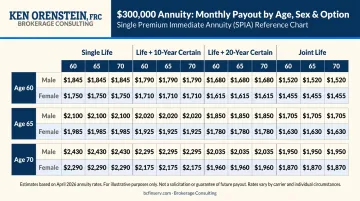
Estimates based on April 2026 rates. Actual payouts vary by insurer, state, and interest rate environment at annuitization.
Age and Life Expectancy
Older annuitants receive higher monthly payments because the insurer expects to make fewer total payments. A 70-year-old male receives $2,250/month on a single-life structure versus $1,590/month for a 60-year-old male — a $660/month difference from waiting ten years.
Women receive slightly lower monthly payments than men of the same age due to longer average life expectancy.
Payout Option Selected
Adding guarantees — a period certain, survivor benefit, or joint-life feature — reduces monthly income because it extends the insurer's liability. As the table above shows, a 65-year-old male choosing life with a 20-year certain period receives $156/month less than the single-life option. That's the cost of protecting a beneficiary.
Insurer's Rates and Financial Strength
The interest rate environment at the time of annuitization directly affects payout calculations. Higher rates generally produce higher payments. Equally important: annuity guarantees are backed by the claims-paying ability of the issuing insurer, not FDIC insurance.
Brokerage Consulting evaluates carrier financial strength ratings from A.M. Best, Moody's, S&P, and Fitch as a standard step in every annuity recommendation. An independent advisor can compare payouts and ratings across multiple carriers — because a competitive payout from a financially shaky insurer isn't actually a win.
How Annuity Interest Is Credited and Taxed During Payout
Interest Crediting During Accumulation
How your annuity earns money during the accumulation phase depends on the product type:
- Fixed annuities — earn a guaranteed rate set by the insurer for a specified period
- Fixed indexed annuities (FIAs) — credit interest linked to a market index (such as the S&P 500), subject to caps, floors, participation rates, and spreads; minimum credited rate can be 0% or 1%
- Variable annuities — fluctuate based on underlying subaccount investment performance; value can decrease
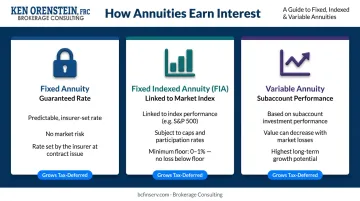
All three types grow tax-deferred until distribution begins.
Tax Treatment During the Payout Phase
Tax treatment at distribution turns on one key distinction: whether the annuity is qualified or non-qualified.
Qualified annuities (funded with pre-tax dollars via 401(k), IRA, etc.):
- All distributions are taxed as ordinary income
- There is no cost basis to recover — you've never paid tax on any of it
Non-qualified annuities (funded with after-tax dollars):
- Only the earnings portion of each payment is taxable
- The principal (cost basis) is returned tax-free via the exclusion ratio
The exclusion ratio is the IRS-calculated percentage of each payment that represents a return of your original after-tax investment — and is therefore not taxable. It's calculated by dividing your investment in the contract by the total expected return.
Once your full cost basis has been recovered, all subsequent payments become fully taxable.
Annuity earnings are taxed as ordinary income, not capital gains — regardless of how the underlying funds were invested. This matters in practice: a mutual fund held outside an annuity may qualify for lower long-term capital gains rates, while the same growth inside an annuity does not. It's a meaningful trade-off to weigh when comparing tax-deferred annuity growth against taxable investment accounts.
Fees, Surrender Charges, and Early Withdrawal Penalties
Surrender Charges
Surrender charges are fees imposed by the insurer when you withdraw funds or fully surrender the contract before the surrender period ends — typically 6 to 10 years. A representative schedule per SEC/Investor.gov:
| Year | Surrender Charge |
|---|---|
| Year 1 | 7% |
| Year 2 | 6% |
| Year 3 | 5% |
| Year 4 | 4% |
| Year 5 | 3% |
| Year 6 | 2% |
| Year 7 | 1% |
| Year 8+ | 0% |
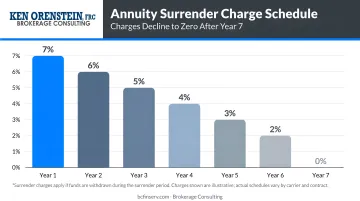
If you fully surrender the contract, the final contract value is reduced by the applicable surrender charge — and potentially a market value adjustment as well. Most contracts include a free withdrawal provision (typically 10% of contract value annually) that lets you access some funds without triggering charges.
IRS Early Withdrawal Penalty
Distributions before age 59½ trigger an additional 10% federal tax penalty on top of ordinary income taxes — regardless of whether a surrender charge also applies. Both penalties can apply at once.
Other Common Fees
Variable annuities in particular carry layered costs:
- Mortality and expense (M&E) risk charges — typically around 1.25% annually of account value
- Administrative fees — approximately $25–$30 flat or 0.15% of account value
- Rider charges — guaranteed income riders (GLWB, GMIB) typically run 1.0–1.5% annually on the income base
All-in costs on a variable annuity with riders can exceed 3% per year. That's why comparing fee structures across carriers matters — weighing whether the guarantee a rider provides is worth its annual cost is a core part of any sound annuity review.
Death Benefits: What Happens to Your Annuity
During the Accumulation Phase
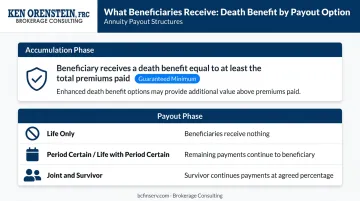
If the annuitant dies while the contract is still accumulating, the named beneficiary receives the death benefit. At minimum, this equals the total premiums paid into the contract. Many contracts include enhanced death benefits that lock in credited interest or previous account highs.
If no beneficiary is named, proceeds pass to the estate, which can delay distribution and create probate complications.
During the Payout Phase
What beneficiaries receive after annuitization depends entirely on the payout option selected:
- Life only: payments stop at death; beneficiaries receive nothing
- Period certain / Life with period certain: remaining guaranteed payments continue to the beneficiary
- Joint and survivor: the surviving spouse continues receiving payments at the agreed percentage
Beneficiary Distribution Rules by Contract Type
Qualified annuities: Most non-spouse beneficiaries must withdraw the full value within 10 years of the annuitant's death, per current IRS rules (with exceptions for eligible designated beneficiaries such as minor children or disabled individuals).
Non-qualified annuities: Options typically include a lump sum subject to the five-year rule, or payments based on the beneficiary's life expectancy. Rules vary based on the beneficiary's relationship to the annuitant and the contract's specific terms.
Beneficiary planning — which distribution method fits, whether stretch payouts or a lump sum — is worth reviewing before annuitization, not after.
Frequently Asked Questions
How much does a $300,000 annuity pay each month?
Based on April 2026 SPIA rates, a $300,000 annuity pays between $1,338/month (20-year period certain) and $2,250/month (single life, age 70 male). A 65-year-old male would receive roughly $1,875/month on a single-life basis. Actual amounts vary by age, sex, payout option, state, and prevailing interest rates at purchase.
Is interest paid during an annuity's payout period tax-deductible, taxable, or capital gains?
Annuity earnings distributed during the payout phase are taxed as ordinary income — not capital gains and not tax-deductible. For non-qualified annuities, only the earnings portion is taxable; the cost basis is returned tax-free through the exclusion ratio. Qualified annuity distributions are fully taxable.
Do annuities pay out monthly or yearly?
Most annuities default to monthly payments, which is the norm for SPIAs. Contract holders can typically elect quarterly, semi-annual, or annual payment schedules depending on the insurer and contract terms. Payment frequency is set at contract issue and generally cannot be changed afterward.
How is interest paid on an annuity?
Interest isn't "paid out" during accumulation — it's credited to the contract value. The method depends on the annuity type: fixed annuities use a guaranteed rate, FIAs credit interest based on a market index (subject to caps and floors), and variable annuities reflect actual subaccount investment performance.
What happens when you liquidate an annuity?
Fully surrendering an annuity means receiving the cash surrender value, reduced by any applicable surrender charge and market value adjustment. Proceeds are subject to ordinary income tax on the gain, plus a 10% IRS early withdrawal penalty if you're under age 59½.
What happens when the annuitant dies while the annuity is still in the accumulation stage?
The named beneficiary receives the death benefit — at minimum the total premiums paid, and potentially more with an enhanced death benefit rider. Tax treatment and withdrawal timelines depend on the annuity's qualified status and the beneficiary's relationship to the annuitant.
The figures cited in this article are for educational purposes only and are not a guarantee of future payout amounts. Annuity payouts vary by insurer, state, interest rate environment, age, sex, premium amount, and payout option selected. Annuity guarantees are backed by the claims-paying ability of the issuing insurance company. This content does not constitute investment or tax advice. For personalized guidance, contact Brokerage Consulting at (888) 315-3608 or visit bcfinserv.com.