Introduction
A TSP rollover to an annuity moves funds from a federal employee's Thrift Savings Plan into a qualified annuity contract, converting a retirement balance into a structured income stream. The TSP is built for accumulation during your working years — retirement requires a different approach entirely.
Getting this transition wrong can trigger unexpected taxes, impose costly penalties, or lock you into the wrong financial product for decades.
Most federal retirees receive little guidance on this transition. According to the Federal Retirement Thrift Investment Board, the TSP holds approximately $941 billion across 7.1 million accounts, yet less than 1% of participants purchase an annuity each year through the plan's internal option. That gap points to a real problem: most federal employees don't know the difference between the TSP's built-in annuity and a private annuity rollover — and those differences are significant.
This article explains the key distinction between the TSP's own annuity and a private annuity rollover, how the transfer process actually works, what the tax rules mean in practice, and when this strategy may or may not make sense for your situation.
Key Takeaways
- Rolling your TSP to a private annuity is not the same as buying one directly through the TSP program
- Direct rollovers avoid taxes and withholding; indirect rollovers trigger 20% federal withholding and a 60-day deadline
- Traditional TSP funds roll to traditional annuities; Roth TSP funds must go to Roth contracts
- Most retirees roll over only a portion of their TSP to create guaranteed income while keeping the rest flexible
- Factor in your FERS pension and Social Security timing before deciding how much to roll over
What Is a TSP Rollover to an Annuity?
A TSP rollover to an annuity means transferring some or all of your TSP account balance into a qualified annuity contract held by a private insurance company. The primary goal shifts from growing a balance to generating predictable income you can't outlive.
This process replaces market-dependent withdrawals with a contract-defined income stream. You can structure it to last for life, cover a spouse, or protect against sequence-of-returns risk. That's the danger of a market downturn in your early retirement years, when withdrawals can compound losses quickly.
This is different from:
- Simply cashing out your TSP (which triggers immediate taxes and potential penalties)
- Using the TSP's installment payment option (which keeps money in the TSP system)
- Purchasing the TSP's own internal annuity (covered in the next section)
When you execute a rollover, funds leave the TSP entirely and enter a new qualified contract with a private insurance carrier. This opens access to product features not available inside the TSP:
- Flexible withdrawal provisions
- Income riders for guaranteed lifetime payments
- Principal protection guarantees
- Beneficiary death benefits
TSP's Own Annuity vs. Rolling Over to a Private Annuity
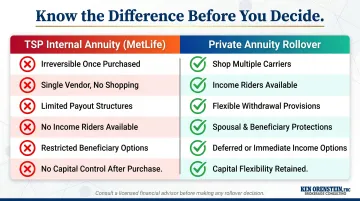
The TSP offers its own annuity purchase option through MetLife. Once you buy it, the transaction is irreversible. As TSP's official documentation states: "Once annuity funds have been disbursed, the purchase cannot be canceled, the option cannot be changed, and the joint annuitant cannot be changed."
TSP Annuity Types Available
The TSP annuity comes in three basic structures:
- Single life annuity — monthly payments for your life only
- Joint life with spouse (100% or 50% survivor) — survivor receives the same payment or half
- Joint life with another person — similar structure, subject to insurable interest rules
Optional features include:
- Increasing payments — 2% annual increase on the anniversary of your first payment
- Cash refund — remainder of purchase price paid to beneficiaries at death
- 10-year certain payout — payments continue to beneficiaries for the remainder of a 10-year period if you die early
Key limitation: You cannot combine the 10-year certain feature with a joint life annuity. Once elected, there are no meaningful death benefits in most configurations, and you give up control of that capital permanently.
Private Annuity Rollover Advantages
Rolling TSP funds to a private annuity through an insurance carrier typically provides broader options:
- Shop multiple carriers and compare income rates side by side
- Access contracts with principal protection and flexible withdrawal provisions
- Choose income riders that activate at future dates
- Build in spousal protections and beneficiary death benefits not available through the TSP vendor
- Retain control over your capital if your circumstances or income needs change
These options give retirees who want to coordinate income sources or protect a spouse's financial security far more flexibility than the TSP's single-vendor contract allows. That said, comparing carriers and selecting the right contract structure takes expertise. Working with a federal retirement advisor at Brokerage Consulting can help you evaluate your options and match the right annuity design to your household's specific retirement goals.
How to Roll Over Your TSP Into an Annuity: Step-by-Step
Your most important goal in this process: complete a direct rollover so funds move from the TSP straight to the annuity carrier without passing through your hands. This preserves tax deferral and avoids automatic withholding.
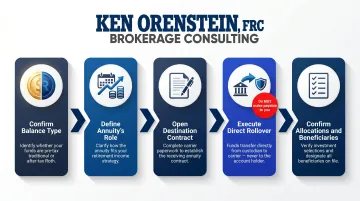
Step 1: Confirm Your TSP Balance Type
Determine whether your TSP dollars are traditional (pre-tax), Roth (after-tax), or a blend. This matters because:
- Traditional (pre-tax) funds must go to a traditionally registered annuity contract
- Roth (after-tax) funds must go to a Roth-registered contract
Mixing them creates an unintended taxable event. Note that agency matching contributions are always traditional, even if you contribute to Roth TSP. Most participants with Roth contributions will have both balance types requiring two separate rollover destinations.
Step 2: Decide the Annuity's Role in Your Income Plan
Before selecting a product, determine what job the annuity will perform:
- Is it a deferred growth-and-protection contract you'll activate for income later?
- Or an immediate income contract designed to start payments within the first year?
This role clarity should drive product selection, not the reverse. Consider how the annuity income layer fits alongside your FERS pension and Social Security benefits.
Step 3: Open the Destination Contract in the Correct Qualified Registration
Once you've confirmed the product, the receiving insurance carrier will establish the annuity contract and provide transfer instructions. Account titling must match the tax character of the TSP funds you're moving — traditional funds to a traditional contract, Roth funds to a Roth-registered one — to keep the rollover clean and avoid reporting complications.
Step 4: Execute the Direct Rollover
Instruct the TSP to send funds directly to the insurance carrier (or its custodian) for your benefit. The check must not be made payable to you personally.
A check made payable to you triggers mandatory 20% withholding and starts the 60-day indirect rollover clock — both costly mistakes to unwind. All TSP withdrawal requests must now be initiated through "My Account" on tsp.gov or by calling ThriftLine at 1-877-968-3778. Legacy paper forms (TSP-70, TSP-75, TSP-99) were retired in February 2023.
Coordinating directly with a Federal Retirement Advisor at this stage helps ensure the paperwork flows correctly between the TSP and the receiving carrier — a step where small errors can cause significant delays.
Step 5: Confirm Allocations, Income Elections, and Beneficiaries
After funds arrive at the carrier, confirm:
- How money is allocated (fixed rate bucket, indexed strategy, or income configuration)
- Any income rider elections and deferred income start dates
- Beneficiary designations
These elections should be confirmed in writing before the contract is issued.
Tax Rules, Roth Balances, and RMDs
A properly executed direct TSP rollover to a qualified annuity is not a taxable event. Funds remain within the qualified (tax-deferred) system. Taxes are owed only when distributions are taken, at which point traditional pre-tax dollars are taxed as ordinary income.
Roth TSP Rollover Requirements
Roth TSP contributions and earnings must roll into a Roth-designated annuity contract to retain their tax-free growth and withdrawal treatment.
Important: Employer match contributions in a Roth TSP plan are treated as pre-tax and must be directed to a traditional registration. Rolling employer match dollars to a Roth contract would trigger a taxable conversion.
Required Minimum Distributions (RMDs)
Once you reach the applicable RMD age (currently 73, rising to 75 in 2033), qualified annuities must support required annual distributions—just like other qualified retirement accounts.
Key RMD planning points to know:
- Roth TSP balances are exempt from RMDs during your lifetime, giving you more control over when and how you draw down those funds
- Lifetime income payments from a traditional annuity can satisfy RMD obligations on a predictable, automatic schedule
- Under SECURE 2.0, excess annuity payments from one qualified annuity can now satisfy RMD requirements for other retirement accounts
Confirm that your annuity contract structure accommodates RMDs before purchasing.
Indirect Rollover Risk
Indirect rollovers—where the TSP sends a check directly to you—are subject to mandatory 20% federal withholding under IRS rules. You must redeposit the full pre-withholding amount into the new contract within 60 days to avoid the withheld portion being treated as a taxable distribution.
Example: If your TSP distribution is $100,000, the TSP withholds $20,000 and sends you a check for $80,000. To complete the rollover without taxes, you must deposit the full $100,000 (using $20,000 of your own money) into the annuity within 60 days. If you only deposit $80,000, the $20,000 difference is taxable income and may trigger a 10% early withdrawal penalty if you're under age 59½.
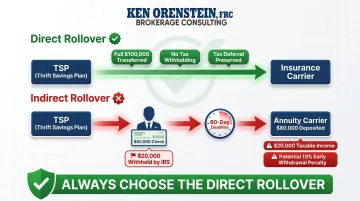
Direct rollovers eliminate this entire problem.
Common Mistakes and When to Reconsider
Most Common Error: Indirect Rollovers
The biggest mistake is executing an indirect rollover instead of a direct transfer. This causes:
- Mandatory 20% withholding
- A strict 60-day redeposit deadline
- The need to use personal funds to avoid a partial taxable distribution
All of this is entirely avoidable with a direct rollover.
Misconception: TSP Annuity = Private Annuity Rollover
Many retirees believe the TSP's internal annuity purchase and a private annuity rollover are the same thing. They are not. Mixing up the two leads people to either overlook better-suited private market products or misunderstand the irreversible nature of the TSP's own annuity purchase.
When a TSP Rollover May Not Be the Right Fit
A TSP rollover to an annuity may not be appropriate if:
You already have a sufficient income floor. Retirees with strong FERS pensions and Social Security income may not need additional guaranteed income. Adding an annuity could reduce flexibility without meaningful benefit.
You have significant liquidity needs. Private annuities typically include surrender charge periods of 5-10 years. If you need access to large amounts of cash in early retirement, weigh surrender schedules carefully against your reserve strategy.
You're still employed and under age 59½. Federal employees generally cannot roll funds out of the TSP without penalty until separation from service. Age 59½ in-service withdrawals are available, but they carry 20% withholding unless transferred directly to a qualifying account.
You haven't evaluated all TSP distribution options. Options include leaving money in the TSP, taking installment payments, partial distributions, or combining strategies. The right approach depends on your complete retirement income picture, not any single factor in isolation.
Frequently Asked Questions
What is the best thing to do with your TSP when you retire?
The best approach depends on your income needs, existing pension and Social Security benefits, and liquidity requirements. Options include keeping funds in the TSP, rolling to an IRA or annuity, taking installments, or combining strategies — most retirees benefit from a mix rather than a single choice.
Can you roll over a TSP into an annuity?
Yes, TSP funds can be rolled over into a qualified private annuity using a direct rollover after separation from service. This is separate from the TSP's internal annuity purchase option. When structured correctly as a direct trustee-to-trustee transfer, it is not a taxable event.
Is rolling my TSP into an annuity a taxable event?
A direct rollover from TSP to a qualified annuity is generally not taxable at the time of transfer. Taxes are deferred until distributions are taken; Roth TSP funds rolled to a Roth annuity retain their tax-free withdrawal treatment.
What is the difference between the TSP's own annuity and a private annuity rollover?
The TSP's annuity is purchased directly through MetLife and is irrevocable with limited features. A private annuity rollover allows you to shop multiple insurance carriers, access broader product features (income riders, beneficiary options, flexible withdrawals), and retain more planning control.
Can I roll over just part of my TSP into an annuity?
Partial rollovers are permitted. Most retirees transfer only a portion of their TSP to fund a guaranteed income floor while keeping the rest accessible for liquidity and growth. You can specify whether the rollover draws from your traditional balance, Roth balance, or proportionally from both.
How do required minimum distributions work with a TSP-funded annuity?
Qualified annuities funded by a TSP rollover are subject to RMD rules once you reach the applicable age (currently 73). For many retirees, the annuity's scheduled income payments satisfy the annual RMD requirement automatically. Review the contract's distribution structure with an advisor before purchase to confirm compliance.