
Introduction
Growing retirement savings while keeping market losses in check is one of the harder balancing acts pre-retirees face. Fixed annuities offer security but often leave growth on the table. Variable annuities unlock higher upside but expose your principal to full market swings. Registered Index-Linked Annuities (RILAs) sit between those two extremes, linking returns to a market index while using a buffer or floor to absorb a defined layer of losses.
RILA sales reached $79.6 billion in 2025 — roughly ten times the volume from a decade earlier, according to LIMRA. That kind of growth reflects real demand from pre-retirees who want more than a fixed rate but less risk than a variable product delivers.
This guide compares four standout RILAs: Lincoln Financial Level Advantage 2, Nationwide Defender Annuity, Allianz Index Advantage+, and F&G Confidence Builder. Each is evaluated on protection design, growth potential, fee structure, insurer financial strength, and flexibility. Each product leads in a specific area, so the right fit depends on your priorities.
Key Takeaways
- RILAs link returns to a market index and use a buffer or floor to limit losses — but you can lose principal if losses exceed the buffer
- Lincoln Financial Level Advantage 2 — best for customization (multiple buffers, seven indices, Secure Lock+ feature)
- Nationwide Defender Annuity — best for growth: high cap rates, uncapped strategies, and currently 0% product fee
- Allianz Index Advantage+ — best for accessibility (lowest minimum premium reviewed, flexible additional contributions)
- F&G Confidence Builder — best for innovative strategy: Hindsight 20/20 credits the best of three asset allocation mixes
- RILAs work best for investors with a 5–10 year horizon who can accept limited downside risk for higher growth potential
What Is a Registered Index-Linked Annuity (RILA)?
A RILA is a long-term annuity contract where returns are tied to the performance of a market index — such as the S&P 500 or Nasdaq 100 — over a defined crediting period. What distinguishes it from a variable annuity is the built-in downside protection feature: either a buffer or a floor that limits how much of a market decline hits your account.
The SEC classifies RILAs as securities under the Securities Act, which means they carry investment risk and must be sold by securities-licensed advisors — a key distinction from fixed or fixed index annuities.
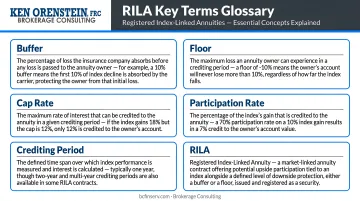
Key Terms to Know Before Comparing Products
| Term | What It Means |
|---|---|
| Buffer | The insurer absorbs losses up to a set percentage (e.g., 10%); you absorb losses beyond that |
| Floor | The maximum loss you absorb, regardless of how far the index falls |
| Cap Rate | The maximum gain credited per crediting term |
| Participation Rate | The percentage of index gain credited to your account |
| Crediting Term | The period over which index performance is measured — typically 1 to 6 years |
One risk stands out: most RILA index strategies use price-return indexes that exclude reinvested dividends. As FINRA notes in its 2025 regulatory guidance, this typically lowers returns compared to total-return investing. It's a real cost to factor in when comparing RILAs against direct index fund ownership.
Best Registered Index-Linked Annuities
These four RILAs were evaluated across protection design, growth potential, fee structure, insurer stability, and flexibility — each excels in a specific area to match different retirement needs.
Lincoln Financial Level Advantage 2 — Best for Customization
Lincoln National Life Insurance Company holds an AM Best A (Excellent) rating, affirmed March 2026, with additional ratings of A+ from Fitch, A2 from Moody's, and A+ from S&P. The Level Advantage 2 earns the customization title because no other product on this list gives investors as many levers to pull.
The product's flexibility spans multiple dimensions:
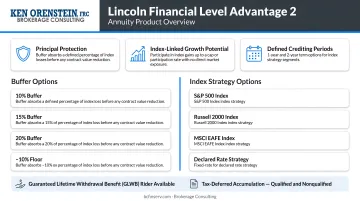
- Protection levels: 10%, 15%, 20%, 25%, 30%, and 100% buffers
- Crediting terms: 1-, 3-, and 6-year options
- Index choices: Seven indices
- Strategy types: Performance Cap, Participation Rate, Performance Trigger, and Dual Performance Trigger
The Secure Lock+ feature is worth a close look. It allows contract owners to lock in index value gains during a term — protecting accumulated performance before the crediting period ends — at no additional cost and available up to once per contract year. For investors who want to take risk off the table when a good year materializes mid-term, this is a capability no other product on this list provides.
| Lincoln Financial Level Advantage 2 | |
|---|---|
| Insurer Rating (AM Best) | A (Excellent) — affirmed March 2026 |
| Minimum Premium | $25,000 (see note below) |
| Maximum Premium | $2,000,000 (see note below) |
| Issue Ages | Up to 85 (see note below) |
| Buffer Options | 10%, 15%, 20%, 25%, 30%, 100% |
| Index Options | Seven indices; terms of 1, 3, and 6 years |
| Annual Product Fee | None |
| Surrender Charges | Up to 7% of contract value |
| Free Withdrawals | 10% annually |
Note: Premium limits and issue age were not verified from primary SEC or Lincoln sources. Confirm current specs directly with Lincoln Financial or a licensed advisor.
Nationwide Defender Annuity — Best for Growth
Nationwide Life Insurance Company carries an AM Best A+ rating (affirmed December 2023), S&P A+ (affirmed April 2024), and Moody's A1 (affirmed November 2023) — the strongest multi-agency rating profile on this list.
The Defender Annuity is built for investors who want meaningful downside protection without giving up too much growth. It offers 10% and 20% buffer options, plus uncapped strategies for investors willing to accept more index variability in exchange for unlimited upside exposure.
One important update: Nationwide restructured its fee pricing for new contracts. Contracts issued before June 1, 2025 carried a 1.10% annual product fee; contracts issued on or after June 1, 2025 currently carry a 0% product fee. If you see the 1.10% figure elsewhere, verify which contract vintage it applies to.
Optional riders add cost back in — the Return of Premium Death Benefit runs 0.15% annually. Nationwide also offers the Defined Protection Annuity 2.0 as a floor-based RILA alternative with no annual fee, which suits investors who want a guaranteed maximum loss rather than a buffer.
| Nationwide Defender Annuity | |
|---|---|
| Insurer Rating (AM Best) | A+ (Superior) — affirmed December 2023 |
| Minimum Premium | $25,000 |
| Maximum Premium | $1,000,000 |
| Issue Ages | Up to 85 |
| Buffer Options | 10% and 20%; uncapped strategies available |
| Annual Product Fee | 0% (for contracts issued June 1, 2025 or later) |
| Optional Rider Fees | Return of Premium Death Benefit: 0.15%/year |
| Surrender Charges | Up to 8% (schedule: 8%, 7%, 6%, 5%, 4%, 0%) |
| Free Withdrawals | 10% of contract value annually |
Allianz Index Advantage+ — Best for Accessibility
Allianz Life Insurance Company of North America holds an AM Best A+ (Superior) rating (affirmed March 2026), plus Moody's Aa3 and S&P AA — one of only a handful of U.S. life insurers rated A+ or better across all three major agencies.
What sets the Index Advantage+ apart is accessibility. At $10,000, it carries the lowest minimum of the four products compared here, and the product accepts ongoing flexible premium contributions over time — a feature most RILAs don't offer. For investors building their retirement position incrementally rather than deploying a single lump sum, that matters.
Protection options include buffers of 10%, 20%, and 30%, plus a -10% floor option (Index Guard Strategy) on select strategies, giving investors the choice between buffer-style and floor-style protection within the same product family.
The trade-off is fees. The 1.25% annual product fee is the highest on this list, and accounts under $100,000 pay an additional $50 annual contract maintenance charge. For investors adding premiums over several years, the flexible contribution feature can justify that cost — for a one-time lump-sum deployer, it's harder to rationalize.
| Allianz Index Advantage+ | |
|---|---|
| Insurer Rating (AM Best) | A+ (Superior) — affirmed March 2026 |
| Minimum Premium | $10,000* |
| Maximum Premium | $1,000,000 |
| Issue Ages | Up to 85 |
| Buffer/Floor Options | 10%, 20%, 30% buffers; -10% floor on select strategies |
| Annual Product Fee | 1.25% |
| Contract Maintenance Fee | $50/year (waived for accounts over $100,000) |
| Surrender Charges | Up to 8% |
| Free Withdrawals | 10% annually |
The $10,000 minimum was not verified from the core Index Advantage+ primary source. The Select Income variant SEC filing shows a $5,000 minimum. Confirm current specs before purchasing.
F&G Confidence Builder — Best for Custom Index Strategies
Fidelity & Guaranty Life Insurance Company holds an AM Best A (Excellent) rating, upgraded May 2024, plus S&P A- and Moody's A3. Note: this is F&G, not Fidelity Investments — an unrelated company.
The Confidence Builder stands out for its Hindsight 20/20 strategy, launched February 2024. Rather than locking you into a single index, this strategy simultaneously tracks three BofA asset allocation indexes — Balanced, Growth, and Defensive — and credits your account based on whichever performed best at the end of the 6-year crediting period. The credited return is determined at term end, meaning you benefit from the strongest of the three without having to predict which one it will be.
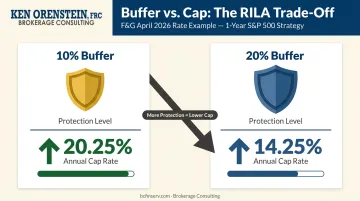
F&G's current rate sheet illustrates the buffer-cap trade-off clearly: as of April 1, 2026, the 1-year S&P 500 strategy shows a 20.25% cap with a 10% buffer versus a 14.25% cap with a 20% buffer. More protection directly reduces your upside ceiling — a trade-off that applies across every RILA on the market, not just this one.
The product caps issue age at 80, which is lower than the other three products reviewed here. Contracts must be issued before age 80, so investors in their late 70s should confirm eligibility before beginning the application process.
| F&G Confidence Builder | |
|---|---|
| Insurer Rating (AM Best) | A (Excellent) — upgraded May 2024 |
| Minimum Premium | $25,000 |
| Maximum Premium | $1,500,000 |
| Issue Ages | Up to 80 |
| Buffer Options | 10% and 20%; Hindsight 20/20 (6-year) |
| Annual Product Fee | None |
| Surrender Charges | 7% (years 1–2), declining to 3% (year 6), 0% thereafter |
| Free Withdrawals | 10% of initial premium (year 1); 10% of prior anniversary value thereafter |
How to Choose the Best RILA for Your Retirement Goals
Start with Buffer Level and Risk Tolerance
Choosing your buffer is the biggest trade-off you'll make. A few reference points:
- 10% buffer — standard for moderate-risk investors comfortable absorbing losses beyond that threshold
- 20–30% buffer — better suited for those closer to retirement who prioritize capital preservation over maximizing cap rates
- Floor (e.g., -10%) — guarantees your worst-case loss, regardless of index depth; available on select Allianz strategies
- No buffer tolerance at all? A Fixed Index Annuity (FIA) — which carries a 0% floor by design — is the more appropriate fit than a RILA
Understand the Buffer-Cap Trade-Off
Higher protection comes at a price. F&G's April 2026 rate sheet shows this directly: moving from a 10% buffer to a 20% buffer on the 1-year S&P 500 strategy drops the cap from 20.25% to 14.25% — a 6-point reduction. This trade-off holds across all RILA products, though exact numbers change with market conditions and insurer discretion.
Longer crediting terms (6-year vs. 1-year) often offer higher caps or uncapped participation rates, but they also mean your money is measured less frequently and adjustments can't be made until the term ends.
That crediting structure directly affects how flexible you can be — which brings liquidity into the picture.
Factor in Liquidity and Time Horizon
RILAs are not liquid products. Before committing:
- Surrender charges typically last 5–7 years (Nationwide: 6 years, F&G: 6 years, others vary)
- Most contracts allow 10% annual free withdrawals after year one
- Withdrawals before age 59½ trigger a 10% federal tax penalty on the taxable portion, per IRS Publication 575
- Only allocate money you genuinely won't need for at least 5–7 years
Once you've confirmed your time horizon fits, compare how RILAs stack up against the other main annuity types before deciding.
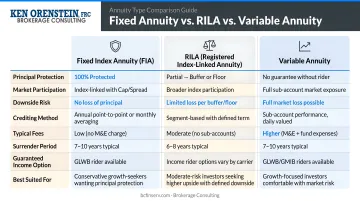
Compare RILAs to Competing Annuity Types
| Annuity Type | Principal Protection | Growth Potential | Typical Fees |
|---|---|---|---|
| Fixed Index Annuity (FIA) | 100% (0% floor) | Capped; moderate | Low to none |
| RILA | Partial (buffer/floor) | Higher caps possible | Varies (0%–1.25%) |
| Variable Annuity | None (full market risk) | Uncapped | Higher (1.5%–3%+) |
Verify Insurer Financial Strength
An annuity guarantee is only as reliable as the insurer behind it. All four products reviewed here carry at least an A rating from AM Best — a useful minimum threshold. Check ratings through AM Best's company search, S&P, or Moody's before purchasing. A rating from two years ago means little if the carrier's outlook has shifted — always pull current ratings, not figures from a brochure.
At Brokerage Consulting, Ken Orenstein includes carrier financial strength ratings from AM Best, S&P, Moody's, and Fitch in every annuity review — alongside cap rates, buffer levels, and surrender terms.
How We Evaluated These RILA Products
Evaluation Criteria
Products were assessed across five dimensions:
- Buffer and floor design, including protection depth, available percentages, and strategy variety
- Cap rates and participation rates measured against peers at comparable protection levels
- Fee transparency across annual product fees, rider fees, and surrender charge schedules
- Insurer financial strength using current AM Best, S&P, and Moody's ratings from primary sources
- Product flexibility, covering available indices, crediting term options, and optional riders
Common Mistakes to Avoid
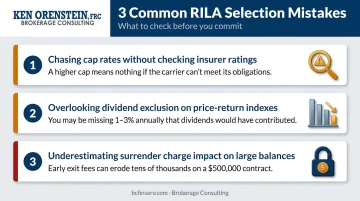
Investors selecting RILAs frequently make three errors:
- Chasing the highest cap rate without verifying the insurer's financial strength rating
- Overlooking dividend exclusion: most RILA indexes track price return only, not total return with dividends, which creates a real performance drag versus direct index investing
- Underestimating surrender charge impact — a 7–8% charge on a large balance is a meaningful liquidity constraint if your circumstances change
Avoiding these mistakes is easier when you can compare products across carriers rather than evaluating each one in isolation. An independent advisor with access to multiple carriers — Ken Orenstein at Brokerage Consulting, for example — can assess RILA options side-by-side across protection levels, fee structures, and insurer ratings.
Conclusion
No single RILA is universally best — the right product depends on what you're optimizing for. Each carrier addresses a distinct investor need:
- Lincoln Financial: Best for investors who want precise control over protection levels and crediting strategy
- Nationwide: Best for growth-focused investors who want uncapped upside potential
- Allianz: Best entry point for those building their position over time, with a lower minimum commitment
- F&G Hindsight 20/20: Best for investors who want market-linked growth and a creative approach to reducing timing risk
Choosing between them requires looking beyond the cap rate headline — insurer strength, surrender period length, fee structure, and how the product fits into your broader retirement income plan all matter just as much.
To compare these products across carriers and build a tax-efficient retirement plan tailored to your specific timeline and risk tolerance, schedule a no-cost consultation with Ken Orenstein at Brokerage Consulting. Call (888) 315-3608 to get started.
Frequently Asked Questions
Are registered index-linked annuities a good investment?
RILAs can be a sound choice for investors seeking more growth potential than fixed annuities offer and who are comfortable accepting limited downside risk — typically 5–20% in a bad year. They're not well-suited for investors who need liquidity within 5–7 years or those who cannot tolerate any principal loss.
What is the difference between a RILA and a Fixed Index Annuity?
A Fixed Index Annuity protects 100% of principal — the worst-case return is 0%. A RILA uses a buffer that absorbs only a defined portion of losses, meaning you can lose principal if the index drops beyond that buffer. In exchange, RILAs typically offer higher cap rates and greater growth potential.
Can you lose money in a registered index-linked annuity?
Yes. With a 10% buffer and a 15% index decline, your account loses 5%. The contract calculates losses at the end of the crediting term, not intra-period, so interim market swings don't trigger a realized loss until the term closes.
What are typical fees for a RILA?
Fee structures vary by product:
- No explicit annual fee: Lincoln Level Advantage 2, F&G Confidence Builder
- Annual product fee of 1.00%–1.25%: Allianz Index Advantage+
All products carry embedded costs through cap limits and dividend exclusion. Optional income or death benefit riders add 0.15%–0.70% annually.
How long should I hold a RILA before making withdrawals?
Surrender charge periods typically run 5–7 years, with most contracts allowing 10% annual free withdrawals after year one. Withdrawals before age 59½ also trigger a 10% federal tax penalty, so plan to hold for at least that long.
Can I roll my 401(k) or IRA into a RILA?
Yes. A 401(k) or IRA can be rolled into a RILA without triggering immediate taxes, provided the transfer follows IRS rollover rules. Compare the RILA's cost structure and surrender schedule against your existing plan's features before committing — not every rollover is advantageous.