The Brighthouse SecureKey is one of the more complete FIA products available today. Issued by Brighthouse Life Insurance Company — one of the largest annuity providers in the U.S., managing over $241 billion in total assets — SecureKey is a suite of single-premium deferred fixed indexed annuities designed to protect principal while still participating in index-linked growth.
This guide breaks down how SecureKey works, what term versions are available, how the crediting strategies function, and how the optional ReadyPay lifetime income rider can support a structured retirement income plan.
Key Takeaways
- SecureKey accepts a minimum $25,000 premium and protects 100% of the purchase payment against market losses
- Available in 5-year, 7-year, 10-year, and Advisory versions with varying surrender charge schedules
- Crediting ties to four index options via cap rates, participation rates, or step rates — principal is never directly invested in the market
- The optional ReadyPay rider adds guaranteed lifetime withdrawals, with a 7% annual roll-up applied during the first 10 rider years
- All guarantees are backed by Brighthouse Life Insurance Company's claims-paying ability — not FDIC-insured
What Is the Brighthouse SecureKey Fixed Indexed Annuity?
SecureKey is a single-premium deferred fixed indexed annuity — meaning you fund it once with a lump sum (minimum $25,000), it grows on a tax-deferred basis, and payouts begin at a future date you choose. Issue ages go up to 85, making it accessible to retirees who are still looking to reposition assets late in retirement.
SecureKey delivers 100% protection of your purchase payment against market downturns, with the opportunity to earn interest linked to market index performance. If the index performs well, you receive a credit. If it falls, you receive zero — but you don't lose principal.
How the Contract Grows
SecureKey offers two fundamental ways to earn interest:
- Indexed Accounts — track one or more market indices and credit interest based on a specific crediting formula tied to index performance
- Fixed Account — applies a guaranteed annual interest rate for clients who prefer stable, predictable growth without index exposure
The base contract also carries no hidden costs and preserves liquidity:
- No annual contract fees, mortality and expense charges, or administrative fees
- 10% annual free withdrawal provision — a portion of the contract value stays accessible each year without triggering surrender charges
Death Benefit
When the annuitant dies, beneficiaries receive the greater of:
- The contract value (without surrender charges applied), or
- The Guaranteed Minimum Surrender Value (GMSV)
The GMSV floor matters most when index performance has been flat or the contract is in its early years — ensuring beneficiaries aren't left with less than the minimum guaranteed amount regardless of timing.
SecureKey Term Versions: 5-Year, 7-Year, 10-Year, and Advisory
SecureKey comes in three standard versions (each named for its surrender charge period) plus an Advisory version. Index options, crediting strategies, and rider availability are consistent across all versions. The key differences are the surrender charge schedule and the crediting rates the carrier offers for each term.
Surrender Charge Schedules
| Contract Year | 5-Year | 7-Year | 10-Year |
|---|---|---|---|
| Year 1 | 9% | 9% | 9% |
| Year 2 | 8% | 8% | 8% |
| Year 3 | 7% | 7% | 7% |
| Year 4 | 5% | 6% | 6% |
| Year 5 | 3% | 5% | 5% |
| Year 6 | 0% | 4% | 4% |
| Year 7 | — | 2% | 3% |
| Year 8 | — | 0% | 2% |
| Year 9 | — | — | 1% |
| Year 10 | — | — | 1% |
| Year 11+ | — | — | 0% |
Withdrawals within the 10% annual free withdrawal amount are not subject to these charges.
Choosing the Right Term
Term selection should reflect two things: your time horizon and your liquidity tolerance.
- 5-year version — best for clients who may need flexibility within 5–6 years or are closer to distribution phase
- 7-year version — middle-ground option balancing reasonable lock-up with competitive crediting potential
- 10-year version — suited for clients who have longer runway before income and want to maximize the ReadyPay rider's 7% roll-up over the full 10-year accumulation window
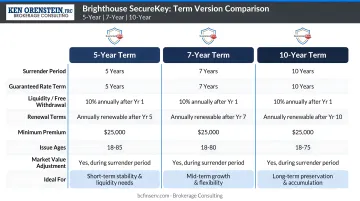
Longer surrender periods typically come with higher cap rates and participation rates. If your timeline aligns with a 7- or 10-year commitment, that trade-off can translate directly into stronger index-linked growth potential.
How SecureKey Earns Interest: Crediting Strategies Explained
SecureKey does not invest directly in the stock market. Instead, it uses index performance as a reference point to calculate how much interest to credit to your contract at the end of each term. This distinction matters — you get a portion of the upside, but none of the downside.
The Four Index Options
| Index | What It Tracks |
|---|---|
| S&P 500 | ~500 large-cap U.S. companies; covers approximately 80% of U.S. equity market capitalization |
| Russell 2000 | Small-cap U.S. stocks; a widely used benchmark for smaller domestic companies |
| MSCI EAFE | Large- and mid-cap companies across 21 international developed markets (Europe, Australasia, Far East) |
| S&P 500 Low Volatility Daily Risk Control 5% | A blended index targeting 5% daily volatility; designed to produce smoother, more predictable index movement for FIA crediting |
Three Ways Interest Gets Credited
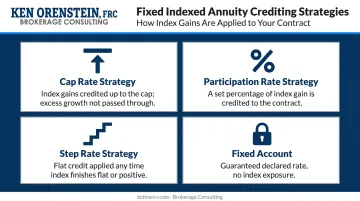
Cap Rate Strategy The cap is the maximum interest credited in a given period. If an index gains 12% but the cap is 6%, you receive 6%. Cap rates change over time based on market conditions and the carrier's hedging costs — which is why comparing current rate sheets matters when evaluating this product.
Participation Rate Strategy Instead of a cap, participation rates credit a percentage of index growth to your contract. A 150% participation rate on a 4% index return credits 6%. However, participation rates on standard indices like the S&P 500 tend to be lower, which can limit appeal for growth-focused buyers.
The S&P 500 Low Volatility Daily Risk Control 5% index often pairs with higher participation rates precisely because its smoother movement makes hedging more cost-effective for the insurer.
Step Rate Strategy The step rate credits a flat, predetermined interest rate any time the index finishes flat or positive — regardless of how much it actually gained. If the index is negative, no interest is credited, but there is also no loss to principal. For the S&P 500, the step rate is set at contract issue and applies for the full withdrawal charge period.
Fixed Account A declared interest rate applied annually. The rate may change after the first contract year. The current 1-year fixed rate for the 10-year version is 4.00% — works much like a traditional fixed annuity. Contracts funded at $100,000 or more qualify for improved crediting rates across both indexed and fixed account options.
Since rates change regularly, the figures above are snapshots. For current cap rates, participation rates, and step rates across all term versions, contact Ken Orenstein at Brokerage Consulting directly — he'll have access to the latest Brighthouse rate sheets.
The ReadyPay Rider: How SecureKey Delivers Lifetime Income
According to Allianz Life's 2025 Annual Retirement Study, 64% of Americans worry more about running out of money than death. The ReadyPay Guaranteed Lifetime Withdrawal Benefit (GLWB) rider directly answers that concern by converting your accumulated value into guaranteed income you cannot outlive.
What ReadyPay Is and How the Income Base Works
ReadyPay is an optional rider (not a built-in feature) that overlays a separate Income Base on top of the contract's account value. Here's how it operates:
- The Income Base starts equal to the initial premium
- It cannot decline due to market performance
- It grows through a 7% annual roll-up for the first 10 rider years when no withdrawals are taken
- It also receives automatic step-ups on each anniversary where the account value (after charges) exceeds the rolled-up Income Base, locking in the higher value permanently
- Step-ups remain available through the anniversary just before the older owner's 91st birthday
One critical clarification: the Income Base is not the cash value of the contract and cannot be withdrawn as a lump sum. It exists solely to calculate the guaranteed withdrawal amount.
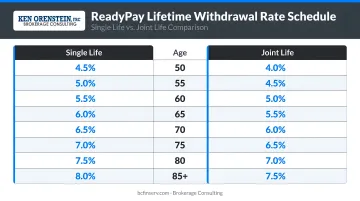
Lifetime Withdrawal Rates
Income can begin any time after age 59½. The annual guaranteed withdrawal equals the Income Base multiplied by the applicable Lifetime Withdrawal Percentage:
| Age at First Withdrawal | Single Life Rate | Joint Life Rate |
|---|---|---|
| 59½ | 5.70% | 5.20% |
| 70 | 6.30% | 5.80% |
| 85 | 7.00% | 6.50% |
Nursing home provision: If the annuitant is confined to a qualified nursing home, the applicable withdrawal rate doubles — up to a maximum of 10% in any policy year.
What ReadyPay Costs
The rider fee is 1% annually, calculated against the Income Base (not the account value). Because the Income Base typically grows larger than the account value through roll-ups and step-ups, the effective cost as a percentage of account value is often greater than 1%. Work through this cost dynamic with an advisor before committing to the rider.
Built-In Waivers (Base Contract)
Beyond the ReadyPay rider, the base contract includes two complementary waivers that provide liquidity in hardship situations:
- Nursing home waiver: after the first contract year, 100% of accumulated contract value may be withdrawn without surrender charges or Market Value Adjustment if the annuitant is confined to a qualified nursing home for 90+ consecutive days
- Terminal illness waiver: the same full-access provision applies if diagnosed with a terminal illness with a prognosis of 12 months or less
Costs, Fees, and Surrender Considerations
SecureKey's cost structure is straightforward: no layered fees on the base contract.
What you pay:
- No annual contract fees
- No mortality and expense charges
- No administrative fees on the base contract
- ReadyPay rider fee: 1% annually on the Income Base (only if elected)
For context, variable annuities can carry mortality and expense charges, administrative fees, and underlying fund expenses that stack up to 2–4% annually before any rider charges. SecureKey's base structure avoids all of that.
Market Value Adjustments
When a withdrawal or surrender exceeds the free withdrawal amount during the charge period, a Market Value Adjustment (MVA) may be applied in addition to the surrender charge. The MVA reflects changes in prevailing interest rates:
- In a rising rate environment, the MVA typically reduces surrender value further
- In a falling rate environment, the MVA may work in your favor
MVA formulas vary by contract — read the terms carefully before making any large unscheduled withdrawals.
After the Surrender Period Ends
Once the surrender charge period concludes, MVA exposure disappears along with it — the full contract value becomes accessible without charges. However, any withdrawal still reduces account value. If the ReadyPay rider is active, withdrawals exceeding the guaranteed annual amount proportionately reduce the Income Base, which directly lowers future guaranteed income payments.
Who Should Consider the Brighthouse SecureKey FIA?
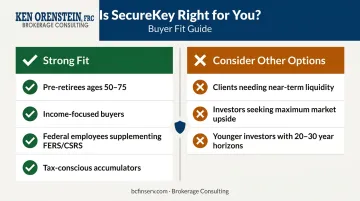
The Right Fit
SecureKey is most appropriate for:
- Pre-retirees and retirees ages 50–75 who want guaranteed principal protection with market-linked growth potential
- Income-focused buyers who want a predictable lifetime withdrawal stream through ReadyPay
- Federal employees looking to supplement FERS or CSRS income — the FERS basic annuity replaces approximately 32% of final salary for an employee retiring at 62 with 30 years of service, which often leaves a meaningful income gap that a GLWB rider can help fill
- Tax-conscious accumulators who benefit from tax-deferred growth during higher earning years
Who Should Look Elsewhere
- Clients needing near-term liquidity beyond the 10% annual free withdrawal — the surrender charge period is a real constraint
- Investors primarily seeking maximum market upside — cap and participation rates limit gains by design
- Younger investors with a 20–30 year time horizon who may have better long-term growth options in equity-based accounts
Working With an Advisor
If you identify with the first list but share any concerns from the second, the right answer usually depends on your specific mix of income sources, time horizon, and liquidity needs — not a one-size-fits-all rule. Ken Orenstein at Brokerage Consulting works with federal employees, pre-retirees, and individuals nationwide to build low-cost, tax-efficient retirement income plans around those details. Schedule a no-cost consultation by phone, virtually, or in person.
Frequently Asked Questions
What do experts like Dave Ramsey and Warren Buffett say about fixed indexed annuities?
Dave Ramsey has historically criticized annuities for complexity and fees; Warren Buffett favors low-cost index investing. FIAs like SecureKey serve a different purpose — principal-protected, guaranteed income for retirees who can't afford to lose money, not a substitute for equity growth.
What is the minimum investment required for the Brighthouse SecureKey FIA?
The minimum initial premium is $25,000. Contracts funded with $100,000 or more qualify for improved crediting rates across both indexed and fixed account options, making the purchase amount a meaningful factor in potential returns.
Can I lose money with the Brighthouse SecureKey Fixed Indexed Annuity?
The purchase payment is 100% protected against market losses — SecureKey does not invest directly in the market. However, early surrenders can reduce contract value through surrender charges and potential MVAs. All guarantees depend on the claims-paying ability of Brighthouse Life Insurance Company.
What happens if I need to access my money early?
The contract allows 10% annual free withdrawals. Amounts beyond that during the surrender period are subject to withdrawal charges and a potential MVA. Nursing home or terminal illness waivers allow full access after the first contract year.
How financially strong is Brighthouse Financial?
Brighthouse Life Insurance Company holds ratings of AM Best: A, Fitch: A-, Moody's: A3, and S&P: A, with total assets exceeding $241 billion. Annuity guarantees are backed by the insurer's claims-paying ability — not FDIC insurance — so carrier financial strength is a critical factor in product selection.
Is the ReadyPay rider automatically included with SecureKey?
ReadyPay is an optional add-on rider, not a built-in feature. It carries a 1% annual charge calculated against the Income Base. Buyers should evaluate whether the guaranteed lifetime income benefit justifies the ongoing fee given their specific retirement income needs and other guaranteed income sources.