
The confusion is understandable. Both options let you leave federal service before a standard retirement date. Both require you to leave your FERS contributions in the fund. But the eligibility rules, health coverage implications, and lifetime income differences between the two are significant enough that choosing the wrong path — or misunderstanding which one applies to you — can permanently reduce your retirement income.
This article breaks down how each option works, where the key differences lie, and how to determine which path fits your situation.
Key Takeaways
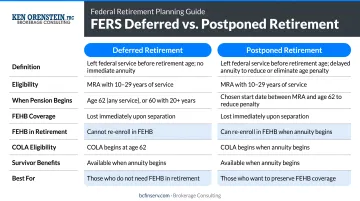
- Deferred retirement applies when you leave federal service before your MRA with at least 5 years of service; annuity starts at 62 (or at MRA with 10+ years, with a penalty)
- Postponed retirement means you've already reached your MRA with 10+ years of service and delay your annuity start date to reduce or eliminate the age penalty
- Postponed retirees can reinstate FEHB and FEGLI coverage when their annuity begins — deferred retirees cannot
- Neither option qualifies for the FERS Annuity Supplement
- Withdrawing your FERS contributions after separation permanently forfeits eligibility for both paths
Deferred vs. Postponed Retirement: Quick Comparison
| Feature | Deferred Retirement | Postponed Retirement |
|---|---|---|
| Minimum service required | 5 years (for age-62 annuity); 10 years (for MRA annuity) | MRA + 10 years of creditable service |
| Must have reached MRA at separation? | No | Yes |
| Annuity start age | Age 62 (no reduction); MRA with 10+ years (subject to reduction) | Any elected date after MRA; age 60 with 20+ years eliminates reduction |
| Age reduction penalty | 5% per year (5/12 of 1% per month) for each year before age 62 | Same MRA+10 reduction — postponing reduces or eliminates it |
| FEHB reinstatement | ❌ Not available | ✅ Yes, if 5-year coverage rule met at separation |
| FEGLI reinstatement | ❌ Not available | ✅ Yes, if 5-year coverage rule met at separation |
| FEDVIP (dental/vision) | ❌ Not available | ✅ Available when annuity begins |
| COLA before age 62 | ❌ No COLAs until age 62 | ❌ No COLAs until age 62 (same FERS COLA rules apply) |
| FERS Annuity Supplement | ❌ Not eligible | ❌ Not eligible |
| TSP age-55 penalty exception | Generally unavailable (if separated before year you turn 55) | Generally available (if separated during or after year you turn 55) |
Both options require you to leave FERS retirement contributions in the system. According to OPM, taking a refund of your retirement deductions permanently voids all annuity rights.
What Is FERS Deferred Retirement?
Deferred retirement applies to former FERS employees who leave federal service without qualifying for an immediate annuity but have enough creditable service to collect a pension at a future age. There are two eligibility thresholds:
- Age 62 with at least 5 years of creditable civilian service (no age reduction)
- MRA with at least 10 years of creditable service (subject to age reduction)
This option most commonly applies to employees who leave federal service well before their MRA — for example, someone who resigns at 40 or 45 to take a private sector role. Their pension locks in based on their High-3 average salary and years of service at the time of separation, and that record doesn't grow after they leave.
The Age Reduction Rule
If a deferred retiree elects to begin their annuity at MRA (with 10+ years of service), OPM reduces the annuity by 5/12 of 1% per month (equal to 5% per year) for each month the start date precedes age 62. Two exceptions eliminate this reduction entirely:
- Age 60 or later with at least 20 years of service
- MRA with at least 30 years of service
What Deferred Retirement Does Not Provide
This is where many employees are surprised by what they're giving up:
- No FEHB, FEGLI, or FEDVIP reinstatement
- No FERS Annuity Supplement
- No COLAs until age 62 — even if annuity payments begin at MRA
Concrete example: A federal employee leaves at age 45 with 8 years of service, leaves contributions in the fund, and collects a pension starting at age 62. That annuity is based entirely on a frozen service record — 8 years and a High-3 that stopped growing 17 years earlier. No FEHB. No inflation adjustments until 62.
When Deferred Retirement Is the Only Option
Those limitations matter even more when deferred retirement isn't a choice. For employees who left before reaching their MRA, it's the only available path to preserving a future pension.
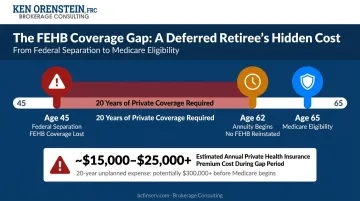
The most pressing planning gap for these employees: health coverage. Deferred retirees lose FEHB immediately upon separation and cannot reinstate it. They'll need private health insurance from the day they leave until Medicare eligibility at 65 (and potentially beyond). For someone leaving in their mid-40s, that coverage gap spans 15 to 20 years — a significant unplanned expense that catches many early separators off guard.
What Is FERS Postponed Retirement?
Postponed retirement is available to employees who have already reached their MRA and have at least 10 years of creditable service before separating. The key difference from deferred retirement: you must have hit MRA before you leave. This option lets you delay the annuity start date to reduce or eliminate the age reduction penalty.
Finding Your MRA
Your MRA determines the earliest you can qualify — here's the OPM MRA table:
| Year of Birth | MRA |
|---|---|
| Before 1948 | 55 |
| 1948–1952 | 55 years + 2 months per year (up to 55 years, 10 months) |
| 1953–1964 | 56 |
| 1965–1969 | 56 years + 2 months per year (up to 56 years, 10 months) |
| 1970 and after | 57 |
How Postponed Retirement Works
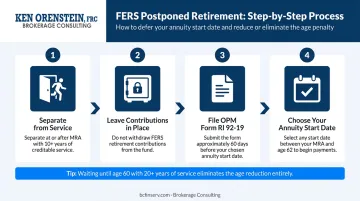
Four steps cover the full process:
- Separate from service at or after MRA with 10+ years of service
- Leave FERS contributions in the fund
- File OPM Form RI 92-19 approximately 60 days before your desired annuity start date
- Choose any start date between MRA and two days before your 62nd birthday
The longer you wait, the smaller the age reduction. An employee with 20+ years of service who begins their annuity at age 60 faces no age reduction at all.
The Health Coverage Advantage
This is the most valuable benefit of postponed over deferred retirement. If you were enrolled in FEHB for at least 5 consecutive years immediately before separation, you can reinstate FEHB, FEGLI, and FEDVIP when your annuity begins — even after a gap of several years.
During the postponement window, FEHB and FEGLI are suspended. You can continue FEHB temporarily through Temporary Continuation of Coverage (TCC) for up to 18 months, paying the full premium (both employee and government shares) plus a 2% administrative fee.
If your postponement period exceeds 18 months, you'll need an alternative coverage plan until your annuity begins.
When Postponed Retirement Makes Sense
The ideal candidate: an employee who has reached MRA with 10 to 29 years of service and wants to leave federal service without locking in a maximum age penalty. A few specific scenarios stand out:
- Separating at MRA with 10–19 years? Postponing shrinks the penalty; waiting until 62 wipes it out entirely
- Leaving at 58–59 with 20+ years? Just 1–2 more years of postponement reaches age 60 and eliminates the reduction
- Mid-career pivot in your late 50s? Delaying to 60 or 62 protects both the annuity amount and FEHB reinstatement
Key Differences That Impact Your Benefits
FEHB and FEGLI
This is the most consequential distinction between the two paths.
- Deferred retirees permanently lose FEHB and FEGLI upon separation (no reinstatement under any circumstance)
- Postponed retirees who met the 5-year continuous enrollment rule can resume both coverages when their annuity begins
The cost of replacing FEHB in the private market is substantial. KFF's 2025 data puts the national average benchmark silver premium at $497/month ($5,964/year) for a 40-year-old, and premiums climb sharply with age.
For a deferred retiree in their late 50s navigating the gap before Medicare, unsubsidized marketplace premiums run considerably higher. Over a decade, the cumulative cost of private coverage can easily reach six figures.
Survivor Benefits
Both options offer potential survivor annuity protection, but with conditions:
- Deferred retirees: A survivor annuity may be payable to a surviving spouse if the employee had 10+ years of creditable service, was married at separation, and remained married for at least 9 months before death
- Postponed retirees: Survivor benefits can still be paid to a surviving spouse if the employee dies during the postponement window (the annuity does not have to have started yet)
For married federal employees, this distinction matters when planning the timing of both separation and annuity commencement.
TSP Withdrawal Considerations
Both deferred and postponed retirees retain their TSP accounts, but their penalty exposure differs:
- Deferred retirees who separate before the year they turn 55 generally cannot use the IRS age-55 separated-service exception and may face a 10% early withdrawal penalty on TSP distributions before age 59½
- Postponed retirees who separate during or after the year they turn 55 (their MRA ranges from 55-57) typically qualify for the age-55 exception, avoiding this penalty
Note: the age-55 exception applies to TSP distributions while funds remain in the TSP. Rolling TSP funds to an IRA may affect this exception ; consult a tax advisor before moving assets.
FERS Annuity Supplement
Neither deferred nor postponed retirees qualify for the FERS Annuity Supplement. This supplement (which approximates the Social Security benefit earned during FERS service and bridges the gap to age 62) is only available to employees who retire on an immediate, unreduced annuity. Federal employees leaving early need to account for this missing income stream — potentially several hundred dollars per month — when projecting retirement cash flow.
Which Option Is Right for You?
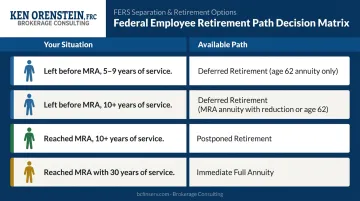
Honestly, the choice is often made for you by your own timeline. Eligibility determines which path is available:
| Your Situation | Available Path |
|---|---|
| Left before MRA, 5–9 years of service | Deferred retirement only (age 62 annuity) |
| Left before MRA, 10+ years of service | Deferred retirement (MRA annuity with reduction, or age 62) |
| Reached MRA, 10+ years, want to leave now | Postponed retirement (or immediate reduced annuity) |
| Reached MRA with 30 years | Immediate full annuity — neither deferred nor postponed needed |
If you're at MRA with 10+ years and want to leave federal service, postponed retirement almost always makes more sense than taking an immediate MRA+10 annuity: every month you delay the start date saves 5/12 of 1% in permanent reduction.
Timing isn't the only consequential decision here. Whether to withdraw your FERS contributions is always within your control — and always irrevocable. Taking that refund eliminates any future pension entitlement, regardless of how many years you served.
Calculating the real cost of each path requires modeling your specific High-3 salary, years of service, age reduction percentage, FEHB replacement costs, and COLA timing over a 20–30 year horizon.
Ken Orenstein at Brokerage Consulting works with federal employees on exactly this type of analysis. His Federal Retirement Consultant (FRC) practice covers FERS retirement calculation and timing, including deferred versus immediate retirement decisions and the irrevocable elections federal employees get only one shot at. A no-cost consultation is available by calling (888) 315-3608 or visiting bcfinserv.com.
Frequently Asked Questions
What is a deferred retirement annuity?
A deferred retirement annuity is a FERS pension collected at a future date (age 62, or MRA with 10+ years at a reduced rate) after leaving federal service before qualifying for an immediate annuity. Eligibility requires at least 5 years of creditable service and leaving FERS contributions in the retirement fund.
Does deferred annuity income affect SSDI?
FERS deferred annuity payments are classified as unearned income under SSA rules, not wages or earnings. They generally don't affect SSDI eligibility the way employment income does, but they may factor into SSI calculations or related benefit thresholds. Consult SSA or a benefits advisor for your specific situation.
Can I keep my FEHB coverage if I choose deferred retirement?
No. Deferred retirees permanently lose FEHB at separation and cannot reinstate it when the annuity begins. You'll need to arrange private coverage through the ACA marketplace, a spouse's plan, or other sources until Medicare eligibility at 65.
What happens to my TSP if I choose deferred or postponed retirement?
You retain your TSP account in both cases and can leave it invested or take distributions. The key difference: deferred retirees under age 59½ at separation may face a 10% IRS early withdrawal penalty, while postponed retirees who separated at 55 or older generally qualify for the age-55 exception and can avoid it.
What is the age reduction penalty for FERS MRA+10 retirement?
The annuity is reduced by 5% for each full year (5/12 of 1% per month) the annuity start date precedes age 62. This reduction is permanent — which is precisely why postponing the start date closer to 62 (or to age 60 with 20+ years) can meaningfully increase total lifetime annuity income.
What happens if I withdraw my FERS contributions after leaving federal service?
Withdrawing FERS retirement contributions after separation permanently forfeits any entitlement to a deferred or postponed annuity. You receive your contributions back, but you permanently give up the right to any future pension — regardless of how many years you served.