
The distinction has nothing to do with the quality of the annuity product itself. It's entirely about the tax status of the money used to fund it. Get that right, and the rest follows logically.
Key Takeaways
- Qualified annuities use pre-tax dollars (IRAs, 401(k)s, 403(b)s, TSP); every dollar withdrawn is taxed as ordinary income
- Non-qualified annuities use after-tax dollars; only the earnings portion of withdrawals is taxable
- Both types grow tax-deferred, but qualified annuities carry IRS contribution limits and RMD obligations
- The 10% early withdrawal penalty (before age 59½) applies to taxable portions of both types
- Owning both creates tax diversification, a strategy many retirees use to manage their tax bracket annually
What Is a Qualified Annuity?
A qualified annuity is an annuity held within — or issued under — a tax-qualified retirement arrangement. Common examples include traditional IRAs, 401(k)s, 403(b)s, the Thrift Savings Plan (TSP), and defined benefit pension plans. The defining characteristic: contributions are made with pre-tax dollars the IRS hasn't touched yet.
That pre-tax status creates an immediate benefit. Contributions typically reduce your taxable income in the year you make them, which lowers your current tax bill. The trade-off arrives at withdrawal: both the original contributions and all accumulated earnings come out as ordinary income, fully taxable.
Key Rules Attached to Qualified Annuities
Three IRS rules apply regardless of which qualified plan you're using:
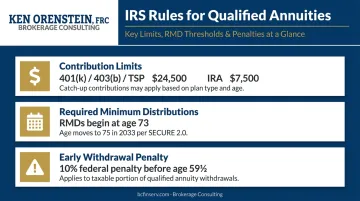
- Contribution limits — For 2026, the elective deferral limit for 401(k), 403(b), and TSP accounts is $24,500 (up from $23,500 in 2025), with an additional age 50+ catch-up of $8,000 and an age 60–63 super catch-up of $11,250 under SECURE 2.0 rules per IRS Notice 2025-67. Traditional IRA contributions are capped at $7,500 for 2026 ($7,000 in 2025), with a $1,100 catch-up for those 50+.
- Required Minimum Distributions (RMDs) — Under current IRS rules, RMDs generally begin at age 73. SECURE 2.0 pushes this to age 75 for later cohorts beginning in 2033.
- Early withdrawal penalty — Distributions before age 59½ trigger a 10% additional federal tax on the taxable portion under IRC Section 72(t), with limited exceptions for disability, death, substantially equal periodic payments, and other qualifying events.
Why Place an Annuity Inside a Qualified Plan?
Placing an annuity inside a tax-qualified plan doesn't add extra tax deferral — the plan wrapper already provides that. The annuity's value comes from what the plan itself cannot offer.
Specifically, the annuity contract layers in insurance-backed features that standard investments can't provide:
- Guaranteed Lifetime Withdrawal Benefits (GLWB) or Guaranteed Minimum Income Benefits (GMIB)
- Principal protection against market downturns
- Death benefits for named beneficiaries
For federal employees rolling over TSP assets at retirement, these features convert a lump sum into a predictable, guaranteed income stream. The TSP's built-in annuity option through MetLife is worth comparing directly — terms, payout rates, and rider options vary, and an outside annuity contract may offer more flexibility.
What Is a Non-Qualified Annuity?
A non-qualified annuity is purchased outside of any employer-sponsored or IRS-qualified retirement plan, using after-tax dollars — money that has already been through income tax once. The term "non-qualified" describes the funding source, not the quality of the contract.
Earnings inside the contract still grow without being taxed each year. That tax-deferral advantage makes non-qualified annuities well suited for high earners who have already maxed out their qualified accounts and want continued deferred growth with no IRS-imposed ceiling.
How Withdrawals Are Taxed
Taxation depends on whether you take withdrawals or annuitize the contract:
Lump-sum or partial withdrawals (pre-annuitization): The IRS applies a "last-in, first-out" (LIFO) rule — per IRS Publication 575, earnings are treated as withdrawn first and taxed as ordinary income. Once earnings are exhausted, the original principal comes out tax-free.
Annuitized payments: The exclusion ratio applies. Per IRS Publication 939, the tax-free portion of each payment equals the ratio of your investment in the contract to your total expected return. This spreads your return of principal evenly across every payment over time.
One common misconception is that non-qualified annuities are exempt from early withdrawal penalties. They're not. IRC Section 72(q) imposes the same 10% penalty on premature distributions — applied to the taxable (earnings) portion only.
Major Advantages Over Qualified Annuities
| Feature | Non-Qualified Annuity |
|---|---|
| Annual contribution limits | None imposed by the IRS |
| RMDs during owner's lifetime | Not required |
| Withdrawal timing control | Fully flexible |
| Tax on withdrawals | Earnings only |
No IRS-mandated contribution ceiling means you can move significant assets — $500,000, $1 million or more — into a non-qualified annuity in a single premium payment. Insurance carriers may set their own internal limits, but the IRS imposes no cap.
Qualified vs. Non-Qualified Annuity: Key Differences Compared
| Qualified Annuity | Non-Qualified Annuity | |
|---|---|---|
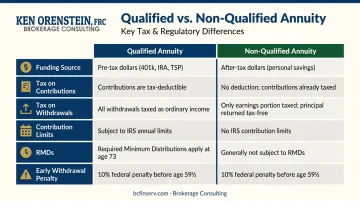
| Funding source | Pre-tax dollars | After-tax dollars |
| Tax on contributions | Deductible (most plan types) | Not deductible |
| Tax on withdrawals | 100% taxable as ordinary income | Earnings only; principal tax-free |
| Contribution limits | IRS caps apply by plan type | No IRS limits |
| RMDs | Required beginning at age 73 | Not required during owner's lifetime |
| Early withdrawal penalty | IRC 72(t) — 10% on taxable portion | IRC 72(q) — 10% on earnings portion |
The Withdrawal Difference in Plain Numbers
Take a $100,000 withdrawal as an example:
- From a qualified annuity: The full $100,000 is taxable income. If you're in the 22% federal bracket, that's a $22,000 tax bill on that single distribution.
- From a non-qualified annuity where $60,000 is original principal and $40,000 is accumulated earnings: Only the $40,000 is taxable — roughly $8,800 at the same 22% rate. The $60,000 return of principal comes back tax-free.
That gap matters considerably when you're managing taxable income against Social Security thresholds, Medicare IRMAA surcharges, or bracket boundaries.
Beneficiary and Estate Implications
Both annuity types pass to named beneficiaries outside of probate. The tax consequences, however, differ:
- Qualified annuity beneficiaries must generally take all distributions within 10 years of the account owner's death (unless they qualify as an eligible designated beneficiary), and they owe ordinary income tax on every dollar — per IRS Publication 590-B.
- Non-qualified annuity beneficiaries owe tax only on accumulated earnings, not the original principal, since that investment in the contract has already been taxed.
State Tax Considerations
Federal rules are just part of the picture. AARP's 2026 state tax guides identify 13 states — including Florida, Texas, Nevada, and Pennsylvania — that don't tax IRA and 401(k) distributions.
State treatment of non-qualified annuity income often follows different rules than qualified plan distributions. Confirm your state's specific position on both before drawing income from either source.
Which Annuity Is Right for Your Retirement Plan?
Neither type is universally superior. The right answer depends on where you are in your financial picture.
Choose a qualified annuity if you:
- Are contributing pre-tax dollars and currently in a higher tax bracket than you expect in retirement
- Want to roll over an existing 401(k), TSP, or pension lump sum into a product with guaranteed lifetime income
- Are a federal employee looking to complement FERS pension income with predictable annuity payments
- Haven't yet maxed out qualified plan contribution room
Choose a non-qualified annuity if you:
- Have already maxed out 401(k) and IRA contributions
- Want tax-deferred growth without RMD pressure
- Need flexibility to control when and how much taxable income you recognize each year
- Are focused on passing assets to heirs with a more favorable tax basis
The Tax Diversification Case for Owning Both
Many retirees benefit from holding both types simultaneously. The strategy: use qualified annuity income to cover essential fixed expenses (housing, healthcare, utilities), then draw selectively from a non-qualified annuity to manage taxable income in years where bracket positioning matters: for instance, before Social Security begins or in years with large one-time deductions.
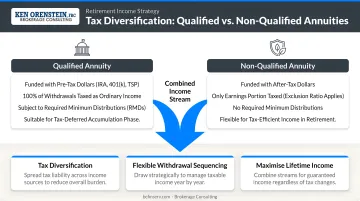
That sequencing becomes especially critical for federal employees. Layering a qualified or non-qualified annuity on top of FERS pension income, Social Security, and TSP distributions requires careful planning. The interaction between these income sources can push ordinary income into higher brackets or trigger Medicare IRMAA surcharges if not managed deliberately.
Ken Orenstein at Brokerage Consulting works with federal employees and pre-retirees to model these scenarios: comparing after-tax income across carriers, evaluating 1035 exchange opportunities for existing contracts, and determining whether a qualified or non-qualified structure (or a combination) fits the full retirement income picture. Consultations are available at no cost by phone, virtually, or in person. You can reach the practice at (888) 315-3608 or request a consultation at bcfinserv.com.
Frequently Asked Questions
What's the difference between a qualified and non-qualified annuity?
A qualified annuity is funded with pre-tax dollars through a retirement plan like an IRA, 401(k), or TSP — all withdrawals are taxed as ordinary income. A non-qualified annuity is funded with after-tax dollars; only the earnings portion is taxable when withdrawn. Both offer tax-deferred growth.
Do qualified annuities have contribution limits?
Yes. Qualified annuities are subject to IRS annual limits tied to the plan type. For 2026, that's $24,500 for 401(k)/403(b)/TSP elective deferrals and $7,500 for IRAs, with additional catch-up allowances for those 50 and older. These limits adjust annually for inflation.
What are the benefits of a qualified annuity?
Pre-tax contributions reduce your taxable income in the year you contribute, earnings grow tax-deferred, and the annuity can layer in insurance-backed features — like guaranteed lifetime income riders — that standard qualified plan investments don't provide.
How much would a $100,000 qualified annuity pay per month?
Monthly payouts vary based on annuity type, your age at purchase, the payout period, and current interest rates. A 70-year-old purchasing a $100,000 immediate annuity will receive a meaningfully different payment than a 60-year-old with a deferred contract. For a personalized estimate, request a no-cost consultation or use an annuity calculator with your specific contract details.
What is the QLAC limit for 2026?
The QLAC dollar limit is $210,000 for both 2025 and 2026, per IRS Notice 2025-67. The prior 25%-of-account-balance cap was repealed for contracts purchased on or after December 29, 2022. QLAC premiums are excluded from RMD calculations — making them a practical tool for deferring income and reducing mandatory distributions.
Who buys tax-qualified annuities?
Typically: employees with access to 401(k) or 403(b) workplace plans, federal employees rolling over TSP balances at retirement, IRA holders seeking guaranteed income options, and pre-retirees converting accumulated pre-tax savings into a predictable income stream. The most common client profile is someone in their 60s or early 70s who has stopped receiving employment income and needs guaranteed cash flow to replace it.