
Annuities exist to solve exactly this problem — but not all annuities work the same way. Immediate and variable annuities are two of the most widely used types, yet they serve fundamentally different purposes. One converts your savings into income starting next month. The other grows your money tax-deferred for years before income begins.
This article breaks down how each type works, how they compare on risk, cost, and flexibility, and which type makes sense for different retirement situations — including federal employees who already have FERS pension and TSP income.
Key Takeaways
- Immediate annuities convert a lump sum into income payments that begin within 30 days to 13 months — best for retirees who need guaranteed cash flow now
- Variable annuities invest your premium in market-linked subaccounts for tax-deferred growth — with fluctuating values and higher fees
- Immediate annuities prioritize income certainty; variable annuities prioritize long-term accumulation and flexibility
- Variable annuity total costs can reach 2.5% or more annually, which meaningfully erodes returns over time
- The right choice depends on your income timing, risk tolerance, and existing guaranteed income
What Is an Immediate Annuity?
An immediate annuity is a contract between you and an insurance company: you hand over a lump sum, and the insurer starts sending you income payments almost immediately. According to FINRA, payments typically begin within 30 days and always within 13 months of purchase.
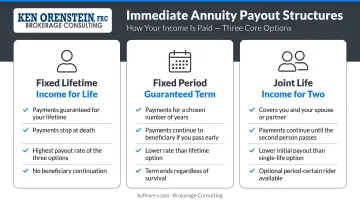
You choose how often you receive payments — monthly, quarterly, semiannually, or annually. You also choose the payout structure:
- Fixed period — payments for a set term, such as 10 or 20 years
- Lifetime — payments continue as long as you live, regardless of how long that is
- Joint life — payments continue while either you or your spouse is living
The core trade-off is straightforward: you surrender access to the principal in exchange for guaranteed income. The insurance company takes on your longevity risk. If you live to 95, they keep paying. For retirees who worry about outliving their savings, that's exactly the protection an immediate annuity is designed to provide.
Fixed Immediate Annuities
In a fixed immediate annuity, the payment amount is locked in at purchase and never changes. You get the same check every month whether the stock market is up 20% or down 30%. That predictability is the whole point.
The inflation caveat is real, though. A $2,000 monthly payment today buys meaningfully less — roughly 26% less purchasing power in 15 years at a 2% annual inflation rate. You can add a cost-of-living adjustment (COLA) rider — typically offering 1%, 2%, or 3% annual increases — though it reduces your starting payment in exchange for that protection, making it worth weighing carefully if you're younger at purchase or anticipate a long retirement.
Variable Immediate Annuities
A variable immediate annuity starts income right away like a fixed immediate annuity, but your payment amount fluctuates based on the performance of underlying investment subaccounts — stocks, bonds, mutual funds. A strong market year means a higher payment; a down year means less.
This structure suits buyers who want immediate income but are willing to accept some variability in exchange for market participation. Unlike a fixed SPIA's locked-in payment or a deferred variable annuity's years-long accumulation phase, the variable immediate annuity trades some income stability for ongoing growth potential — starting from day one.
What Is a Variable Annuity?
A variable annuity is a long-term insurance and investment contract. You allocate your premium among a menu of investment subaccounts — similar to mutual funds — and your account value grows or shrinks with market performance. The SEC's variable annuities guide confirms the key feature: you can move money between subaccounts without triggering a taxable event, and gains accumulate tax-deferred until you withdraw them.
That tax deferral is the primary selling point. You don't owe federal income tax on earnings until withdrawals begin. One important rule: withdrawals before age 59½ may trigger a 10% IRS penalty on top of ordinary income tax on gains, per IRS Publication 575.
Accumulation Phase
During the accumulation phase, you make contributions — either a lump sum or ongoing payments — and your account value moves with your chosen subaccounts. Some contracts also include a fixed account option, a portion allocated to a guaranteed minimum interest rate, giving you a partial buffer against market swings.
For pre-retirees with a decade or more before income begins, tax-deferred compounding can meaningfully grow an account that would otherwise face annual taxation in a standard brokerage account.
Payout (Annuitization) Phase
The payout phase begins when you choose to annuitize, converting your accumulated value into an income stream. Payments can be structured as fixed or variable, for a set period or for life.
Before reaching this phase, review two contract provisions:
- Some contracts automatically annuitize at a specified age — check your terms before that date arrives
- Once annuitization begins, lump-sum withdrawals are generally off the table; the income-for-access trade-off is permanent
That permanence makes market timing a real concern: annuitizing when the market is down locks in a lower account value. Many retirees use living benefit riders, such as a Guaranteed Lifetime Withdrawal Benefit (GLWB), to sidestep this risk by taking lifetime income without formally annuitizing.
Key Differences Between Immediate and Variable Annuities
The most important distinction is purpose: immediate annuities are income tools designed to start paying now, while variable annuities are accumulation tools built for growth over time. Using one where you need the other is a costly mismatch.
| Dimension | Immediate Annuity | Variable Annuity |
|---|---|---|
| Primary use | Convert lump sum to income now | Tax-deferred growth before income |
| Income timing | Within 30 days to 13 months | Years or decades later |
| Investment risk | None (fixed) or moderate (variable SPIA) | Full market risk during accumulation |
| Liquidity | Principal largely inaccessible after purchase | Withdrawals possible, subject to surrender charges |
| Ideal buyer | Retirees needing income today | Pre-retirees with a 10+ year horizon |
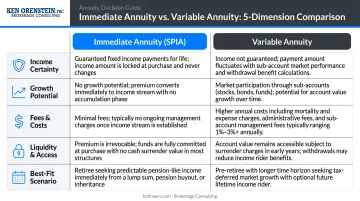
Of all the rows in that table, liquidity is the one that catches buyers off guard most often. With an immediate annuity, your principal is locked once payments begin — no lump-sum retrieval later. Variable annuities are more flexible during accumulation, but surrender charges (which FINRA notes can last 8 years or more) and early-withdrawal tax penalties make accessing that money costly. For both product types, keep your emergency reserves outside any annuity contract.
Costs, Fees, and Risks to Know Before You Buy
Variable Annuity Fee Structure
Variable annuities carry multiple layers of fees that compound against your returns:
- Mortality and expense (M&E) charges — typically around 1.25% annually
- Administrative fees — roughly $25–$30 flat or about 0.15% of account value
- Subaccount fund expenses — vary by investment option
- Living benefit rider fees — typically 1.0–1.5% annually on the income base
Morningstar research puts total variable annuity costs at nearly 2.5% or more annually when all layers are included. At Brokerage Consulting, Ken Orenstein's process specifically evaluates whether living benefit rider guarantees justify their added cost — a critical step since these fees can erode the very returns the contract is meant to deliver.
Surrender charges apply if you withdraw more than the allowable amount during the surrender period (commonly 6–10 years). Most contracts allow a free withdrawal of roughly 10% of the contract value per year without penalty.
Immediate Annuity Cost Considerations
Immediate annuities don't have ongoing annual management fees. Instead, the insurer's costs are embedded in the payout rate itself — a lower monthly payment reflects higher embedded costs. This makes comparison shopping essential. Request quotes from multiple carriers before committing, because payout rates can vary widely across insurers.
The risk unique to immediate annuities: if you die shortly after purchase and didn't add a death benefit or period-certain rider, the remaining principal goes to the insurer — not your heirs. For a $100,000 SPIA paying roughly $617/month (per the CANNEX PAY Index benchmark from April 2026), the nominal break-even is around 13–14 years. Outlive that window and you come out ahead; fall short of it and your estate absorbs the loss.
Riders can protect against early-death risk at a modest reduction in monthly payment. Common options include:
- Period-certain guarantee — pays income for a set term (e.g., 10 or 20 years) to your beneficiary if you die early
- Cash-refund feature — returns the unused portion of your premium to your heirs
- Joint-life payout — continues income to a surviving spouse after your death
Who Should Consider Each Type?
Immediate Annuity Candidates
An immediate annuity fits best if you:
- Are retired or within 1–2 years of retirement
- Need income to start within the next few months
- Want to eliminate the decision burden of ongoing portfolio management
- Have a longer-than-average life expectancy
- Lack a pension or other guaranteed income source
Variable Annuity Candidates
A variable annuity fits best if you:
- Are 10+ years from needing income
- Have already maxed out tax-advantaged accounts (IRA, 401(k))
- Can tolerate market fluctuation and high fees
- Have an existing guaranteed income base and want supplemental growth
A Note for Federal Employees
Federal employees face a specific planning challenge: they often already have substantial guaranteed income from FERS pension, Social Security, and TSP distributions. Adding an annuity without accounting for these sources can lead to over-insurance — locking up capital you don't need in a guaranteed income vehicle.
Ken Orenstein at Brokerage Consulting, a Federal Retirement Consultant (FRC) and author of The Informed Fed, structures retirement income in layers for federal clients: Social Security and FERS pension form the base, annuities fill any remaining guaranteed income gap (Layer 3), and discretionary portfolio assets (Layer 4) handle growth and flexibility.
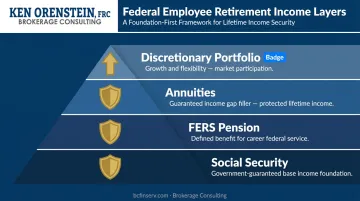
The core question that analysis answers is whether an annuity is even needed — and if so, which type and how much — given what FERS and TSP already provide.
For federal employees weighing a TSP distribution or pension buyout, getting that question right before committing is critical. A free consultation with Ken Orenstein at (888) 315-3608 can clarify the right path before any irreversible decisions are made.
Frequently Asked Questions
How much does an immediate annuity pay per month?
It depends on the lump sum invested, your age, payout option, and current interest rates. As a benchmark, CANNEX reported in April 2026 that $100,000 produces roughly $617/month on average; Blueprint Income showed $651/month for a 65-year-old male and $625/month for a female. Always request quotes from multiple insurers, as payouts vary significantly.
Is there such a thing as an immediate variable annuity?
Yes. Variable immediate annuities begin income payments right away — like a fixed SPIA — but payment amounts fluctuate based on the performance of the underlying investment subaccounts rather than being fixed. They suit buyers who want immediate income alongside some market participation.
What are the main fees associated with variable annuities?
The primary charges are M&E fees (around 1.25% annually), administrative fees, underlying subaccount fund expenses, and optional living benefit rider fees (typically 1.0–1.5% annually). Total all-in costs commonly exceed 2.5% per year, which cuts into net returns.
Are annuity payments taxable?
For nonqualified annuities (funded with after-tax dollars), only the earnings portion of each payment is taxable as ordinary income. For qualified annuities (funded with pre-tax dollars from an IRA, TSP, or 401(k)), the full payment is generally taxable. Withdrawals before age 59½ may trigger an additional 10% IRS penalty.
What happens to my annuity if I die before collecting all payments?
Under a standard lifetime-only payout, payments stop at death and nothing passes to heirs. Adding a period-certain guarantee (such as 10 or 20 years) or a cash-refund rider ensures beneficiaries receive remaining payments or the unpaid premium balance, though monthly income will be modestly lower.
Which is better: an immediate annuity or a variable annuity?
Neither is universally better. Immediate annuities suit buyers who need guaranteed income now; variable annuities fit those still accumulating assets who can accept fees and market risk. The right choice depends on your income timing, risk tolerance, and existing guaranteed income sources — a personalized consultation can help clarify which applies to you.