
This article breaks down minimum investment amounts by annuity type, the factors that push that number up or down, how to estimate the right amount for your situation, and the mistakes that trip people up before they sign a contract.
Key Takeaways
- Minimums range from $5,000 to $25,000+ depending on annuity type and carrier — but real buyers typically invest far more
- Income goal is the primary driver: the monthly payout you need determines the investment size, not an arbitrary minimum
- Higher income needs, immediate payouts, and added riders all push the number up
- Deferred and fixed products carry lower starting thresholds than immediate or variable options
- The more useful question: how much monthly income do you need this annuity to generate?
How Much Do You Need to Start an Annuity? Minimums by Type
There is no federally mandated minimum. Insurers set their own thresholds, and these vary by product type, carrier, and platform. The gap between stated minimums and actual buyer behavior is significant — verified examples from carriers and platforms show minimums as low as $5,000, while LIMRA's buyer metrics put historical average premiums at $112,000–$148,000 depending on product type.
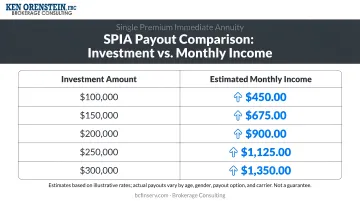
Focusing only on the minimum misses the point. A $10,000 SPIA, for instance, produces roughly $60/month — a footnote, not a retirement income strategy. Matching the right product to your timeline matters as much as meeting the entry threshold.
Fixed Annuities and MYGAs
Fixed annuities and Multi-Year Guaranteed Annuities (MYGAs) carry the lowest minimums in the market. New York Life's fixed deferred annuities start at $5,000, and most MYGA platforms show examples in the $10,000 range. These products function similarly to CDs — a guaranteed interest rate over a fixed term (typically 3, 5, 7, or 10 years) with tax-deferred growth.
Best for: Conservative savers and retirees who want predictable, guaranteed growth without market exposure.
Fixed Indexed Annuities (FIAs)
Fixed indexed annuities link returns to a market index — commonly the S&P 500 — while protecting principal from market losses. Verified carrier examples show minimums around $25,000 (Nationwide Summit), though this varies by product. Upside is limited by caps and participation rates (a 65% participation rate, for instance, means you're credited 65% of the index gain), but your principal is protected from index declines.
Best for: Those who want some market-linked growth potential without putting principal at risk.
Immediate Annuities (SPIAs)
Single Premium Immediate Annuities require a lump sum upfront because that sum becomes the income engine — payments begin within 30 days. Platform minimums verified through Fidelity start at $10,000, but the real-world average at purchase is much higher because small investments generate correspondingly small monthly checks.
As a concrete benchmark: CANNEX data from April 2026 shows a $100,000 investment producing $617/month at a 7.41% yield. A $10,000 investment would generate roughly $60/month — a modest supplement at best.
Best for: Retirees who need income to start now and want to convert a lump sum into a pension-like income stream.
Deferred Income Annuities and Variable Annuities
These two products share a similar entry point but serve different purposes:
- Deferred Income Annuities (DIAs): Minimums start at $10,000. Payments begin years in the future, giving the investment time to grow — suited to pre-retirees with a longer runway before they need income.
- Variable Annuities: Also around $10,000 on major platforms (Fidelity Personal Retirement Annuity). Returns depend on sub-account performance, so market risk applies. Living benefit riders (GLWBs, GMIBs) can layer in guaranteed income features, though each rider adds cost.
DIAs work well for pre-retirees locking in future income at today's rates. Variable annuities fit those willing to accept market exposure in exchange for higher growth potential.
Key Factors That Determine How Much You Actually Need
Minimums are a floor, not a goal. The amount you should invest depends on your personal financial picture, not product rules.
Your Income Goal Comes First
The monthly or annual income you want the annuity to produce is the single biggest driver of investment size. Someone targeting a $300/month supplement needs far less than someone building a full $3,000/month pension replacement. Work backward from the income target — that tells you the investment required, not the other way around.
Your Age and Life Expectancy
Older buyers get higher monthly payments for the same investment because the insurance company expects to pay for fewer years. Age matters significantly:
- A 60-year-old male investing $100,000 in a SPIA receives approximately $620/month
- A 70-year-old male investing the same $100,000 receives approximately $778/month
(Source: ImmediateAnnuities.com, May 2026 quote data)
Younger buyers who need the same monthly income must invest a larger lump sum to offset the longer expected payout period.
The Interest Rate Environment
Annuity payouts track interest rates closely. Research from CANNEX and David Blanchett found SPIA payout rates have a 0.96 correlation with prevailing interest rates. In the 2023–2024 environment, with the 10-year Treasury ranging from 3.53% to 4.80%, annuity payouts reached their most competitive levels in years. Higher rates mean the same investment generates more income — so timing matters.
Your Existing Retirement Income Sources
For federal employees especially, existing income sources dramatically shape the annuity math. Someone with a FERS pension, Social Security, and TSP distributions may only need an annuity to fill a modest gap. Someone without a pension may need to invest substantially more.
For context, 2024 data shows how much guaranteed income FERS retirees already have in place:
- Average FERS monthly annuity: $2,126 (CRS data)
- Average TSP balance for FERS participants: $194,131 (2024 TSP Annual Report)
Whether that combination covers retirement expenses determines how large an annuity investment — if any — is needed. Ken Orenstein applies a layered income framework to this calculation: Social Security and FERS pension form the guaranteed base, with annuities sized to fill whatever gap remains. The investment amount flows directly from that gap.
Fees, Riders, and Product Costs
Fees reduce net payout, which means you may need to invest more to hit your income target after costs. The most common fee types:
| Fee Type | Typical Range |
|---|---|
| Mortality & Expense (M&E) charge | ~1.25%/year (SEC data) |
| Administrative fee | $25–$30/year or ~0.15%/year |
| GLWB/living benefit rider | ~1.0–1.5%/year on income base |
| Surrender charge period | 6–10 years (not a fee, but locks in capital) |
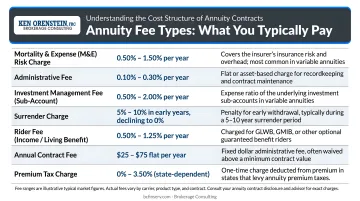
Variable annuities with living benefit riders can carry all-in costs exceeding 3% annually — which meaningfully reduces effective return and requires a larger initial investment to hit a given income target.
How Smaller vs. Larger Annuity Investments Affect Your Payout
Smaller investments (near the minimum) produce lower monthly payouts — useful for supplementing Social Security or a pension rather than replacing income. The upside: lower surrender charge exposure and more assets preserved for emergencies, accessible savings, and heirs.
Larger investments create stronger guaranteed income and better protection against longevity risk. The trade-off: less flexibility and liquidity, and the risk of over-concentrating retirement savings in a single product.
Two planning approaches guide how much to allocate toward annuities:
- Percentage-based: Allocate roughly 30% of your portfolio to annuities alongside bonds and equities — a guideline cited in Financial Planning Association research
- Spending-needs based: Annuitize enough to cover essential monthly expenses, then keep the remaining assets in liquid investments
Most planners favor the spending-needs approach. It ties your annuity investment directly to what you need guaranteed, rather than to an arbitrary portfolio percentage.
How to Estimate the Right Annuity Investment for Your Situation
The right number starts with your income gap — what your guaranteed sources don't cover.
Calculate Your Monthly Income Gap
Add up all guaranteed monthly income sources:
- Social Security benefit
- FERS pension (or other pension income)
- Rental income or other guaranteed streams
Subtract that total from your estimated monthly retirement expenses. The remaining unfunded amount is the gap the annuity should address. That gap — not an arbitrary number — determines the investment size.
Factor In Fees and the Impact on Net Income
Before finalizing an investment amount, understand the total cost structure of the specific contract. If fees reduce your net payout by 0.5–1.5%, you may need to invest more to hit your target after costs. Two annuities with the same headline income figure can produce very different net results.
Consider Liquidity Needs Before Committing
Annuities are not liquid. Most contracts carry surrender charge periods of 5–10 years with penalties for early withdrawal. Only invest money you genuinely won't need access to during that window. Locking up too much capital can leave retirees short on reserves for healthcare costs, home repairs, or other unexpected expenses.
Practical guideline: Maintain 6–12 months of liquid reserves outside the annuity before determining what's available for a long-term income vehicle.
Work With a Retirement Income Specialist
Annuity pricing is specific to your age, the current rate environment, the exact contract terms, and your full financial picture. The right investment size for a 68-year-old with a FERS pension looks very different from what a 62-year-old without a pension needs.
Brokerage Consulting's no-cost initial consultation (available by phone, virtually, or in person) walks through this income gap analysis using your Social Security estimate, pension income, TSP distributions, and monthly expenses.
For federal employees especially, integrating FERS pension calculations, TSP income strategies, and Social Security timing into one coordinated income plan determines the right investment size. Reach Ken Orenstein directly at (888) 315-3608 or request a consultation at bcfinserv.com.
Mistakes to Avoid When Deciding How Much to Invest in an Annuity
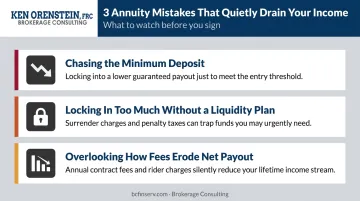
Three mistakes consistently derail annuity decisions — and all three come down to misjudging how much to commit.
Chasing the minimum deposit. Buying the cheapest annuity possible often results in payouts too small to move the needle. A $10,000 SPIA producing $60/month doesn't meaningfully improve retirement security. The goal is reliable income, not just clearing the entry bar.
Locking in too much without a liquidity plan. Concentrating all retirement savings in an annuity leaves no buffer for healthcare costs, major repairs, or unexpected expenses. Keep accessible funds outside the annuity — surrender charge periods make early withdrawals expensive. No annuity should absorb more capital than you can genuinely afford to leave untouched for the full contract term.
Overlooking how fees erode net payout. Two annuities quoting the same monthly income can deliver very different results after costs. A variable annuity with a GLWB rider running 3%+ in annual fees will typically underperform a lower-cost fixed indexed annuity with a comparable income guarantee. That gap only closes if the VA's market exposure generates enough upside to offset the cost drag. Before committing, request side-by-side net payout comparisons across at least three carriers.
Frequently Asked Questions
How much do you need to start an annuity?
There's no universal minimum — it varies by annuity type and insurer. Verified examples range from $5,000 for fixed deferred products to $25,000 for some indexed annuities. That said, LIMRA data shows historical buyer averages of $112,000–$148,000, because meaningful retirement income typically requires a significantly larger investment than the minimum.
What is the minimum investment for a fixed annuity?
Fixed annuities and MYGAs offer the lowest entry points in the market — verified examples start as low as $5,000, with many platforms and carriers setting minimums around $10,000. These are among the most accessible annuity types for conservative savers entering the market.
Can I start an annuity with $10,000?
Yes, some fixed and deferred annuity products are available at or near that amount. However, $10,000 will generate limited monthly income — roughly $60/month from a SPIA, for example — which may not meaningfully improve your retirement security on its own. It can work as a supplement, but not as a primary income strategy.
How does the amount I invest affect my monthly annuity payout?
The relationship is direct: double the investment, double the payout (approximately). Age, current interest rates, and fees also influence the final number. A 70-year-old investing $100,000 today generates meaningfully more monthly income than the same investment made at age 60.
What fees should I be aware of when starting an annuity?
Common fees to account for:
- Mortality and expense charges (~1.25%/year for variable annuities)
- Administrative fees ($25–$30/year)
- Surrender charges (applied over 6–10 year periods)
- Optional rider fees (1.0–1.5%/year for living benefit riders)
All of these reduce net payout and should factor into your investment sizing.
How much of my retirement savings should I put into an annuity?
Research frameworks suggest 25–30% of retirement portfolio assets, though a more practical approach ties the allocation to your income gap rather than a fixed percentage. Either way, keep sufficient liquid reserves outside the annuity and avoid over-concentrating in any single product.