
This isn't a minor accounting detail. Accumulation units are the mechanism that determines how every premium dollar gets recorded, how market gains and losses affect your balance, and ultimately how your savings convert into retirement income. Misunderstanding them leads to misreading your statements, misjudging your account's real value, and making poorly timed decisions.
This article breaks down what accumulation units are, how they're calculated, what drives their value, and how they convert into income — along with the most persistent misconceptions to avoid.
Key Takeaways
- An accumulation unit measures your proportional share of a variable annuity's subaccount — not a fixed dollar amount
- Each net premium buys a specific number of units — the unit count grows with contributions while the unit value moves with markets
- Unit values reset daily based on subaccount investment performance, meaning your account balance changes every trading day
- At retirement, accumulation units convert to annuity units — a one-time, irreversible calculation
- Dividends and capital gains grow tax-deferred inside the annuity — unlike a comparable taxable mutual fund
What Accumulation Units Actually Represent
An accumulation unit is a unit of measurement — not a currency. It represents a proportional ownership interest in a variable annuity's separate account, the legally segregated pool of investments your premiums flow into.
The Separate Account Structure
When you pay a variable annuity premium, that money doesn't sit in the insurer's general business account. Under the Investment Company Act (15 U.S.C. 80a-2(a)(37)), a separate account is established and maintained to ensure that its income, gains, and losses are credited or charged against that account alone , independent of the insurer's other operations.
The NAIC Model Regulation reinforces this: assets backing separate account liabilities cannot be claimed against any other insurer business.
Within the separate account, your premiums flow into subaccounts — investment options that resemble mutual funds. Common subaccount types include:
- Stock funds (domestic and international equity)
- Bond funds (government, corporate, high-yield)
- Money market options
- Target-date funds
The total net asset value of a subaccount, divided by the number of units outstanding, produces the current unit value.
How This Differs from Mutual Funds
Accumulation units work similarly to mutual fund shares in some ways, but the structure is different where it counts:
| Feature | Mutual Fund Shares | Accumulation Units |
|---|---|---|
| Ownership structure | Direct investor ownership | Through insurance contract |
| Dividends/capital gains | Distributed to investor (taxable) | Reinvested into unit value (tax-deferred) |
| Daily pricing | Yes (NAV) | Yes (separate account NAV) |
| Regulatory framework | Investment Company Act | Insurance law + SEC Form N-4 |
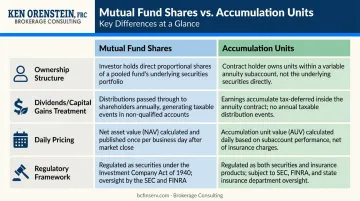
The tax treatment difference matters significantly over time. According to Investor.gov, variable annuity investors pay no federal taxes on income and investment gains until withdrawal , whereas mutual fund holders face annual tax events on distributions.
Accumulation units exist only during the accumulation phase — from contract issue until income payments begin. Once income payments start, accumulation units are converted into annuity units, which use a separate calculation to determine each payment amount.
How Accumulation Units Are Calculated and Tracked
The math behind accumulation units is straightforward once you see the two-part structure: unit count and unit value work independently.
The Unit Credit Formula
When you make a premium payment, the insurer deducts applicable fees first. The net premium is then divided by the current accumulation unit value to determine how many units you receive:
Units credited = Net premium ÷ Current accumulation unit value
A concrete example: if your net premium after fees is $200 and the current unit value is $100, you receive 2.00 accumulation units. Fractional units count too — a $150 net premium at a $100 unit value credits 1.50 units.
Your total account value at any moment is equally simple:
Account value = Units held × Current unit value
For instance: 3,200 units × $4.00 per unit = $12,800 account value. If markets rise and the unit value moves to $4.50, that same unit count is now worth $14,400 — without any new contribution.
What Moves the Unit Value
Understanding what drives unit value changes explains why two contracts with identical contributions can end up at very different account balances.
Unit values are recalculated at each valuation date (typically daily) based on the net asset value of the underlying subaccount investments. Three forces drive changes:
- Market performance: Rising equity or bond markets increase NAV; declining markets reduce it
- Fee deductions: Mortality and expense (M&E) risk charges (~1.25% annually), administrative fees (~0.15%), and subaccount management expenses are all deducted before unit values are set
- Subaccount fund activity: Dividends and gains are reinvested into the unit value rather than paid out as cash
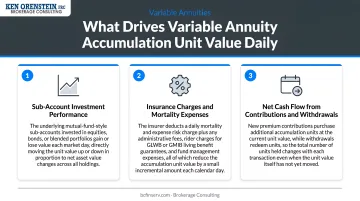
Per SEC Form N-4 disclosure requirements, these charges are applied before the unit value you see on your statement — meaning it reflects net performance, not gross. A subaccount returning 7% gross with 1.4% in total annual charges reflects closer to 5.6% in unit value appreciation.
Statement Disclosure Requirements
The NAIC Variable Annuity Model Regulation (Section 8B) requires insurers to provide at least annual statements disclosing the number of accumulation units credited to the contract and the dollar value of each unit. This gives contract holders a trackable record — your unit count should grow with each contribution, while the per-unit price fluctuates with markets.
Key Properties of Accumulation Units
Variable Value, Stable Count
Accumulation units have a dual nature that trips up many investors:
- Unit count increases monotonically with each premium contribution — it never shrinks unless you make a withdrawal
- Unit value fluctuates continuously with market performance — it can fall sharply during a downturn
When markets decline, each premium contribution buys more units because unit prices are lower. That's dollar-cost averaging at work: a rising unit count during a downturn can position the account well for recovery. In the short run, though, total account value can still fall even as your unit count grows.
Tax-Deferred Reinvestment
When subaccount funds generate dividends or capital gains, those amounts don't flow out as cash distributions. The subaccount reinvests them automatically, increasing the accumulation unit value with no current tax liability.
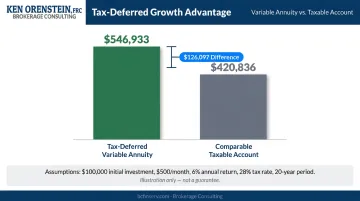
The compounding effect over decades is meaningful. A TIAA illustration (assuming a $100,000 initial investment plus $500/month for 20 years at a 6% annual return and 28% tax rate) shows:
- Tax-deferred account: $546,933
- Comparable taxable account: $420,836
That's a $126,097 difference from the same contributions and the same return rate. Note that this is an illustration with stated assumptions, not a guarantee — and withdrawals from variable annuities are taxed as ordinary income (not at lower capital gains rates), with a 10% IRS penalty for distributions before age 59½ under IRC Section 72(q).
Subaccount-Specific Valuation
Most variable annuities let you allocate premiums across multiple subaccounts simultaneously. Each subaccount maintains its own accumulation unit value and unit count. A reallocation — moving money from a stock subaccount to a bond subaccount — changes the unit counts and prices within each subaccount but doesn't alter your total dollar value at the moment of transfer.
No Interest Rate Guarantee
Unlike a fixed annuity, which credits a stated guaranteed rate, accumulation unit values carry no guaranteed return. You bear the investment risk entirely. The Assumed Interest Rate (AIR) that appears in variable annuity contracts applies exclusively to the payout phase calculation — it has no bearing on how accumulation units are valued.
From Accumulation Units to Retirement Income
The Annuitization Trigger
When you elect to begin receiving income, your accumulation units must be converted into annuity units. This happens once, at a specific conversion date, and it's irreversible. After conversion:
- The number of annuity units is fixed for the life of the contract
- The dollar value of each annuity unit continues to fluctuate with subaccount performance
How the Initial Payout Is Set
The insurer uses several factors to calculate your initial monthly payment:
- Total account value at conversion (accumulation units × unit value on that date)
- Your age and sex (actuarial tables)
- The income option selected
- The Assumed Interest Rate (AIR) — the benchmark return rate for the payout phase
According to a Sun Life SEC-filed prospectus, if the subaccount's net investment return equals the AIR, payments remain level. If returns exceed the AIR, payments increase. If returns fall short, payments decrease. A higher AIR produces a larger initial payment but sets a higher performance bar to maintain it.
Common Payout Options
| Option | Description | Trade-off |
|---|---|---|
| Life only | Payments for your lifetime | Highest payment; nothing to heirs |
| Life with period certain | Guaranteed minimum payout period | Slightly lower payment; beneficiary protection |
| Joint and survivor | Continues while either spouse lives | Lower payment; spousal protection |
| GLWB rider | Guaranteed withdrawals without full annuitization | Flexibility retained; rider costs apply |
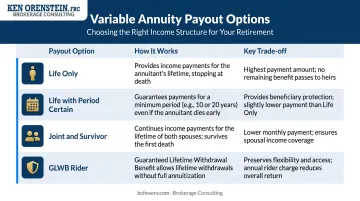
For federal employees, the payout structure decision doesn't happen in a vacuum. Variable annuity income typically sits alongside a FERS pension, TSP distributions, and Social Security — so how much market-linked income you need, and which payout option fits, depends on what your guaranteed income already covers. Ken Orenstein works with federal employees specifically to coordinate these income sources and determine where a variable annuity fits within their broader retirement income plan.
Common Misconceptions About Accumulation Units
"My unit count is my account balance"
Accumulation units are not dollars. A stated number of units has no fixed cash value : the balance is always unit count × current unit price, and that price changes daily. Treating unit count as a stable savings balance leads to serious miscalculations, especially near retirement when a market drop can meaningfully reduce what's available for conversion.
"More units means a higher account value"
Receiving more units when unit prices drop (dollar-cost averaging) can be beneficial long-term. But a rising unit count does not offset a falling unit price in the short run.
Consider this example:
| Scenario | Unit Count | Unit Value | Account Value |
|---|---|---|---|
| Before | 3,000 | $5.00 | $15,000 |
| After | 3,200 | $4.00 | $12,800 |
More units, less money. The math is straightforward — the unit price decline outweighed the gain in units.
"The AIR applies during accumulation"
Misreading the contract language around the Assumed Interest Rate (AIR) is a common mistake. The AIR appears in variable annuity documents but applies only to the payout phase — it benchmarks annuity unit performance after annuitization, not before.
During accumulation, unit values are determined by subaccount investment performance and applicable fees. There is no AIR-based guarantee while you're still contributing.
Frequently Asked Questions
What is an accumulation unit in a variable annuity contract?
An accumulation unit is a unit representing your proportional share of a variable annuity's separate account investments during the saving phase. The value fluctuates daily with subaccount performance, not a fixed dollar amount.
How are accumulation units calculated?
Units credited equal your net premium (after fees) divided by the current accumulation unit value. Your total account value at any point equals units held multiplied by the current per-unit price.
Are accumulation units fixed?
The unit count in your account is stable between contributions, but the per-unit value is not. It fluctuates daily with subaccount investment performance, meaning your total account value rises or falls with market conditions.
What is the accumulation phase in a variable annuity?
The accumulation phase runs from contract issue until you begin taking income. During this period, premium contributions purchase accumulation units and the account grows tax-deferred based on subaccount investment performance.
What does accumulated value in a variable annuity contract refer to?
Accumulated value is the total current dollar value of the contract — calculated as accumulation units held multiplied by the current unit value. It represents what you've built before annuitization or withdrawal.
Is it better to buy income or accumulation units?
Income units distribute earnings as regular cash payments, suited to investors needing current income. Accumulation units reinvest earnings for long-term growth, suited to those still in the saving phase. The right choice typically shifts as retirement approaches.