Pick the wrong one, and you could expose your retirement savings to market losses you can't recover from, or lock yourself into returns that inflation quietly erodes over a 20- or 30-year retirement. This guide breaks down how each annuity type works, who each is suited for, and how to decide between them.
Key Takeaways
- Fixed annuities credit a guaranteed interest rate — your principal cannot decline due to market losses
- Variable annuities invest in market-based subaccounts, offering higher growth potential but real risk of loss
- Both grow tax-deferred; both can provide lifetime income through annuitization
- Variable annuities carry significantly higher fees — all-in costs can exceed 3% per year, eroding returns over a long accumulation period
- Neither type is universally better — the right choice depends on your risk tolerance, timeline, and income goals
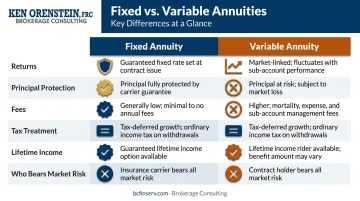
Fixed vs. Variable Annuity: At a Glance
Here's how the two annuity types compare across the features that matter most.
| Feature | Fixed Annuity | Variable Annuity |
|---|---|---|
| Returns | Guaranteed rate set at contract signing | Tied to subaccount performance; can rise or fall |
| Principal Protection | Fully protected — cannot lose your deposit to market losses | No protection; account value can decline |
| Fees | Generally low; no investment management charges | Multiple fee layers — M&E charges, admin fees, fund expenses, optional riders |
| Tax Treatment | Tax-deferred growth; withdrawals taxed as ordinary income | Same; 10% IRS penalty for withdrawals before age 59½ |
| Lifetime Income | Available through annuitization | Available through annuitization or living benefit riders |
| Who Bears Market Risk | Insurance company | Policyholder |
What Is a Fixed Annuity?
A fixed annuity is a contract with an insurance company where the insurer credits a guaranteed interest rate for a set period, regardless of how markets perform. The insurance company absorbs all investment risk — your account value doesn't fluctuate with the stock market.
The Two Main Subtypes
Multi-Year Guaranteed Annuities (MYGAs) lock in a fixed rate for a defined term — typically 3, 5, 7, or 10 years. They function similarly to CDs but with tax-deferred growth and often better rates than comparable bank products. As of May 2026, top MYGA rates were running approximately 5.85%–6.00% for 3-year terms and 6.30%–6.50% for 5-year terms (rates change frequently and vary by carrier).
Immediate fixed annuities (SPIAs) convert a lump sum into a pension-like income stream, with payments typically beginning within 30 days. These are often used by retirees who need income right now rather than accumulation over time.
Core Benefits for Retirement
- Predictable, guaranteed income regardless of market conditions
- Full principal protection — no exposure to stock market downturns
- Simpler to understand than variable products
- Generally low fees, with no investment management charges
The Real Risks of Fixed Annuities
"Fixed" does not mean risk-free. Two genuine risks apply:
- Inflation risk — a fixed rate that looks attractive today may not keep pace with rising living costs over a long retirement. BLS data shows CPI-U hit 8.0% in 2022 and averaged 2.9% in 2024, which can erode purchasing power over 20+ years
- Opportunity cost — when markets perform well over a long stretch, a fixed annuity captures none of those gains
Who Fixed Annuities Fit Best
Fixed annuities are well-suited for conservative investors, those at or within five years of retirement, and anyone relying on the annuity as a primary income source.
For federal employees specifically, a MYGA or SPIA can add a predictable income layer on top of FERS pension payments — without introducing market volatility into the stable base of a retirement plan.
What Is a Variable Annuity?
A variable annuity is a contract where you allocate your premium across investment subaccounts — essentially mutual fund-like portfolios of stocks, bonds, or both. Your account value rises and falls with the performance of those subaccounts. Unlike a fixed annuity, the policyholder, not the insurance company, bears all investment risk.
How Payouts Work
Because the account value depends on market performance, the income you receive during the payout phase reflects how those subaccounts performed. Strong markets mean higher income; weak or negative markets mean less — potentially far less if markets decline significantly before or during retirement.
The Fee Structure: What You're Actually Paying
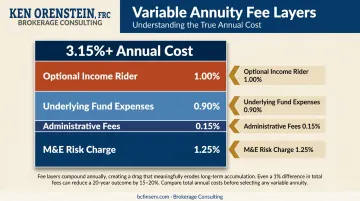
Variable annuities carry multiple fee layers that fixed annuities simply don't have. According to the SEC's guide to variable annuities, a typical contract includes:
- Mortality & expense (M&E) risk charge — approximately 1.25% of account value annually in SEC examples
- Administrative fees — approximately 0.15% of account value, or flat fees of $25–$30 per year
- Underlying fund expenses — paid indirectly through subaccount costs
- Optional rider charges — living benefit riders such as GLWBs or GMIBs add cost, typically 1.0–1.5% annually on the income base
An educational all-in example from Annuity.org illustrates how these stack: 1.25% M&E + 0.90% fund fees + 1.00% income rider = 3.15% per year before surrender charges. That's a real drag on compounding — the account starts each year down 3% or more before markets move at all.
Fee analysis is a central part of any variable annuity review at Brokerage Consulting. Ken Orenstein regularly works with clients on VA replacement analysis: evaluating whether an existing variable annuity should be exchanged for a lower-cost fixed or fixed-indexed product through a 1035 tax-free exchange.
Potential Advantages for the Right Investor
Despite the fees, variable annuities offer real advantages in specific situations:
- Market-linked growth potential over a long time horizon
- Investment flexibility to shift subaccount allocations as conditions change
- Tax-deferred accumulation on gains that would otherwise be taxed annually in a mutual fund
- Optional living benefit riders that can guarantee lifetime income even if account value declines
Who Variable Annuities Fit Best
Those advantages translate to a specific suitability profile. Variable annuities fit growth-oriented investors with a long time horizon — generally 15 or more years from retirement — who are comfortable with market volatility. They work best when a guaranteed income base is already in place from other sources.
They are not appropriate as a primary retirement income source for anyone near or in retirement who cannot absorb potential losses.
Fixed vs. Variable Annuity: Which One Is Right for You?
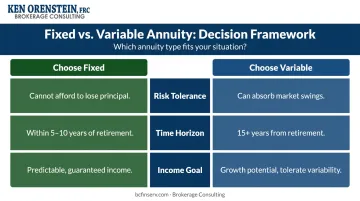
No single answer fits everyone. The decision comes down to three factors:
Decision Framework
| Factor | Choose Fixed | Choose Variable |
|---|---|---|
| Risk tolerance | Cannot afford to lose principal | Can absorb market swings over a long horizon |
| Time horizon | Within 5–10 years of (or already in) retirement | 15+ years from retirement |
| Income goal | Need predictable, guaranteed income | Want growth potential; can tolerate income variability |
Situational Guidance
Choose a fixed annuity if:
- You are conservative about market exposure
- You are retired or within five years of retirement
- The annuity will serve as a primary income source
- You want a simple, low-cost product with no investment management decisions to make
A variable annuity may be appropriate if:
- You are decades from retirement and have a genuinely long time horizon
- You already have guaranteed income covered through Social Security, a pension, or other sources
- You understand that fees and market risk can reduce returns or cause losses
- You have sufficient assets (typically $250,000 or more available) to absorb volatility without derailing your retirement plan
The Middle-Ground Option
If neither option fits cleanly, fixed-indexed annuities (FIAs) link interest credits to a market index — often the S&P 500 — without directly investing in the market. Principal is protected if the index falls, but growth is capped or limited by participation rates and spread charges. For many pre-retirees who want some growth potential without full market exposure, FIAs represent a practical middle ground between the two.
A Note on Federal Employees
For federal employees, the calculus requires factoring in FERS or CSRS pension income as part of the overall income floor. At Brokerage Consulting, Ken Orenstein works through this layered income picture — Social Security, a federal pension, and any annuities — to identify where a fixed or variable product actually fits. For most federal employees seeking to supplement pension income conservatively, fixed or fixed-indexed annuities tend to be the more appropriate fit than variable products.
For personalized guidance that accounts for your complete retirement picture, Brokerage Consulting offers no-cost consultations by phone, virtual meeting, or in-person. You can reach Ken Orenstein at (888) 315-3608 or through the consultation request page at bcfinserv.com.
Conclusion
Fixed annuities deliver stability, principal protection, and predictable income. They're built for people who cannot afford to lose ground near or in retirement. Variable annuities offer market-linked growth potential for long-horizon investors comfortable with fees, market risk, and income uncertainty. Neither is the universally correct choice.
The right decision comes down to a few core factors:
- Risk tolerance — how much volatility you can absorb without altering your retirement plans
- Time horizon — how many years remain before you need to draw income
- Portfolio context — how this annuity fits alongside Social Security, pension payments, and other assets
Working with an advisor who understands both the insurance and investment sides — and who can compare products across multiple carriers rather than pushing a single option — leads to a better-structured outcome.
Ken Orenstein at Brokerage Consulting focuses on exactly this kind of analysis, including carrier comparisons, income rider evaluation, and FERS coordination for federal employees planning around their existing government benefits.
Frequently Asked Questions
Which is better, a fixed annuity or a variable annuity?
Neither is universally better. Fixed annuities suit conservative investors who need guaranteed income and principal protection, while variable annuities may be appropriate for growth-focused investors with a long time horizon who can tolerate market risk and higher fees. The right choice depends entirely on your individual situation.
Can you lose money in a variable annuity?
Yes. Because a variable annuity's value is tied to market-based subaccounts, your account can lose value if those investments decline. Unlike a fixed annuity, there is no guarantee of principal return in a standard variable annuity contract.
Are fixed annuities FDIC insured?
No. Annuities are insurance products, not bank deposits, and are not FDIC insured. They are backed by the financial strength of the issuing insurance company and protected by state guaranty associations, which according to NOLHGA provide $250,000 or more in annuity coverage in every member state, though limits vary by state.
What fees should I expect with a variable annuity?
Variable annuities carry multiple fee layers: mortality and expense charges (typically around 1.25% annually), administrative fees, underlying fund expenses, and optional rider charges that can add another 1.0–1.5% per year. All-in costs frequently exceed 3% annually, which quietly erodes compounding over time.
What happens to my annuity when I die?
Most annuities include a death benefit that passes the remaining contract value — or a guaranteed minimum — to named beneficiaries. In a basic variable annuity, the death benefit typically pays at least the purchase payments minus any withdrawals. Enhanced stepped-up death benefits are available at additional cost.
Can I switch from a variable annuity to a fixed annuity?
Yes, through a 1035 exchange, which allows tax-free transfer of funds between annuity contracts as long as the annuitant remains the same. Review surrender charges on your existing contract and the terms of the new contract carefully before proceeding — a licensed annuity advisor can walk you through the tradeoffs.