
The complication isn't the annuity itself. It's whether that annuity sits inside a qualified retirement account or was purchased with after-tax dollars outside one. That single distinction determines whether RMDs apply at all, how they're calculated, and what happens when payments fall short. Add the SECURE 2.0 Act changes layered on top, and there's real planning opportunity here—but also real risk if you misread the rules.
This article answers the core questions: whether your fixed annuity triggers RMDs, how those distributions are calculated, and how SECURE 2.0 may actually work in your favor.
TL;DR: Key Takeaways
- RMD exposure depends on account type, not annuity type—qualified accounts trigger RMDs, non-qualified accounts don't
- Qualified fixed annuity RMDs begin at age 73 (or 75 for those born in 1960 or later under SECURE 2.0)
- The 25% IRS penalty applies to any shortfall—reduced to 10% only if corrected within the correction period
- Under SECURE 2.0, annuity payments that exceed the contract's own RMD can count toward RMDs on your other IRAs
- Non-qualified fixed annuities have no RMD requirement, but earnings are still taxed as ordinary income
Fixed Annuities and RMDs: The Distinction That Changes Everything
Fixed Annuities and RMDs: It's the Tax Wrapper, Not the Product Type
A fixed annuity is a contract with an insurance company that delivers guaranteed interest growth and predictable income—no market exposure, no fluctuating account value. Unlike variable annuities (tied to sub-account performance) and fixed indexed annuities (linked to a market index), it carries no market risk. But none of those product differences affect RMD obligations.
What determines RMD exposure is the tax wrapper around the annuity. IRS RMD rules apply to qualified retirement arrangements—not to annuity product types. A fixed annuity inside a traditional IRA is treated exactly like any other IRA asset for RMD purposes.
Qualified Fixed Annuities
Qualified fixed annuities are purchased with pre-tax dollars inside tax-advantaged accounts. Because the IRS hasn't yet collected taxes on those funds, mandatory withdrawals are required once the account holder reaches RMD age.
Accounts that trigger RMDs include:
- Traditional IRAs
- 401(k) and 403(b) employer-sponsored plans
- SEP IRAs and SIMPLE IRAs
- Profit-sharing plans
- 457(b) plans funded with pre-tax dollars
One notable exception: Roth IRAs have no RMD requirement during the account holder's lifetime. Designated Roth accounts in 401(k) and 403(b) plans also have no lifetime RMD requirement under current IRS guidance.
Non-Qualified Fixed Annuities
Non-qualified fixed annuities are purchased with after-tax dollars outside retirement accounts. The IRS has no claim on mandatory withdrawals because the principal was never tax-deferred—so RMD rules don't apply.
That doesn't mean they're tax-free, though. Taxation depends on when and how you take withdrawals:
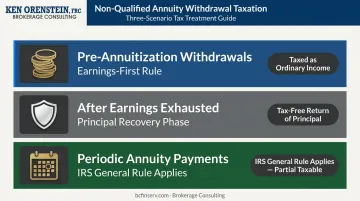
- Withdrawals before annuitization are allocated to earnings first under IRS Publication 575, and those earnings are taxable as ordinary income
- Once earnings are exhausted, remaining withdrawals represent a tax-free return of your original investment
- Periodic annuity payments are subject to the IRS General Rule, which determines what portion of each payment is taxable
How RMDs Are Calculated for Qualified Fixed Annuities
The Core Formula
The RMD for a qualified fixed annuity in the accumulation phase follows the standard IRS formula:
RMD = Prior December 31 Fair Market Value ÷ IRS Life Expectancy Factor
The life expectancy factor comes from the IRS Uniform Lifetime Table, which most account holders use unless their sole beneficiary is a spouse more than 10 years younger.
What "Fair Market Value" Means for a Fixed Annuity
Unlike a mutual fund with a daily price, a fixed annuity doesn't have a market quote. The issuing insurance company determines the FMV annually using actuarial methods that account for the present value of all future guaranteed payments. For annuitized contracts, IRS instructions require the insurer to report the current actuarial value as of December 31. This figure appears on IRS Form 5498, which trustees and custodians must provide annually.
The Annuity Exception Rule
If a qualified fixed annuity has entered the payout phase, the payment structure itself may satisfy the RMD obligation—but only when the payments meet specific IRS requirements under 26 CFR 1.401(a)(9)-6:
- Payments made at least annually
- Uniform amounts over the distribution period
- Nonincreasing payments (with limited exceptions)
- Structured over the account holder's life expectancy
When these conditions are met, the regular annuity payments can satisfy the RMD without a separate annual calculation—as long as they meet or exceed the calculated minimum.
When Payments Fall Short
Not every annuity payout clears the RMD threshold. If payments fall short of the calculated minimum, the account holder must withdraw the difference from other qualified accounts. Missing this step triggers a 25% excise tax on the shortfall, per the 2025 Form 5329 instructions. That penalty drops to 10% if corrected within the IRS correction window—which ends on the earliest of a deficiency notice, a tax assessment, or the last day of the second tax year after the year the tax was imposed.
Timing Rules
- First RMD: Due by April 1 of the year after reaching RMD age
- All subsequent RMDs: Due by December 31 each year
Waiting until April 1 in year one means two distributions land in the same calendar year. That double-up can push taxable income into a higher bracket—so if your other income is already significant, taking the first RMD in the year you reach RMD age often costs less.
How SECURE 2.0 Changed the Rules for Fixed Annuity Holders
The Age Change
The SECURE 2.0 Act, signed December 29, 2022, moved the RMD starting age from 72 to 73 for those born 1951–1959, and to 75 for those born in 1960 or later. This is confirmed in the Federal Register final RMD regulations implementing SECURE 2.0 Section 107.
The Excess Annuity Payment Rule
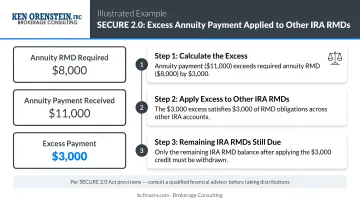
SECURE 2.0 Section 204 introduced a more nuanced change worth understanding: qualifying annuity payments that exceed the annuity's own RMD can now be applied to satisfy RMDs from the originating IRA or other IRAs that can be aggregated.
Before this change, annuity income from a qualified account only satisfied the RMD for that specific account. Post-SECURE 2.0, the excess can flow across your IRA portfolio.
Hypothetical example:
| Item | Amount |
|---|---|
| Annual annuity payment | $12,000 |
| Calculated RMD for the annuity | $7,500 |
| Excess available for other IRAs | $4,500 |
A retiree in this position may not need to take any additional withdrawal from their traditional IRAs—allowing those balances to continue compounding tax-deferred. For anyone managing multiple IRA accounts, that means fewer forced withdrawals and more control over taxable income each year.
Important Caveats
This rule isn't fully settled or universally applicable:
- Final IRS regulations reserved implementation detail for Section 204; the 2024 proposed regulations (REG-103529-23) supply additional operational guidance, but the rules are still evolving
- The excess payment rule applies to qualifying income annuities—not all fixed annuity types uniformly
- IRA RMDs can be aggregated across accounts; 401(k) RMDs cannot—a workplace plan RMD must be taken separately from that plan, and an IRA distribution won't satisfy it
- The calculation must be redone each year based on the updated FMV
With this many moving parts, getting the calculation right matters—especially when the wrong approach triggers unnecessary withdrawals or IRS penalties. Ken Orenstein at Brokerage Consulting incorporates RMD planning—including SECURE 2.0 considerations—into retirement income engagements. A no-cost initial consultation is available at (888) 315-3608 or bcfinserv.com to map out how this applies to your specific account mix.
Tax Implications of Fixed Annuity RMDs You Need to Plan For
Distributions from qualified fixed annuities are taxed as ordinary income at your marginal rate—the entire distribution, not just the earnings portion. That's different from long-term capital gains, which are taxed at preferential rates of 0%, 15%, or 20% depending on income. For retirees in the 22% or 24% bracket, the tax drag from large RMDs is real.
The Downstream Effects
Large RMDs don't just increase your tax bill—they can trigger a cascade of secondary costs:
- Social Security taxation: Per IRS Publication 915, up to 85% of Social Security benefits become taxable once combined income exceeds $34,000 for single filers or $44,000 for joint filers
- Medicare IRMAA surcharges: Higher MAGI from RMDs can push you into a higher IRMAA bracket. For 2026, individual MAGI above $109,000 triggers Part B surcharges starting at $81.20/month, escalating significantly at higher thresholds, per CMS 2026 Medicare data
- Reduced deduction eligibility: Higher AGI can phase out certain deductions and credits
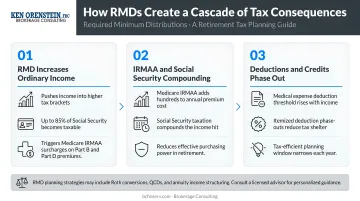
These cascading costs are exactly why proactive planning matters. Ken Orenstein's retirement planning practice addresses IRMAA thresholds and healthcare cost projections as core components of retirement roadmap design, not items discovered at tax time.
The QCD Option
If you're 70½ or older and hold a traditional IRA, a Qualified Charitable Distribution (QCD) lets you direct up to $111,000 in 2026 (per IRS Notice 2025-67, up from $108,000) directly from your IRA to a qualified charity. The amount satisfies your RMD but is excluded from taxable income entirely — a meaningful advantage for charitable-minded retirees who don't need the full RMD for living expenses.
QCDs are IRA-specific; they don't apply directly to 401(k) plans.
Common Mistakes Fixed Annuity Holders Make with RMDs
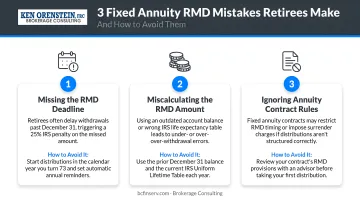
Mistake #1: Assuming annuity payments automatically cover all RMD obligations
Receiving regular income from a fixed annuity does not mean every qualified account's RMD is satisfied. You must verify that the payment amount meets or exceeds the calculated minimum for each qualifying account you hold. The 25% penalty applies per account, per year.
Mistake #2: Relying on last year's RMD figure
The FMV of a fixed annuity changes annually, so the RMD amount changes too. Using a prior year's figure—or the annuity's original purchase price—produces an inaccurate result. The correct starting point is always the December 31 FMV from the prior year as reported on Form 5498.
Mistake #3: Conflating qualified and non-qualified annuities
Retirees who hold both types frequently misapply the rules. They may incorrectly apply RMD obligations to a non-qualified contract, or assume that income from a non-qualified annuity satisfies a qualified account's RMD. These are separate instruments governed by different tax rules, and treating them interchangeably can trigger penalties and unexpected tax liability.
Frequently Asked Questions
Do you have to take RMDs from fixed annuities?
It depends on the account. Fixed annuities held inside a traditional IRA, 401(k), 403(b), SEP IRA, SIMPLE IRA, or similar qualified account are subject to RMDs starting at age 73 (or 75 for those born in 1960 or later). Fixed annuities purchased with after-tax dollars outside a retirement account are not subject to RMD rules.
How do RMDs work with annuities?
For qualified annuities, the annual RMD equals the December 31 fair market value divided by an IRS life expectancy factor from the Uniform Lifetime Table. If the annuity is in payout phase, payments that are at least annual, uniform, and nonincreasing may satisfy the RMD obligation automatically, provided they meet or exceed the calculated minimum.
Do qualified annuity payments count toward RMDs?
Yes. Under SECURE 2.0 Section 204, payments from a qualifying income annuity that exceed the annuity's own RMD can also satisfy RMDs from other IRAs in the account holder's portfolio. Note that IRA and 401(k) RMD aggregation rules differ: this cross-account benefit applies to IRAs, not workplace plans.
Can a non-qualified annuity be subject to RMDs?
No. Non-qualified annuities (purchased with after-tax dollars outside a retirement account) are not subject to RMD rules. However, the earnings portion of withdrawals is still taxable as ordinary income, and pre-annuity-start withdrawals are allocated to earnings first under IRS Publication 575.
What are the new 2026 RMD rules?
Under SECURE 2.0, individuals born in 1960 or later begin RMDs at age 75; those born 1951–1959 use age 73. The law also introduced the excess annuity payment rule, allowing qualifying annuity income to satisfy RMDs on other IRAs. Always verify current IRS guidance before acting, as details continue to evolve.
What is the biggest RMD mistake to avoid?
Assuming that receiving annuity income automatically satisfies all RMD obligations. Each qualified account has its own RMD requirement, and the 25% excise tax applies to any shortfall—regardless of how much other income you received that year. Verify the calculated minimum for every qualifying account annually.