
The problem is that this option often appears as a checkbox buried in pension paperwork or a line item in a benefits brochure, with little explanation of what you're actually choosing. Most people either default to it or avoid it without fully understanding the mechanics — or the permanent consequences.
This article breaks down exactly how a single life annuity works, what determines your monthly payout, the real advantages and drawbacks, and how it compares to other options. By the end, you'll know whether it fits your retirement picture or whether a different structure serves you better.
Key Takeaways
- A single life annuity pays guaranteed income for one person's lifetime — payments stop at death with nothing passing to beneficiaries
- Monthly payouts are typically higher than joint or period-certain options because the insurer covers only one lifespan
- Payout amount depends on age, gender, premium size, interest rates, and any optional riders
- Best fit: single retirees or those with no financially dependent survivors and separate assets set aside for heirs
- This is an irrevocable decision — getting the payout structure right before you sign is critical
What Is a Single Life Annuity and How Does It Work?
A single life annuity is a contract with an insurance company: you pay a lump sum, and in return, you receive regular income payments for as long as you live. Not for 10 years. Not until your account runs out. For life, regardless of how long that turns out to be.
You'll also see it called a straight life annuity or life-only annuity. All three terms mean the same thing.
Two Ways to Set One Up
Single Premium Immediate Annuity (SPIA): You pay a lump sum and income begins within 30 days to one year. This is the go-to structure for retirees who need income now — for example, someone converting a pension buyout or 401(k) rollover into guaranteed monthly checks.
Single Premium Deferred Annuity (SPDA): You pay upfront, but payments start at a future date. During the accumulation period, the contract grows tax-deferred. This works for someone 10-15 years from retirement who wants to lock in terms now and let the balance compound before annuitization.
Annuity Types That Can Offer a Single Life Payout
"Single life" describes the payout structure, not the annuity type. Fixed, variable, and fixed-indexed annuities can all be set up with a single life payout:
- Fixed annuities pay the same dollar amount every month, guaranteed
- Variable annuities fluctuate based on the performance of underlying investment sub-accounts
- Fixed-indexed annuities link growth to a market index (like the S&P 500) with downside protection, but payments vary based on credited interest
The type you choose shapes how your income behaves — but the amount itself comes down to a separate set of factors.
What Determines Your Monthly Payout Amount
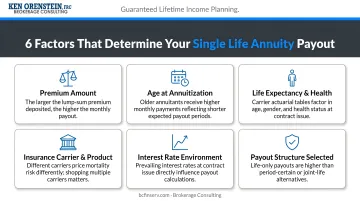
Several factors drive how much income you actually receive:
- Age at annuitization — older annuitants receive higher payments because the insurer expects fewer years of obligation
- Gender — women typically receive slightly lower payments due to longer average life expectancy (the SSA's 2022 life table shows a 2.64-year gap at age 65: 20.12 years for females vs. 17.48 years for males)
- Premium size — larger lump sums produce proportionally larger monthly payments
- Current interest rates — higher rates at purchase time translate to better payouts
- Optional riders — adding features like inflation adjustments or a period-certain guarantee reduces the base payout
When you die, payments stop. Any remaining value reverts to the insurer, with nothing passing to a spouse or heirs unless you've purchased a specific rider.
Key Benefits of a Single Life Annuity
Unlike most financial products, a single life annuity's advantages don't depend on market conditions or investment skill. They're structural — built directly into the contract.
Guaranteed Lifetime Income — Eliminating Longevity Risk
No matter how long you live — 10, 20, or 30+ years into retirement — payments never stop. This directly eliminates longevity risk, the danger of outliving your savings.
That risk is more common than people expect. BlackRock's 2024 Read on Retirement survey found 60% of respondents worried about outliving their retirement savings — a level that had remained consistent for three consecutive years. Meanwhile, only 15% of private industry workers had access to a defined benefit pension plan as of March 2024 — meaning most retirees have no guaranteed income floor beyond Social Security.
A single life annuity fills that gap directly. Once it's set up, there are no investment decisions to make, no market to monitor, and no withdrawal strategy to stress over.
This benefit matters most for:
- Retirees in good health with a family history of longevity
- Those retiring early who need to fund 25-30+ years of income
- Anyone without a pension who needs a guaranteed income floor
Higher Monthly Payouts Than Other Annuity Structures
Because a single life annuity covers only one person's lifetime, the insurer's expected payout period is shorter than a joint annuity or a period-certain option. That shorter obligation translates directly into higher monthly payments for the same premium.
Based on Annuity.org's April 2026 rate estimates, a 65-year-old male purchasing a $200,000 SPIA would receive approximately $1,250/month with a single life payout versus $1,072/month with a joint life structure — a difference of roughly $178/month or $2,136 annually.
For a retiree with no spouse to protect, that's real income being sacrificed for coverage that was never needed.
This benefit matters most for:
- Single individuals with no surviving dependents
- Married retirees whose spouse has sufficient independent income (their own pension, Social Security, or investment accounts)
Simplicity and Strategic Planning Flexibility
Once set up, a single life annuity requires zero ongoing management. No rebalancing. No allocation decisions. No withdrawal sequencing. Payments arrive automatically, every month, for life.
There's also a lesser-known strategy worth knowing: some married retirees intentionally choose a single life annuity — with the higher-earning spouse as the annuitant — and pair it with a permanent life insurance policy. While the annuitant lives, they receive the higher single-life payments. At death, the annuity stops, but the life insurance death benefit provides for the surviving spouse, who can then use those funds to purchase a new annuity or invest them for income. This approach, often called pension maximization, can deliver meaningfully higher lifetime income while still protecting the surviving partner.
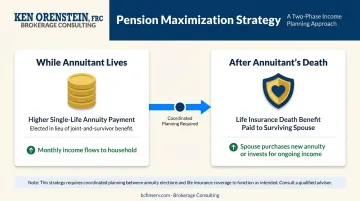
Pension maximization requires careful coordination across annuity structure, life insurance underwriting, and timing — which is why the team at Brokerage Consulting walks clients through the full analysis before any irrevocable decisions are made.
Risks and Drawbacks You Need to Know
A single life annuity is not a universally superior choice. Three risks deserve honest examination before you sign.
No death benefit or legacy value. When you die, all remaining value reverts to the insurer. If you pass away two years after payments begin, the total received could be a fraction of the premium paid. This is the most significant risk — and the primary reason this structure is unsuitable for retirees with financially dependent survivors.
Inflation erosion for fixed-payment contracts. A fixed single life annuity pays the same dollar amount every month for life. That sounds reliable — but inflation steadily erodes what those dollars actually buy. At a 3% annual inflation rate, a fixed $1,000/month payment has the purchasing power of only about $554/month after 20 years — a real loss of nearly 45%.
Variable and inflation-adjusted options exist to address this, but they come with trade-offs: lower starting payments, market exposure, or both. Brokerage Consulting offers COLA riders and inflation-adjusted SPIAs — with annual increases of 1%, 2%, 3%, or CPI-linked — for clients who prioritize purchasing power over initial cash flow.
No exit once annuitization begins. Once annuitization begins, you generally cannot cash out, make additional withdrawals, or change your payout structure. Per the NAIC's buyer guide, once guaranteed income payments begin, the contract owner cannot take additional money from the annuity and usually cannot alter the payment amount. This makes the initial decision permanent — and it's why evaluating your full retirement picture before annuitizing is not optional.
Single Life Annuity vs. Other Payout Options
| Payout Option | Monthly Income | Survivor Benefit | Best For |
|---|---|---|---|
| Single Life | Highest | None | Single retirees; no dependents |
| Joint & Survivor | Lower | Yes (50–100%) | Married couples with income-dependent spouse |
| Period-Certain | Varies | Yes (for guaranteed term) | Retirees with health concerns |
| Life with Period-Certain | Moderate | Yes (if early death) | Balanced protection + lifetime income |
A joint and survivor annuity continues payments to a surviving spouse at 50%, 75%, or 100% of the original amount after the annuitant dies. You accept lower monthly income from day one in exchange for that spousal protection. Brokerage Consulting evaluates survivor percentage options (50%, 66.67%, 75%, or 100%) and their monthly payment impact as a core part of the annuity suitability review.
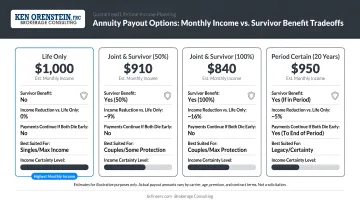
A period-certain annuity guarantees payments for a set number of years — typically 10 or 20 — regardless of whether the annuitant survives that period. If the annuitant dies within the term, remaining payments go to a beneficiary. Outliving the term means payments stop; there's no lifetime protection beyond it.
The life with period-certain option combines lifetime income with a minimum guaranteed payout window. If you die within the first 10 years (for example), your beneficiary receives the remaining payments — but if you live past that threshold, payments continue for life. Monthly income runs slightly lower than a pure single life payout, but the floor protection against early death makes it one of the more widely chosen alternatives.
The right choice depends on marital status, dependent situations, other income sources, and your personal risk tolerance around longevity versus legacy. Working through these trade-offs with a qualified advisor — before locking in a payout structure — is one of the most consequential steps in the retirement income process.
Who Should (and Shouldn't) Choose a Single Life Annuity
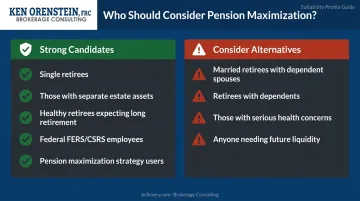
Strong Candidates
- Single individuals with no spouse or financially dependent heirs
- Retirees with separate assets (investments, home equity, life insurance) already designated for their estate
- Those in good health who anticipate a long retirement and want to maximize monthly income
- Federal employees with FERS or CSRS pension coverage who want to supplement guaranteed income without paying for joint coverage they don't need
- Married retirees pursuing a pension maximization strategy paired with life insurance
Who Should Consider Alternatives
- Married retirees whose spouse has limited independent income and would face financial hardship if annuity payments stopped
- Retirees with dependents who rely on their financial support
- Those with serious health concerns that may shorten life expectancy — a period-certain option may return more total value
- Anyone who may need liquidity for future large expenses such as healthcare or long-term care
This decision doesn't happen in isolation. Social Security timing, tax strategy, and legacy goals all interact with the payout structure choice. For federal employees in particular, the single life vs. survivor benefit election in FERS or CSRS pensions carries the same irrevocable weight and deserves the same level of analysis.
Ken Orenstein's practice at Brokerage Consulting offers no-cost initial consultations (phone, virtual, or in-person) to walk through this full picture before any permanent commitment is made. Reach the team at (888) 315-3608 or at bcfinserv.com/request-a-quote.
Frequently Asked Questions
How much will a $100,000 single life annuity pay per month?
For a 65-year-old, estimates based on April–May 2026 market rates range from approximately $590–$625/month for females and $625–$651/month for males, depending on the insurer and state. Actual quotes vary — these figures are illustrative starting points, not guarantees.
How much will a $300,000 single life annuity pay per month?
A $300,000 premium scales proportionally. Based on April 2026 estimates, a 65-year-old male could expect approximately $1,875/month and a female approximately $1,770/month.
How long does a single life annuity last?
For the annuitant's entire lifetime — payments continue until death. There is no account balance to deplete. Payments stop at the annuitant's death with no continuation to beneficiaries unless a rider was added.
What is a single life annuity with a 10-year guarantee?
This hybrid option (also called "life with 10-year certain") provides lifetime income, but if the annuitant dies within the first 10 years, the remaining guaranteed payments pass to a named beneficiary. Payments are slightly lower than a pure single life annuity because of this added protection feature.
Can you cash out a single life annuity?
Generally, no. Once annuitization begins, the contract is irrevocable — no lump-sum withdrawals are permitted. Some deferred contracts allow withdrawals before annuitization, but early withdrawals may trigger surrender charges and a 10% federal tax penalty before age 59½ (IRS Publication 575).
Does income from a single life annuity affect SSDI?
Annuity income does not affect SSDI (Social Security Disability Insurance), which is based on work history rather than current income or assets. It can, however, affect SSI (Supplemental Security Income) eligibility and benefit amounts, since SSA classifies annuity payments as unearned income under POMS SI 00830.160.