
But the choice between them matters far beyond charitable intent. It affects your tax situation, how much income you receive and when, what happens to your estate, and how much administrative complexity you're willing to take on. Getting this decision right requires understanding how these two vehicles actually work — and where they diverge.
Key Takeaways
- A CGA is a simple contract between you and one charity, offering fixed lifetime payments in exchange for your gift; minimums start as low as $5,000 and no trust is needed.
- A CRT is a formal legal trust that pays income to named beneficiaries, then transfers what remains to charity; more complex to establish, but far more flexible in structure.
- CGAs are accessible starting at $5,000–$10,000; CRTs make financial sense only at $100,000 or more.
- Choose a CGA for simplicity and guaranteed fixed income; choose a CRT for large appreciated assets, multiple beneficiaries, or investment control.
- Both provide partial charitable deductions and capital gains advantages, but CRTs spread gains over time while CGAs use an exclusion ratio to reduce taxable income.
CGA vs. CRT: Quick Comparison
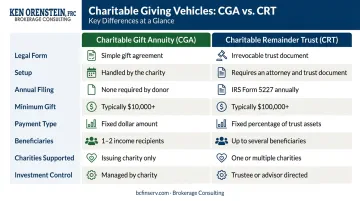
| Factor | Charitable Gift Annuity (CGA) | Charitable Remainder Trust (CRT) |
|---|---|---|
| Legal Form | Contract between donor and charity | Irrevocable legal trust |
| Setup | No attorney or trust document required | Requires trust agreement, attorney drafting |
| Annual Filing | Charity handles; no separate donor trust filing | Trust files IRS Form 5227 annually |
| Minimum Gift | ~$5,000–$10,000 | ~$100,000+ (practical threshold) |
| Payment Type | Fixed for life | Fixed (CRAT) or variable annually (CRUT) |
| Beneficiaries | One or two annuitants | Multiple income beneficiaries allowed |
| Charities Supported | One (the issuing charity) | Multiple organizations |
| Investment Control | None — charity manages assets | Donor can serve as trustee |
Setup and Administration
A CGA requires no trust document, no attorney, and no separate tax filings from the donor. The issuing charity handles everything and sends you IRS Form 1099-R each year for tax reporting.
A CRT demands significantly more setup. The trust needs a formal governing instrument (typically attorney-drafted), its own Employer Identification Number, and must file IRS Form 5227 — the annual split-interest trust information return — every year. That's why CRTs only become cost-effective at larger funding amounts.
What Is a Charitable Gift Annuity?
A CGA is a contractual agreement (not a trust) between a donor and a nonprofit. You transfer assets (cash, securities, or in some cases other property), and in return the charity pays you a fixed dollar amount for the rest of your life. When you die, whatever remains goes to the charity.
How Payments Are Calculated
Payment rates are set at the time of the gift based on your age, using rates published by the American Council on Gift Annuities (ACGA). The ACGA's current suggested single-life immediate rates (effective January 1, 2024) illustrate how age drives the payout:
- Age 65: 5.7% rate
- Age 80: 8.1% rate
Older donors receive higher rates because their expected payment period is shorter. The ACGA targets a charity residuum of roughly 50% of the original contribution, with a minimum 10% charitable remainder required for deductibility purposes. About 97% of charitable organizations follow ACGA's rate schedule.
Tax Benefits
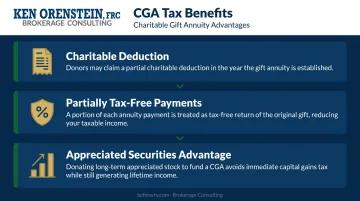
- Charitable deduction: Donors who itemize may claim a partial deduction in the year of the gift.
- Partially tax-free payments: Using IRS annuity rules (see IRS Publication 939), a portion of each payment is excluded from income during the donor's life expectancy.
- Appreciated securities: Contributing appreciated stock or other property can reduce capital gains exposure . Gains are typically spread over the donor's life expectancy rather than recognized all at once. This is not full elimination of the gain, but it is a real tax advantage worth factoring into the gift decision.
The Deferred CGA Option
Donors don't have to start receiving payments immediately. A deferred CGA lets you make a gift now and begin payments at a future date such as retirement. Deferring typically results in a higher payout rate and a larger charitable deduction, which makes this option particularly useful for donors still in their working years who want to lock in a charitable commitment today and receive income later.
Best Fit for a CGA
- Gifts under $100,000 where simplicity matters
- Retirees and seniors who prioritize predictable, guaranteed income over growth potential
- Donors committed to a single charity and comfortable with the direct contractual relationship
One key limitation: CGA payments are backed by the issuing charity's general assets , not a separate trust. If the charity faces financial difficulty, payments could be at risk. Donors should evaluate the financial health of any charity before establishing a CGA.
That predictability and simplicity are what define the CGA — and what most sharply distinguish it from the charitable remainder trust structure covered next.
What Is a Charitable Remainder Trust?
A CRT is an irrevocable trust that receives your contribution, distributes income to named beneficiaries for either a fixed term (up to 20 years) or the beneficiaries' lifetimes, and then transfers the remaining assets to one or more designated charities. The charitable remainder must equal at least 10% of the initial net fair market value of assets placed in the trust.
CRAT vs. CRUT: Two Distinct Structures
There are two main types, and the difference matters:
- Charitable Remainder Annuity Trust (CRAT): Pays a fixed dollar amount each year — typically 5% to 50% of the initial trust value. Payments don't change regardless of investment performance.
- Charitable Remainder Unitrust (CRUT): Pays a fixed percentage of the trust's value, recalculated annually. If investments perform well, payments grow. If they decline, payments shrink.
The CRUT's variable structure is useful for donors worried about inflation eroding fixed payments over a long retirement. The trade-off is income uncertainty in down markets.
Tax Advantages
The CRT offers three distinct tax advantages worth understanding:
- You receive a partial charitable deduction based on the present value of the projected charitable remainder.
- Under IRC Section 664, a CRT generally pays no income tax at the trust level. Appreciated assets sold inside the trust don't trigger immediate capital gains.
- Gains are distributed to beneficiaries over time and taxed as received, following a four-tier ordering rule: ordinary income first, then capital gains, then other income, then corpus. For donors holding low-basis assets, this spread-out taxation can be a meaningful advantage.
Structural Flexibility
Those tax benefits are only part of the picture. CRTs also offer considerable design flexibility:
- Name yourself, a spouse, children, or other individuals as income beneficiaries
- Split the charitable remainder among multiple organizations
- Keep investment control by serving as your own trustee
- Use a flip CRUT structure — a CRUT that starts under an income exception and converts to standard percentage payouts after a triggering event (such as the sale of an illiquid asset)
Setup carries real costs. Expect to budget for:
- Attorney fees to draft the trust document
- Ongoing investment management
- Annual Form 5227 tax preparation
- Beneficiary income tax reporting
These expenses make a CRT practical only when the funding amount justifies them. That's why $100,000 is commonly cited as the minimum useful threshold, though there's no statutory floor.
Best Fit for a CRT
- Donors with large appreciated assets — concentrated stock positions, real estate, or business interests
- Those who want to diversify without triggering an immediate capital gains bill
- Situations involving multiple income beneficiaries or multiple charitable beneficiaries
- High-net-worth individuals with estate planning goals alongside charitable intent
CGA vs. CRT: Which Is the Better Fit?
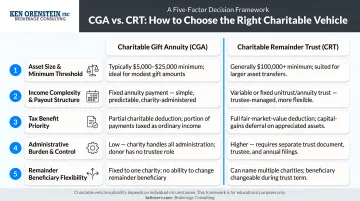
The right vehicle depends on five factors:
- Gift amount — Under $100,000 points to a CGA; over $100,000 makes a CRT viable
- Income preference — Fixed and certain favors a CGA; inflation-sensitive or growth-linked favors a CRUT
- Number of beneficiaries — One or two people fits a CGA; multiple people requires a CRT
- Charitable goals — Giving to one organization fits a CGA; splitting among several requires a CRT
- Appetite for complexity — Minimal overhead favors a CGA; investment control and flexibility justify a CRT
A Practical Scenario
Consider two donors with different circumstances:
Donor A is in their early 60s and holds $200,000 in appreciated stock in a single company. Their primary concerns are avoiding a large capital gains bill, diversifying, and generating income once they retire in five years. A flip CRUT could allow the trust to sell the stock without immediate tax impact, reinvest in a diversified portfolio, and then convert to regular income distributions at retirement, while also providing a current partial charitable deduction.
Donor B is 74 years old with $25,000 in cash they'd like to direct toward a university they've supported for years. They want predictable supplemental income without legal complexity. A CGA — possibly deferred by a year or two to boost the payout rate — is the better fit.
These Tools Aren't Mutually Exclusive
Some donors use both over time — a CGA for a modest annual gift to a favorite charity, and a CRT as part of broader estate planning around a larger appreciated asset. Modeling the income, deduction, and tax impact of each option before committing is worth the time. Ken Orenstein and the team at Brokerage Consulting can help map these vehicles against your broader retirement income and tax picture during a no-cost consultation.
Conclusion
Neither a CGA nor a CRT is universally better. A CGA suits donors who want simplicity, a lower entry point, and predictable income — certainty over complexity. A CRT makes more sense when the goal is maximizing a large appreciated asset, serving multiple beneficiaries, or building in real tax-planning depth. The right choice depends on what you're trying to accomplish, not which structure sounds more sophisticated.
Run the numbers with an advisor who understands both vehicles before committing to either. Contact Brokerage Consulting at (888) 315-3608 or visit bcfinserv.com to schedule a no-cost initial consultation — by phone, virtually, or in person at the Flemington, NJ office — and explore how charitable giving strategies can fit your retirement and estate plan.
Frequently Asked Questions
Is a charitable gift annuity the same as a charitable remainder trust?
No. A CGA is a straightforward contract between a donor and a single charity — no trust, no trustee, no annual trust filing. A CRT is a formal irrevocable trust that can pay income to multiple beneficiaries, split the charitable remainder among several organizations, and requires ongoing legal administration including annual IRS filings.
What are the tax benefits of a charitable gift annuity?
Donors who itemize may claim a partial charitable deduction in the year of the gift. A portion of each annual payment is also excluded from income based on IRS life expectancy calculations. Funding a CGA with appreciated securities spreads capital gains recognition over the donor's lifetime rather than triggering it all at once.
How much money do you need to set up a charitable remainder trust?
There's no federal minimum, but most practitioners consider $100,000 the practical floor. The ongoing costs — trust drafting, Form 5227 filings, investment administration, and beneficiary tax reporting — make smaller amounts difficult to justify. A CGA is typically the better fit below that threshold.
Can a charitable remainder trust benefit multiple charities?
Yes. A CRT can name multiple charitable organizations as remainder beneficiaries and specify how the remainder is split among them. This is one of its key advantages over a CGA, which can only benefit the single charity that issued the annuity contract.
What happens to a charitable gift annuity if the charity becomes insolvent?
CGA payments are backed by all unencumbered assets of the issuing charity — not a separate protected trust. If the charity faces insolvency, payments could be at risk. Many states require charities to maintain reserve funds and submit annual actuarial reports, so reviewing a charity's financial health before committing is worth the effort.
Can I set up a charitable gift annuity and defer payments until retirement?
Yes. A deferred CGA lets you make a contribution now and begin receiving payments at a future date you choose. Deferring typically results in a higher payout rate and a larger charitable deduction, making it a useful option for donors who want to give now but aren't ready to receive income yet.