
The distinction matters more than most people realize. Variable life insurance exists to protect your family after you're gone. A variable annuity exists to protect you from outliving your money. Picking the wrong product for the wrong goal can leave your beneficiaries underprotected, drain your retirement income, or saddle you with fees that eat returns for 10+ years.
This article breaks down exactly how each product works, where they differ on taxes, fees, and payout structure, and how to determine which one — or possibly both — belongs in your financial plan.
Key Takeaways
- Variable life insurance is permanent life coverage with market-linked cash value — its primary job is paying a death benefit to your heirs.
- Variable annuities are retirement income contracts designed to pay you a lifetime income — not pass wealth to heirs.
- Both use tax-deferred investment subaccounts, but their payout structures run in opposite directions.
- Both are regulated as securities products requiring a prospectus — neither is FDIC-insured.
- If protecting your family drives your decision, lean toward variable life; if funding your own retirement does, variable annuities deserve a closer look.
Variable Life Insurance vs. Variable Annuities: Quick Comparison
| Feature | Variable Life Insurance | Variable Annuity |
|---|---|---|
| Primary Purpose | Death benefit for beneficiaries | Retirement income for the policyholder |
| Who Benefits | Heirs and dependents | The policyholder/annuitant |
| Tax Treatment | Cash value grows tax-deferred; death benefit generally income-tax-free to beneficiaries | Tax-deferred growth; withdrawals taxed as ordinary income on the gain |
| Investment Component | Subaccounts tied to market performance; cash value fluctuates | Subaccounts tied to market performance; account value fluctuates |
| Surrender Charges | Often 10–15 years (product-specific) | Typically 6–8 years per SEC guidance |
| 10% Early Withdrawal Penalty | Generally not applicable | Applies before age 59½ |
| FDIC Insured | No | No |
What Is Variable Life Insurance?
Variable life insurance is a form of permanent life insurance that pairs a guaranteed minimum death benefit with a cash value component invested in market subaccounts — similar in structure to mutual funds. The core obligation of the contract is to pay a death benefit to named beneficiaries when the policyholder dies.
How Premiums Work
Each premium payment gets split two ways: a portion covers the cost of insurance (mortality charges, administrative fees), and the remainder flows into the policyholder's chosen subaccounts. Investment performance then directly affects cash value and, in most policies, the death benefit above the guaranteed minimum floor.
Fee layers in a variable life policy typically include:
- Mortality and expense (M&E) risk charges — one SEC-filed VUL prospectus showed M&E at 0.90% annually in early policy years
- Cost of insurance (COI) — varies by age, underwriting class, and policy year; no standard percentage applies universally
- Administrative fees — often a flat monthly policy fee
- Premium charges — one filed prospectus showed charges of 7.5% on premiums up to a target amount
- Underlying subaccount expenses — added on top of the above
- Surrender charges — one SEC-filed VUL example applied surrender charges for the first 14 policy years
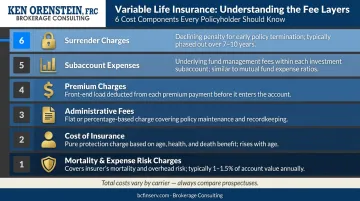
Total annual costs can be substantial — always compare prospectuses across multiple carriers before purchasing.
Tax Advantages
Variable life insurance provides three tax benefits:
- Cash value grows tax-deferred inside the policy
- Policy loans are generally not treated as taxable income
- Under IRC §101(a)(1), death benefits paid to beneficiaries by reason of death are generally excluded from gross income — meaning heirs typically receive the full benefit with no federal income tax due
Who Is Variable Life Insurance Best For?
The ideal candidate has long-term dependents (young children, a non-working spouse, or a business partner), wants investment exposure alongside their coverage, and has already maximized other tax-advantaged accounts.
Federal employees warrant a distinct look here. FERS provides a pension, Social Security, and TSP access — so baseline retirement income is often reasonably covered. That shifts the planning priority toward legacy protection and death benefit design rather than accumulation. A federal retirement specialist can evaluate whether a permanent life product belongs within a broader federal benefits strategy, rather than treating it as a standalone product decision.
What Is a Variable Annuity?
A variable annuity is a contract between you and an insurance company designed to accumulate retirement savings, then convert those savings into an income stream — for a defined period or for life. Unlike variable life insurance, the person who benefits from the payouts is the policyholder themselves, not a named heir.
How Variable Annuities Work
You contribute a lump sum or periodic payments, which are allocated to investment subaccounts. Account value rises and falls with market performance. At annuitization — or upon withdrawal — the insurer pays out income that includes both return of principal and accumulated gains.
Key tax rules to understand:
- Contributions use after-tax dollars (unlike a 401(k))
- Growth is tax-deferred
- Withdrawals are taxed as ordinary income on the gain — not at lower capital gains rates
- A 10% additional tax applies to taxable distributions before age 59½ per IRS Publication 575
- Qualified annuities held within retirement plans may be subject to required minimum distributions (RMDs)
Common Add-On Features
Variable annuities frequently come with optional riders — at additional cost:
- GMIB (Guaranteed Minimum Income Benefit) — guarantees a minimum income base even if the account value drops
- GMWB/GLWB (Guaranteed Minimum/Lifetime Withdrawal Benefit) — allows withdrawals up to a specified percentage annually regardless of market performance
- Death benefit provisions — pass remaining value to a named beneficiary if the annuitant dies before annuitizing
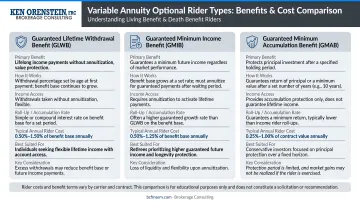
A lifetime guaranteed withdrawal benefit rider averages roughly 1.13% annually, and death benefit riders average approximately 0.35% — and these stack on top of M&E charges, administrative fees, and subaccount expenses.
Who Are Variable Annuities Best For?
The strongest candidates share a few common traits:
- In their 50s or 60s and concerned about outliving their assets
- Have already maxed out 401(k) and IRA contributions
- Want additional tax-deferred growth paired with an income guarantee option
Variable annuities are not short-term savings vehicles. The SEC notes surrender periods typically run 6–8 years, with charges starting around 7% in year one and declining annually. Early withdrawals can trigger both surrender charges and tax penalties at the same time, compounding the cost significantly.
At Brokerage Consulting, variable annuities are positioned as a secondary offering, suited for clients who have already secured a guaranteed income base through Social Security, a pension, or fixed annuities. All-in costs — including M&E charges, administrative fees, subaccount expenses, and rider fees — can exceed 3% annually, which is why fee analysis is central to any suitability review.
Key Differences That Actually Matter
Death Benefit vs. Income Stream
The core distinction comes down to timing and direction of the money. Variable life insurance is designed to pay your beneficiaries after you die — it's a wealth transfer tool. A variable annuity is designed to pay you during retirement. A policyholder who buys a variable annuity hoping to leave a large legacy may discover the payout structure simply wasn't designed for that goal — especially if the annuitant annuitizes and income payments stop at death.
Tax Treatment at Payout
The tax difference at distribution is significant. Consider a $200,000 payout from each product:
- Variable life insurance death benefit: Under IRC §101(a), this amount is generally received income-tax-free by beneficiaries. Your heirs keep the full $200,000.
- Variable annuity withdrawal: Under IRC §72, gains are taxed as ordinary income. If $80,000 of the $200,000 represents accumulated earnings, that $80,000 is taxable. At a 22% federal rate, that's $17,600 owed — reducing the net payout to roughly $182,400.
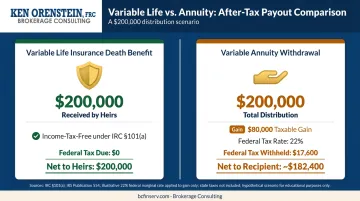
That $17,600 difference on a single $200,000 withdrawal grows considerably across a multi-decade retirement or a large estate — which makes funding structure the next critical variable to evaluate.
Premium and Contribution Flexibility
Variable life insurance requires ongoing premium payments to keep the policy in force — letting the policy lapse eliminates coverage. Variable annuities, by contrast, can often be funded with a single lump sum and carry no ongoing premium obligation to maintain the contract. This makes annuities more practical for someone deploying a pension buyout, a 401(k) rollover, or an inheritance.
Regulatory Classification
Both products are regulated as securities, but the rules differ in key ways:
- Both require a prospectus and sellers must hold securities registrations alongside state insurance licensure
- The NAIC lists each as a separate line of insurance authority
- FINRA Rule 2330 governs suitability requirements specifically for deferred variable annuity recommendations
- Neither product is FDIC-insured — guarantees depend entirely on the financial strength of the issuing insurance company
Which One Is Right for You?
Choose variable life insurance if:
- Your primary concern is protecting dependents financially after your death
- You want permanent life coverage combined with investment upside
- You can sustain ongoing premium payments over the long term
- You've already maximized other tax-advantaged accounts
Choose a variable annuity if:
- Your primary concern is not outliving your retirement assets
- You have a lump sum to deploy (rollover, buyout, inheritance)
- You want guaranteed income options with tax-deferred growth
- You have a long time horizon and a higher risk tolerance
Can You Hold Both?
For high-income earners with dependents and long retirement horizons, yes — one product handles income protection, the other handles income generation. But the combined surrender periods and fee layers require careful analysis before committing to both.
For federal employees specifically, FERS pension income plus Social Security already creates a baseline income foundation. That income floor shifts the priorities: a variable annuity may be partially redundant, while variable life insurance warrants more attention for legacy and estate planning.
The 2024 TSP Annual Report puts the average participant balance at $194,131 — a meaningful asset, but not necessarily sufficient as a standalone retirement income plan for everyone.
Before committing to either product, take stock of what you already have:
- Existing retirement accounts (TSP, IRA, 401(k))
- Social Security income estimates
- Pension income (FERS, CSRS, or private-sector)
- Estate planning objectives and legacy goals
Ken Orenstein at Brokerage Consulting offers no-cost consultations — by phone, virtually, or in person — to assess how variable products fit within your broader retirement plan.
Frequently Asked Questions
Which is better, a variable annuity or variable life insurance?
Neither is universally better. Variable life insurance fits those focused on leaving a death benefit for dependents; a variable annuity fits those focused on generating retirement income for themselves. The right choice depends on your primary goal, timeline, and risk tolerance.
Can you hold both a variable life insurance policy and a variable annuity?
Yes, and for some clients the combination makes sense : one provides a death benefit for heirs, the other generates income for the policyholder. Combined fees and long surrender periods mean this approach requires careful planning with a qualified advisor before committing.
Are variable life insurance and variable annuities regulated the same way?
Both are regulated as securities products, requiring a prospectus and sold by licensed securities representatives. Variable life insurance is additionally regulated under state insurance laws. Neither product is FDIC-insured, and both carry investment risk.
What are the tax differences between variable life insurance and variable annuities?
Both offer tax-deferred growth, but the key difference is at payout: variable life insurance death benefits are generally received income-tax-free by beneficiaries under IRC §101(a), while variable annuity withdrawals are taxed as ordinary income on the gain portion under IRC §72, which can significantly reduce what beneficiaries or the policyholder actually receive.
What fees should I watch out for with variable products?
Key cost layers include mortality and expense (M&E) charges, cost of insurance fees, administrative fees, surrender charges, and subaccount expenses. Living benefit riders add 1%+ annually on top, pushing total variable annuity costs above 3% in many cases. Always compare prospectuses before purchasing.
Is a variable annuity a good option for federal employees?
Federal employees with a FERS pension and TSP already have a baseline income stream, so a variable annuity can be redundant for income purposes — though it may still provide supplemental tax-deferred growth for those with higher risk tolerance. Variable life insurance is often more relevant for legacy planning. A federal retirement specialist can help clarify which fits your situation.