Introduction
Most FIA policyholders focus entirely on index-linked crediting strategies — and in doing so, overlook one of the most predictable options in their contract: the daily interest account. Depending on the carrier, you may see it labeled as a declared rate strategy, fixed account, or declared rate account.
This option doesn't chase index performance. It earns a fixed rate declared by the insurer at the start of each term, with interest accruing daily throughout that period — not in a lump sum at year-end like indexed strategies.
For retirees and near-retirees who want a floor of certainty within their FIA, knowing how this account works — and when to use it — can directly affect how much stable income they're building each day.
Key Takeaways
- Fixed rate declared by the insurer at the start of each term, with interest accruing daily rather than waiting until year-end
- No cap, participation rate, or spread applies, eliminating the risk of a 0% credit year
- Declared rate can change at each renewal term, introducing rate risk over time
- Most FIA contracts let you split funds between the daily interest account and indexed strategies
- Ideal for savers who want stable, predictable accumulation independent of market performance
What the Daily Interest Account Represents in an Indexed Annuity
As the NAIC's buyer guide for fixed deferred annuities notes, many FIAs allow a portion of funds to be placed in a fixed interest rate account — one that earns a set rate that will not change for a defined period, while index interest is determined separately by formulas tied to index performance.
That fixed-rate option is the daily interest account. MassMutual Ascend describes it clearly: a declared-rate strategy earns a fixed rate set at the beginning of the term, with interest credited daily — while indexed strategies credit interest at the end of each annual term.
Carriers use different labels for this same feature:
| Carrier | Label Used |
|---|---|
| Allianz | Fixed interest allocation |
| Athene | Fixed rate |
| American Equity | Fixed Strategy |
| North American | Fixed account rate |
| Midland National | Fixed account rate |
Regardless of the label, the mechanics are the same. The insurer declares a rate upfront for the term. That rate is contractual — not retroactively calculated from index performance. And because it's not linked to any market index, it carries none of the caps, participation rates, or spreads that shape indexed strategy credits.
Factors That Influence the Declared Rate
The declared rate doesn't come from index performance. According to the American Academy of Actuaries, FIA insurers invest most premiums into fixed assets within their general account — primarily bonds, loans, and structured assets. The returns generated by that portfolio drive what the insurer can afford to offer as a declared rate.
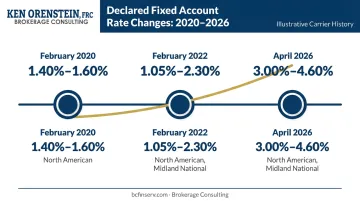
Because declared rates track the insurer's general account yield, they move with the broader interest rate environment. North American's rate sheets show this pattern clearly:
- February 2020: Fixed account rates on NAC VersaChoice 10 were 1.40%–1.60%
- February 2022: Selected fixed account rates ranged from 1.05%–2.30%
- April 2026: Fixed account rates reached as high as 3.90% on NAC Control X, with several products in the 3.00%–3.60% range
Midland National's May 2026 rate sheet reflects the same trend — fixed account rates ranging from 3.10% on MNL IndexBuilder to 4.60% on MNL RetireVantage 14. Both examples are product-specific, but the pattern is consistent: when interest rates rise, declared rates follow.
How the Daily Interest Account Earns and Credits Interest
Daily Accrual vs. Annual Crediting
The core mechanical difference between the daily interest account and indexed strategies comes down to when interest shows up in your account.
With indexed strategies, the insurer measures index performance from the start to end of a crediting term — typically one year. The insurer calculates and credits interest only at term-end. If you exit early, the NAIC notes the insurer may not credit all index-linked interest for that period. You've been in the contract, but you may have earned nothing yet for that year.
The daily interest account works differently. Interest accrues gradually throughout the term, not in a single year-end deposit. Allianz describes this as interest credited daily at a rate established at the beginning of each crediting period. North American and Midland National both confirm this in their rate sheets, describing the declared fixed rate as an annual effective rate credited daily.
That distinction matters most when a policyholder needs to take a distribution mid-term. The daily interest account has already been accumulating credit; an indexed strategy may have earned nothing yet for that term.
The Compounding Benefit
Because interest credits daily rather than annually, the account benefits from more frequent compounding. The practical difference on a modest declared rate isn't dramatic over a single year, but it builds meaningfully over time.
To illustrate with generic math (not a verified FIA contract formula):
- Annual crediting: A $100,000 balance at 3.00% produces roughly $3,000 in year one
- Daily compounding: The same rate yields an effective annual return of ~3.045%, adding around $45 more per year
- 10-year impact: That gap widens as compounding applies to prior credited interest each year
The compounding advantage is modest in isolation, but it works in your favor consistently — and it does so whether markets are up or down. That stability leads directly to the next feature worth understanding: the guaranteed rate floor.
Minimum Guaranteed Rate
Most FIA contracts include a contractual floor below which the insurer cannot drop the declared rate. This is distinct from the indexed strategy's 0% floor.
Carrier disclosures vary: Allianz rate pages show a minimum annual fixed interest rate of 0.10% on at least one product, while Midland's IndexMax ADV discloses a guaranteed minimum fixed account rate of 0.25% after the second term. FINRA notes that FIA guaranteed minimum interest rates generally range from 1% to 3% on at least 87.5% of premium paid.
Note that the FINRA figure applies to the contract's overall guarantee structure, not exclusively to the fixed account minimum.
The specific floor for any daily interest account is disclosed in the contract. Before allocating to this option, confirm that floor rate and the conditions under which the insurer can adjust it.
Daily Interest Account vs. Indexed Strategies: How to Choose
The Core Trade-Off
The choice comes down to one question: how much year-to-year variance can your retirement income plan absorb? The daily interest account delivers predictable, consistent growth regardless of what the S&P 500 does. Indexed strategies offer the potential for higher credited interest when the linked index performs well — but carry the risk of a 0% credit year when the index is flat or negative.
Here's how crediting plays out across three market scenarios:
| Market Scenario | Daily Interest Account | Indexed Strategy (e.g., annual point-to-point with cap) |
|---|---|---|
| Index up 15% | Earns declared rate (e.g., 3.50%) | May earn 8–10% (subject to cap) |
| Index flat (0%) | Earns declared rate (e.g., 3.50%) | Earns 0% |
| Index down 12% | Earns declared rate (e.g., 3.50%) | Earns 0% (floor protection) |
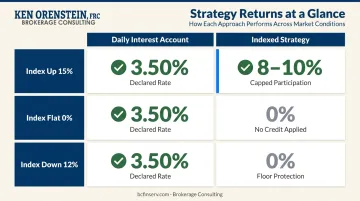
In strong bull markets, indexed strategies can outperform the declared rate. In flat or declining years, the declared rate wins every time — not just when conditions cooperate.
Splitting Your Allocation
Most FIA contracts let policyholders allocate premium across both the daily interest account and one or more indexed strategies. This hybrid approach gives some portion of the contract stable, guaranteed growth while leaving another portion positioned for market-linked upside.
The split isn't permanent, either. MassMutual Ascend allows policyholders to revisit strategy selections at the end of each term and reallocate as needs change. Allianz allows allocation changes online within 21 calendar days following the contract anniversary date.
Who Benefits Most
The daily interest account is a natural fit for:
- Retirees and near-retirees who need consistent growth without year-to-year variance
- Federal employees supplementing FERS pension or TSP income, where stable accumulation complements existing income streams
- Savers whose retirement income plan can't withstand a 0% credit year
- Contract holders in the early years who want certainty before deciding whether to shift toward indexed strategies at renewal
For federal employees evaluating FIAs alongside FERS or TSP income, the daily interest account can serve as a reliable, low-volatility layer within the overall retirement income structure.
Determining the right allocation split depends on your full retirement income picture — how much guaranteed income you already have, how much upside exposure makes sense, and how close you are to drawing down. A consultation with Ken Orenstein at Brokerage Consulting can help map that out at no cost.
Rate Renewal Risk: What Changes When Your Term Ends
The declared rate is not permanent. It's set at the beginning of each term — typically one year — and the insurer resets it at renewal. The NAIC is direct on this point: renewal rates can be higher or lower than the initial rate, subject only to the contract's minimum guaranteed floor.
This introduces what's often called declared rate renewal risk. A policyholder who receives a 4.00% declared rate in year one may receive 2.75% in year two if the interest rate environment has shifted or the insurer adjusts its pricing. Over a long accumulation period, relying entirely on the daily interest account means accepting that variability.
What You Can Do at Renewal
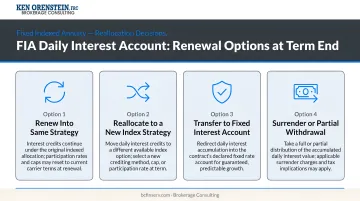
The renewal moment is also an opportunity. Most contracts allow reallocation between the daily interest account and indexed strategies at each term end. When that happens, you have several moves worth considering:
- Shift a portion of your allocation to an indexed strategy if the declared rate drops noticeably
- Maintain your current split if the new rate remains competitive with other fixed options
- Reduce or eliminate the daily interest allocation entirely if an indexed strategy better fits your timeline
- Compare the new declared rate against current MYGA rates before deciding
North American's 2022 rate documentation confirms that FIA rates in subsequent contract years are declared on the contract anniversary, aligned with the contract effective date. That annual reset is the pivot point — treat it as an active decision, not an automatic rollover. Review the new declared rate every year before confirming your allocation.
Common Misunderstandings About Daily Interest Accounts
Three misconceptions about daily interest accounts come up repeatedly. Each one reflects a genuine point of confusion — and getting them wrong can affect how you evaluate an FIA.
Misconception 1: "It's insured like a bank account."
It isn't. Carriers like Allianz, North American, and Midland National all carry the same disclosure: FIA products are not FDIC or NCUA insured, not bank-guaranteed, and not deposits. The guarantees are backed solely by the claims-paying ability of the issuing insurance company.
Misconception 2: "Daily crediting means the rate resets daily."
The declared rate is fixed for the entire contract term — what changes daily is the accrual of interest at that fixed rate. Think of it like a savings account that compounds daily at an annual rate: the compounding frequency is daily, but the rate itself holds steady until the term ends.
Misconception 3: "The daily interest account is the same as the indexed strategy's floor."
These are two separate features serving different purposes:
- The indexed strategy's 0% floor prevents a negative return — but it may credit nothing at all
- The daily interest account's contractual minimum rate guarantees at least a small positive return each term
- The two floors operate independently within the same FIA contract
Confusing them is easy because both sound like "protection" — but one protects against loss while the other guarantees a minimum gain.
Frequently Asked Questions
What is a daily interest account in an index annuity?
It's a fixed-interest crediting option within an FIA where the insurer declares a set rate at the start of each term and credits interest to the account daily. Growth is stable and predictable — it has no connection to any market index.
How is the declared rate in a daily interest account determined?
The insurer sets the rate based on its general account investment portfolio returns and the prevailing interest rate environment. The rate can change at each term renewal, subject to the minimum floor disclosed in the contract.
Can I split my FIA funds between the daily interest account and an indexed strategy?
Yes. Most FIA contracts allow premium to be allocated across both options, and that split can typically be revised at each term renewal when the insurer resets rates and crediting terms.
Does the daily interest account carry the same 0% floor as indexed strategies?
No. The daily interest account has its own contractual minimum declared rate — not simply a 0% floor. It will always earn at least the guaranteed minimum, making it more stable by design than an indexed strategy that can credit 0% in a down year.
How does the daily interest account compare to a traditional fixed annuity?
Both offer a declared fixed rate, but the daily interest account is a crediting option embedded within an FIA contract that also offers indexed strategy options. A traditional fixed annuity (MYGA) locks in one rate for the entire guarantee period without any ability to allocate toward indexed strategies.
What happens to my daily interest account rate at renewal?
At each term end, the declared rate resets — higher or lower than before, but never below the contract's minimum guaranteed floor. You can then adjust your allocation between the daily interest account and indexed strategies accordingly.