
Introduction
For decades, bonds were the default answer for capital preservation in retirement portfolios. Then 2022 happened: the Bloomberg U.S. Aggregate Bond Index dropped roughly 13%, its worst year in modern history. That kind of loss in a supposedly "safe" allocation rattled a lot of pre-retirees — and prompted serious questions about what else belongs in the mix.
Fixed indexed annuities (FIAs) have emerged as one alternative worth understanding. They aren't right for everyone, and they come with real trade-offs. For certain retirement income goals, though, they occupy a distinct space that bonds, CDs, and traditional fixed annuities don't fill the same way:
- Principal protection regardless of market downturns
- Tax-deferred growth tied to an index like the S&P 500
- Optional guaranteed lifetime income riders
This article breaks down how FIAs compare to bonds, CDs, MYGAs, and traditional fixed annuities — so you can evaluate which combination actually fits your retirement income goals.
Key Takeaways
- FIAs credit interest based on index performance (such as the S&P 500) with a 0% floor—no principal loss from market declines
- Caps, participation rates, and spreads limit upside; dividends are excluded entirely
- Research from economist Roger Ibbotson found uncapped FIAs historically outperformed bonds on an annualized basis
- Unlike fixed annuities, FIAs offer more growth potential but no guaranteed minimum return—only protection against loss
- Surrender periods (typically 7–10 years) make FIAs illiquid—unsuitable for near-term cash needs
What Is a Fixed Indexed Annuity?
A FIA is a tax-deferred insurance contract issued by an insurance company—not a direct investment in the stock market. Interest is credited based on the movement of a market index, most commonly the S&P 500, though contracts may also link to the Russell 2000, MSCI EAFE, or proprietary volatility-controlled indexes.
The Core Mechanics
Three parameters determine how much interest a FIA credits in any given period:
- Cap rate — the ceiling on credited interest (e.g., even if the S&P 500 gains 15%, a 6% cap means you earn 6%)
- Participation rate — the percentage of index gains credited to the contract (e.g., 65% participation on a 10% gain = 6.5% credited)
- Spread — a fixed percentage deducted from positive index returns before crediting (e.g., a 2% spread on a 9% gain = 7% credited)
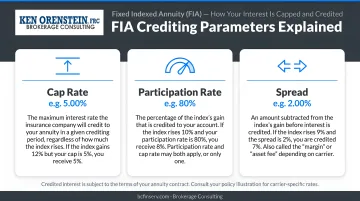
Contracts may use one or a combination of these limits. The crediting method also matters: annual point-to-point, monthly point-to-point, monthly average, and monthly sum each produce different outcomes depending on how markets move through the year.
The 0% floor is the defining feature. If the index falls 20% in a contract year, your credited interest is 0% — your principal is protected from market declines. That said, FIA guarantees are backed by the claims-paying ability of the issuing insurance company, not the FDIC.
Optional Riders
Many FIA contracts offer add-on riders for an additional fee:
- Guaranteed Lifetime Withdrawal Benefit (GLWB) — creates a guaranteed income stream you can't outlive
- Guaranteed Minimum Income Benefit (GMIB) — provides a minimum income floor based on a separate benefit base
- Enhanced death benefit riders — pass accumulated value to beneficiaries under specified terms
These riders turn a FIA from a savings-focused contract into a source of guaranteed retirement income. Comparing income rider growth rates and fee structures across carriers is essential — the differences between contracts can significantly affect your long-term income.
FIAs as an Alternative to Bonds: What the Research Shows
Bonds have traditionally anchored the "safe" portion of retirement portfolios. The logic: predictable coupon income, return of principal at maturity, diversification against equity risk. That logic holds—until interest rates rise sharply.
As the SEC explains in its investor guidance, when interest rates go up, prices of fixed-rate bonds fall. A retiree holding intermediate-term bond funds in 2022 experienced real capital losses at precisely the wrong moment.
What the Ibbotson Research Found
Economist Roger Ibbotson of Zebra Capital Management published a widely cited analysis comparing FIA performance to bonds over a multi-decade period. His finding: uncapped FIAs would have historically outperformed bonds on an annualized basis, driven by equity index participation combined with the 0% downside floor.
In up years, FIAs capture a portion of index gains. In down years, the floor prevents the capital losses that bonds can suffer when rates rise. Over long accumulation periods, that one-sided exposure — gains without market-driven losses — tends to produce a larger ending balance than a bond-heavy approach.

Direct Risk Comparison
| Factor | Bonds | Fixed Indexed Annuities |
|---|---|---|
| Principal risk | Interest rate risk (prices fall when rates rise) | Protected from market declines (0% floor) |
| Inflation exposure | Fixed coupons erode in purchasing power | Indexed growth potential offsets some inflation |
| Upside | Limited to coupon yield | Capped/participatory equity-linked gains |
| Dividends included | Yes (for equity-linked bond funds) | No—FIA tracks price index only |
| Liquidity | Generally higher (especially Treasuries) | Restricted—surrender charge periods apply |
FIA Limitations Relative to Bonds
Before treating FIAs as a bond replacement, consider what they don't do:
- FIA credits are based on a price index, not total return — meaning dividends are excluded entirely. Historically, dividends have accounted for roughly 40% of S&P 500 total returns, and FIA holders miss that portion.
- In strong bull markets, gains are capped or participation-adjusted. You won't capture the full index return.
- Bonds — especially Treasuries — can be sold at any time. FIAs carry multi-year surrender periods that restrict access to your principal.
For investors who can commit to a multi-year holding period, FIAs work best as a partial replacement for the bond sleeve — not a full swap. The protection against downside is real; so are the constraints on liquidity and upside capture. Knowing which trade-off matters more to you is the right starting point for the conversation.
FIA vs. Traditional Fixed Annuity: Key Differences
A traditional fixed annuity—including Multi-Year Guaranteed Annuities (MYGAs)—locks in a predetermined interest rate for the full contract term. Whatever the market does, you earn that rate. Period.
How the Two Products Compare
| Fixed Annuity (MYGA) | Fixed Indexed Annuity | |
|---|---|---|
| Interest crediting | Guaranteed rate, every year | Index-linked; can be 0% in down years |
| Principal protection | Yes | Yes |
| Guaranteed minimum above 0% | Yes | No (floor is 0%) |
| Growth ceiling | Rate set at contract issue | Cap or participation limit |
| Tax treatment | Tax-deferred | Tax-deferred |
| FDIC insured | No | No |

When Each Product Wins
The right choice usually comes down to time horizon and how much certainty you need from your retirement income.
Fixed annuity wins when:
- Markets underperform—you still earn your guaranteed minimum rate
- You need certainty in planning (e.g., a specific income need in 3–5 years)
- You want simplicity without cap/participation complexity
FIA wins when:
- Markets perform well—you capture a portion of index gains that exceed fixed rates
- You have a longer time horizon and can absorb the 0% years
- You want optional income riders that grow based on a benefit base
Both products share key characteristics: tax-deferred growth, surrender charge periods (early withdrawals may trigger penalties plus a 10% IRS tax penalty before age 59½), and no FDIC insurance. Guarantees rest entirely on the issuer's financial strength — so before committing to either product, verify the carrier's ratings across A.M. Best, S&P, Moody's, and Fitch.
FIA vs. Other Retirement Income Alternatives
Dividend-Paying Stocks
Dividend stocks offer income plus appreciation, including full market participation and dividends that FIAs exclude. The cost: no floor. A 30% market decline hits your principal directly. Qualified dividends receive favorable capital gains tax treatment; the IRS taxes FIA withdrawals as ordinary income. For investors comfortable with volatility and a long time horizon, dividend stocks can outperform FIAs by a wide margin. For those who need principal protection, they don't serve the same function.
Bonds and CDs
Government bonds and CDs provide predictable income. CDs carry FDIC insurance up to applicable limits; Treasuries are backed by the U.S. government. Both cap growth tightly and carry meaningful inflation risk over a 20–30 year retirement.
A 4% CD looks attractive today but could be underwater in real terms if inflation averages 3%+ over the next decade. FIAs offer market-linked upside and principal protection, but give up the government backing and day-one liquidity that bonds and CDs provide.
Key tradeoff: bonds and CDs win on safety and access; FIAs win on growth potential and downside protection.
Registered Index-Linked Annuities (RILAs)
RILAs sit between FIAs and variable annuities. They offer greater index participation than FIAs, but replace the 0% floor with a "buffer." A 10% buffer means the insurer absorbs the first 10% of index losses; you absorb losses beyond that. In a severe downturn, RILA holders can lose principal.
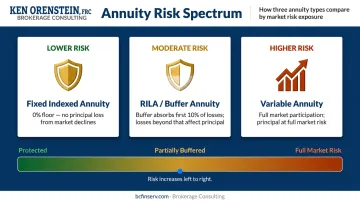
FIA is better for: investors who need hard downside protection and cannot absorb any principal loss from market declines.
RILA may be better for: investors willing to accept limited downside risk in exchange for higher caps or participation rates.
Whole Life Insurance
Cash-value whole life insurance builds tax-deferred savings, supports policy loans, and delivers a death benefit. It serves a dual purpose — insurance and savings — that FIAs don't replicate. Growth in whole life is generally conservative and guaranteed, while FIAs are purpose-built for retirement income accumulation with market-linked upside.
For high-earners focused on estate liquidity or tax-efficient wealth transfer, whole life plays a distinct role from an FIA. Many clients use both — one for income accumulation, the other for legacy planning.
Limitations of FIAs to Consider
FIAs have genuine advantages—but they also have real constraints that need to be weighed carefully.
Surrender charges restrict access to your money for 7–10 years. A common schedule declines from 9% in year one to 0% by year ten. Most contracts allow a 10% free withdrawal annually without penalty, but large lump-sum needs during the surrender period can be costly.
Capped upside is the trade-off for principal protection. In strong bull markets, you'll earn your cap or participation-adjusted rate—not the full index return. Because FIA credits track a price index, dividends are excluded entirely.
Product complexity varies significantly from carrier to carrier. Cap rates, crediting methods, index choices, rider fees, and surrender schedules all differ. Two FIAs tracking the same index can produce very different outcomes depending on how they're structured.
That last point is where the real decision risk lives. Brokerage Consulting compares FIA products across multiple carriers — caps, participation rates, income rider growth rates, and fee structures — to match the right contract to each client's income timeline and liquidity needs. All products are reviewed under NAIC suitability and best-interest standards, with full contract disclosure before any placement.
Choosing the Right Fit for Your Retirement Goals
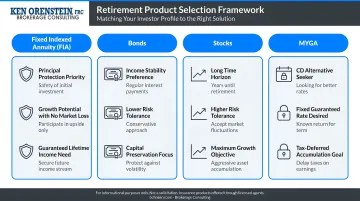
No single product works for everyone. A practical starting framework:
- FIA may fit if: you're risk-averse, need principal protection, want equity-linked growth potential, and have a 7–10+ year horizon before needing access to the funds
- Diversified stocks and bonds may fit if: you're comfortable with moderate volatility, don't need guaranteed income, and want maximum flexibility
- Fixed annuity (MYGA) may fit if: you want predictable, guaranteed growth for a defined term without market exposure
- RILA may fit if: you can tolerate limited downside in exchange for higher growth potential than a FIA offers
A Note for Federal Employees and Retirees
Federal employees with FERS pensions, Social Security, and TSP savings already have a foundation of guaranteed income. But that foundation has gaps—particularly around sequence-of-returns risk, where early-retirement market losses can force portfolio withdrawals at depressed values, permanently reducing what your portfolio can support.
FIAs can fill the gap between FERS pension income and total income needs, while shielding accumulated TSP rollover assets from market volatility during the critical early retirement years.
Ken Orenstein works with federal clients to coordinate these moving parts: Social Security timing, FERS/CSRS pension income, FIA income riders, and discretionary portfolio assets, so each piece reinforces the others.
The right decision depends on several factors:
- Time horizon and when you'll need income access
- Risk tolerance and how much volatility you can absorb
- Existing income sources — FERS pension, Social Security, TSP
- Estate goals and what you want to leave behind
Working with an advisor who can compare products across carriers — rather than representing a single company — is the most effective way to evaluate your options. Brokerage Consulting offers no-cost initial consultations by phone, virtual meeting, or in person.
Frequently Asked Questions
What are the alternatives to a fixed indexed annuity?
The main alternatives include traditional fixed annuities (MYGAs), government bonds and CDs, dividend-paying stocks, RILAs (buffer annuities), and whole life insurance. Each carries a different risk/return/liquidity trade-off — comparing them side by side against your income needs and time horizon is the most reliable way to narrow the field.
How does a fixed indexed annuity differ from a traditional fixed annuity?
A traditional fixed annuity guarantees a set interest rate every year regardless of market conditions. A FIA credits interest based on index performance—offering more growth potential in up markets, but no guaranteed minimum above 0% in down years. Principal is protected in both.
Are fixed indexed annuities safe?
FIAs protect principal from market losses, so your account value won't decline due to index drops. Guarantees are backed by the insurance company's claims-paying ability, not the FDIC. Carrier financial strength (A.M. Best, S&P, Moody's, Fitch ratings) should be reviewed before purchasing any contract.
What are the main drawbacks of a fixed indexed annuity?
The primary limitations: caps and participation rates reduce upside, dividends are excluded from index-linked credits, surrender periods (typically 7–10 years) restrict liquidity, and product complexity makes comparison across carriers difficult without guidance.
Who should consider a fixed indexed annuity for retirement?
FIAs are most suitable for risk-averse pre-retirees or retirees who want market-linked growth potential, need principal protection, and have a long enough time horizon to stay committed through the surrender period. Optional income riders also make them relevant for those building guaranteed lifetime income.
How do caps and participation rates affect what I earn in a FIA?
A cap sets a ceiling on credited interest—if the index gains 12% but your cap is 6%, you earn 6%. A participation rate determines your share of index gains—70% participation on an 8% index gain means 5.6% is credited to your contract. Which mechanism governs your contract is specified in the contract terms — reviewing this with a licensed advisor before signing prevents surprises.