
The choice hinges on four factors: tax treatment, liquidity, payout structure, and long-term income potential. Get these wrong, and a retiree managing Social Security thresholds or planning a 10-year accumulation window could leave significant money on the table. This article breaks down both products so you can make a genuinely informed decision.
Key Takeaways
- MYGAs (fixed annuities) and CDs both lock in a guaranteed rate for a set term, though MYGAs typically offer higher rates with tax-deferred growth
- CD interest is taxed annually as ordinary income; annuity growth compounds without annual tax erosion until withdrawal
- CDs carry FDIC/NCUA federal insurance up to $250,000; fixed annuities are protected by state guaranty associations, typically up to the same limit
- Fixed annuities can convert into lifetime income at maturity; CDs simply return your principal plus interest
- Neither product wins universally — the right choice depends on your time horizon, tax situation, and retirement income needs
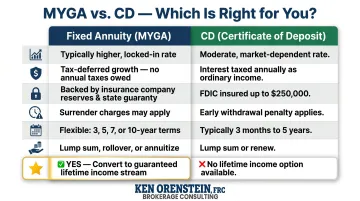
Fixed Annuity vs. CD: Quick Comparison
| Feature | Fixed Annuity (MYGA) | CD |
|---|---|---|
| Interest Rates | Typically higher; top 5-year MYGAs at 6.45% (April 2026) | National average: 1.35% — competitive online CDs near 4.18% |
| Tax Treatment | Tax-deferred — no annual tax on interest | Taxed annually as ordinary income, even on zero-coupon CDs |
| Safety/Backing | Insurer claims-paying ability + state guaranty associations (≥$250K in all states) | FDIC/NCUA federal insurance up to $250,000 per depositor |
| Early Withdrawal Penalty | Surrender charges (often 7–10% early years) + IRS 10% penalty if under 59½ | Loss of several months' interest; no principal forfeiture |
| Term Length | 2–10 years (commonly 3, 5, 7, or 10 years) | 3 months to 5+ years |
| Withdrawal Options at Maturity | Lump sum, systematic withdrawals, or annuitized income stream | Lump sum (principal + interest) |
| Lifetime Income Option | Yes — can convert to income for life, joint life, or a fixed period | No |
Note: "Fixed annuity" in this comparison refers specifically to Multi-Year Guaranteed Annuities (MYGAs) — the annuity type most comparable to a CD, with a rate locked for the full contract term.
What Is a Fixed Annuity?
A fixed annuity is a contract between an individual and an insurance company guaranteeing a set interest rate for a specified accumulation period. MYGAs lock that rate for the entire term — typically 3, 5, 7, or 10 years. Traditional fixed deferred annuities may reset their rate annually after an initial guaranteed period, though never below a contractual minimum floor.
Tax-Deferred Growth
This is the core structural advantage over CDs. Per IRS Publication 575, nonqualified annuity earnings "aren't taxed until distributed." Every dollar of interest stays in the contract, compounding without annual tax erosion. For a retiree in a higher bracket now who expects lower income later, this creates real planning opportunity — taxes get paid when the rate is more favorable.
MYGA growth also stays out of your Social Security combined income calculation until you take a distribution. This matters because that "combined income" figure determines how much of your benefits get taxed. Per IRS Publication 915:
| Combined Income (Single / MFJ) | Benefits Taxable |
|---|---|
| Above $25,000 / $32,000 | Up to 50% |
| Above $34,000 / $44,000 | Up to 85% |
CD interest counts toward that threshold every year. MYGA growth that hasn't been distributed doesn't.

Lifetime Income Option
When a MYGA matures, you're not limited to taking a lump sum. You can annuitize the balance into:
- Payments for a fixed period (e.g., 10 or 20 years)
- Income for your lifetime, regardless of how long you live
- Joint-life income covering both spouses
CDs offer none of this — you get your principal plus interest, and that's it.
Penalty Structure
Fixed annuities carry two distinct penalty layers:
- Surrender charges — typically 7–10% of the withdrawal amount in early years, declining over the surrender period until they reach zero
- IRS 10% early withdrawal penalty — applies to the taxable (gain) portion of any distribution taken before age 59½, per IRC Section 72(q)
Most MYGA contracts include a 10% annual free withdrawal provision, letting you access up to 10% of the account value each year without triggering surrender charges. That free withdrawal doesn't eliminate the IRS penalty for those under 59½, but it meaningfully reduces the liquidity concern for most retirees.
Best Fit for Federal Employees
For federal employees, a MYGA can complement FERS pension income and TSP savings as a third layer of guaranteed income — particularly valuable for those who've maximized TSP contributions and want additional tax-deferred accumulation outside the plan. Ken Orenstein at Brokerage Consulting frequently works with federal retirees evaluating this combination, including 1035 tax-free exchange analysis for those holding older fixed annuities at below-market rates.
What Is a CD?
Per the FDIC, a CD "typically offers a higher rate of interest than a regular savings account, in exchange for you keeping the money for a specified term on deposit, usually from three months to five years or more."
Both FDIC (banks) and NCUA (credit unions) provide federal insurance up to $250,000 per depositor — making CDs one of the most federally protected savings products available.
How CD Interest Is Taxed
The IRS requires CD interest to be reported as ordinary income in the year it accrues — not just when the CD matures. This applies even to zero-coupon CDs where no cash is actually received until maturity (known as Original Issue Discount, or OID). The result: your effective yield is lower than the stated rate because you're paying taxes annually on money you haven't touched. Early withdrawal penalties are deductible, but the base interest remains fully reportable regardless.
Where CDs Make Sense
CDs work best for:
- Short-term savings goals — down payments, vehicles, planned expenses within 1–3 years
- Near-term cash flow — retirees who need predictable access to funds without surrender charge risk
- CD laddering — staggering maturity dates across multiple CDs (e.g., 1-year, 2-year, 3-year) to maintain liquidity while capturing better rates than a savings account
The liquidity trade-off is far more forgiving with CDs. Early withdrawal costs a few months of interest — there's no principal at risk.
Fixed Annuity vs. CD: Key Differences That Matter
Interest Rates and Return Potential
The rate gap between MYGAs and CDs is real and significant. As of April 2026, the FDIC national average for a 5-year CD sits at 1.35%, while top 5-year MYGA rates reach 6.45% (Atlantic Coast Life). Even comparing competitive online CDs (around 4.18% APY) to average 5-year MYGAs (approximately 4.19%), the MYGA holds its own, and top-tier products outperform by a meaningful margin.
Why the premium? Insurance companies invest premiums in longer-duration bond portfolios and aren't subject to the same reserve requirements as banks, allowing them to pass more yield to the contract holder.
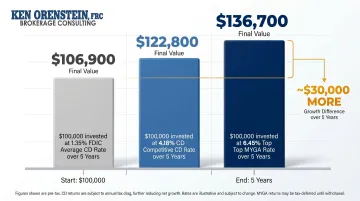
The math on a $100,000 investment over 5 years:
| Rate | 5-Year Ending Balance |
|---|---|
| 1.35% (FDIC avg. CD) | ~$106,900 |
| 4.18% (competitive CD) | ~$122,800 |
| 6.45% (top MYGA) | ~$136,700 |
That's a difference of nearly $30,000 between the national average CD and a competitive MYGA — on the same $100,000 starting point, before accounting for the tax drag on CD interest.
Tax Treatment in Practice
That rate advantage gets further reinforced by how each product is taxed. CD interest hits your tax return every year, whether you want it to or not. For a retiree in the 22% bracket earning $5,000 annually in CD interest, that's $1,100 in taxes paid each year — money that never compounds.
The fixed annuity avoids that erosion entirely. The full $5,000 stays in the contract and earns interest on interest, year after year. Over a decade, that tax deferral can add thousands in additional growth — an advantage that widens as account balances and tax brackets increase.
Safety and Protection
Both products offer solid protection — just through different mechanisms:
- CDs: FDIC or NCUA federal insurance, $250,000 per depositor per institution. Government-backed, clear, and unconditional.
- Fixed annuities: Backed by the issuing insurer's claims-paying ability plus state guaranty associations. Per NOLHGA, all member associations offer $250,000 or more in annuity coverage.
The honest assessment: CDs carry a slight edge due to federal backing. Fixed annuities from financially strong carriers close that gap substantially. That's why any serious MYGA evaluation should weigh carrier financial strength — A.M. Best, S&P, Moody's, and Fitch ratings — alongside the guaranteed rate. The rate is only as good as the company behind it.
Liquidity and Penalties
Financial strength matters less if you can't access your money when you need it. Here's where the products diverge most sharply for near-term planners:
| Scenario | CD | Fixed Annuity (MYGA) |
|---|---|---|
| Early withdrawal cost | Several months' interest forfeited | Surrender charge (7–10% early years) — can erode principal |
| Under age 59½ | No IRS penalty | Additional 10% IRS penalty on gains |
| Annual penalty-free access | Full CD or early withdrawal | Up to 10% of account value per year |
The 10% free withdrawal provision helps, but a MYGA is a long-term commitment. Anyone with a realistic chance of needing funds within 2–3 years should think carefully before committing to one.
Beneficiary and Estate Considerations
Fixed annuities with a named beneficiary bypass probate entirely — the insurance company transfers funds directly to beneficiaries according to the contract terms. For CDs, it depends on whether a Payable-on-Death (POD) designation is in place. Without one, a CD passes through the estate — potentially adding months of delay and cost for heirs. Adding a POD closes the gap, but it's a step many account holders overlook. For retirees with active estate planning goals, the annuity's automatic transfer is a meaningful structural advantage.
Which One Is Right for You?
The right answer depends on your timeline, tax situation, and what you actually need the money to do.
Choose a CD if:
- Your time horizon is 1–3 years
- You may need access to funds before maturity
- You're saving for a non-retirement goal (down payment, car, planned expense)
- You prioritize the clarity of FDIC insurance above all else
- You want to complement an emergency fund with something that earns more than a savings account
Choose a fixed annuity (MYGA) if:
- Your horizon is 5+ years
- You're in or approaching retirement and want to maximize after-tax accumulation
- You've already maxed out other tax-advantaged accounts
- You want the option to convert savings into guaranteed lifetime income
- Keeping taxable income below Social Security thresholds is a priority
Consider Using Both
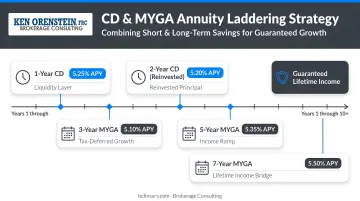
CDs and MYGAs aren't mutually exclusive. A practical retirement plan might hold short-term reserves in CDs for liquidity while directing longer-horizon funds into a MYGA for tax-deferred growth. Annuity laddering — staggering MYGAs across 3-year, 5-year, and 7-year terms — adds a layer of liquidity planning that makes the combination more flexible than either product alone.
Deciding between these products, or structuring a plan that uses both, depends on your income, tax bracket, retirement timeline, and goals. Ken Orenstein at Brokerage Consulting works with federal employees, seniors, and individuals to build tax-efficient retirement income strategies — including annuity laddering, bracket management, and MYGA selection across top carriers — and offers no-cost consultations by phone, virtual, or in-person. You can reach him at (888) 315-3608 or request a consultation at bcfinserv.com.
Frequently Asked Questions
Which is better: a fixed annuity or a CD?
Neither is universally better. CDs suit short-term goals and those who need liquidity; fixed annuities are better for long-term retirement accumulation thanks to tax deferral and higher rates. The right choice depends on your timeline, tax bracket, and income needs — a financial advisor can help match the product to your specific situation.
Which is safer: a CD or a fixed annuity?
CDs hold a slight safety edge due to federal FDIC/NCUA insurance up to $250,000. Fixed annuities are backed by the issuing insurer and state guaranty associations, which also provide up to $250,000 in most states. Working with a financially strong, highly rated insurer narrows that gap considerably.
How much will a $100,000 fixed annuity pay each month?
The monthly payout depends on the interest rate, term length, payout option, and your age at distribution. A financial advisor or annuity calculator can provide a personalized estimate based on current rates and your contract terms.
Are MYGAs better than CDs?
MYGAs often offer higher interest rates and tax-deferred growth compared to CDs of similar terms, making them a better fit for retirement savers who won't need the funds for several years. CDs offer greater liquidity and federal insurance, making them preferable when you need near-term access or maximum safety certainty.
Can I hold a fixed annuity or CD inside an IRA?
Both can be held inside IRAs, but the tax deferral advantage of a fixed annuity becomes redundant inside an tax-deferred account. In that context, the decision shifts to interest rates, liquidity terms, and income options — not tax treatment.
What happens to my CD or fixed annuity when I die?
Fixed annuities with a named beneficiary pass directly outside of probate. CDs without a Payable-on-Death designation may be subject to the probate process, potentially delaying the transfer to heirs. Check with your bank or insurer to confirm your beneficiary designations are current.