
Most people approaching retirement with $500,000 to allocate make one of two mistakes: they assume a single "annuity payout" number applies to everyone, or they grab the highest headline figure without understanding what they're giving up to get it. Neither leads to a good outcome.
This article breaks down monthly payout estimates by annuity type using current market data, explains the variables that move the number up or down, and shows how different payout structures fit different retirement situations.
Key Takeaways
- A $500,000 SPIA at age 65 pays approximately $3,115–$3,425/month for a male; $2,980–$3,170/month for a female (May 2026 market data).
- Waiting until 70 increases male payouts by roughly $465/month on the same $500,000 premium.
- Joint-life payouts run about $390 less per month than single-life for males at age 65 — a significant trade-off for couples.
- MYGA top rates for 5-year terms are currently around 6.15%–6.30%, generating approximately $2,562–$2,625/month in interest on $500,000.
- Tax treatment varies: qualified annuity income (IRA/401k funds) is 100% taxable, while non-qualified income is partially sheltered via the exclusion ratio.
How Much Does a $500,000 Annuity Pay Per Month?
The monthly payout is not a fixed number. It shifts based on annuity type, your age at purchase, payout structure, and prevailing interest rates. Two people writing identical $500,000 checks on the same day can walk away with monthly income that differs by $800 or more.
Single Premium Immediate Annuity (SPIA)
A SPIA converts your $500,000 into guaranteed lifetime income starting within 30 days of purchase. It's the simplest route to maximum guaranteed income — though your principal is no longer accessible after the contract is issued.
According to current payout data from ImmediateAnnuities.com (surveyed May 6, 2026), here's what a $500,000 single-life SPIA pays across ages:
| Age | Male (Best) | Male (Average) | Female (Best) | Female (Average) |
|---|---|---|---|---|
| 60 | $3,100/mo | $2,835/mo | $2,995/mo | $2,740/mo |
| 65 | $3,425/mo | $3,115/mo | $3,170/mo | $2,980/mo |
| 70 | $3,890/mo | $3,495/mo | $3,555/mo | $3,275/mo |
| 75 | $4,530/mo | $4,085/mo | $4,130/mo | $3,800/mo |
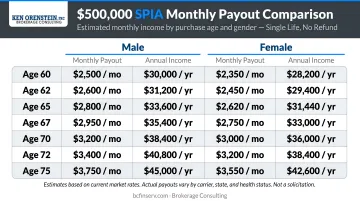
Source: ImmediateAnnuities.com payout rate tables, May 6, 2026. $500,000 figures calculated as 5x the published $100,000 quotes. Actual quotes vary by state, insurer, and contract features.
The income difference between age 60 and 75 is substantial — a 75-year-old male receives roughly $1,430 more per month than a 60-year-old on the same premium. That gap reflects the insurer's shorter expected payment period.
Multi-Year Guaranteed Annuity (MYGA)
A MYGA works like a tax-deferred CD. You deposit $500,000, it earns a guaranteed fixed rate for a defined term (3, 5, or 7 years), and you make a renewal decision at the end — reinvest, convert to an income annuity, or withdraw.
Current top MYGA rates as of May 2026:
| Term | Top Rate | Annual Interest on $500,000 | Monthly Interest |
|---|---|---|---|
| 3-year | 5.85%–6.00% | $29,250–$30,000 | $2,438–$2,500 |
| 5-year | 6.15%–6.30% | $30,750–$31,500 | $2,563–$2,625 |
| 7-year | 5.80%–6.50% | $29,000–$32,500 | $2,417–$2,708 |
Sources: Blueprint Income and Annuity.org, May 2026. Interest-only figures. If compounded, the balance grows to approximately $672,000–$714,000 over 7 years at these rates.
Unlike a SPIA, a MYGA preserves your principal. The trade-off: you're not receiving guaranteed lifetime income — just interest during the term.
Fixed Index Annuity (FIA) with Income Rider
If you want lifetime income but aren't ready to give up your principal immediately, an FIA with an income rider bridges that gap. The contract works on two parallel tracks:
- Contract value grows via index-linked credits tied to an index like the S&P 500, subject to a cap or participation rate
- Benefit base accumulates at a guaranteed rollup rate — commonly 5%–10% annually — and is used solely to calculate your future lifetime income payment
These two amounts are tracked separately. Your actual withdrawable balance is the contract value; the benefit base is the income calculation engine.
For example: a 60-year-old deposits $500,000 into an FIA with an 8% simple rollup (Prudential's SurePath Income carries this structure as of May 2026). Over 7 years of deferral, the benefit base grows to approximately $780,000. The actual monthly income depends on the carrier's payout factor at age 67 — typically 5%–6% of the benefit base — putting estimated lifetime income somewhere in the range of $3,250–$3,900/month.
The key trade-off: rider fees typically run 0.50%–1.00% annually (Nationwide's High Point 365 rider charges 0.95%), and those fees erode your contract value regardless of index performance. The longer you defer — ideally 7–10 years — the more the rollup rate compounds the benefit base, which is what makes the income meaningful at the end.
Key Factors That Affect Your Monthly Payout
Two people investing the same $500,000 can end up with meaningfully different monthly amounts. Here's what drives those differences.
Age at Purchase
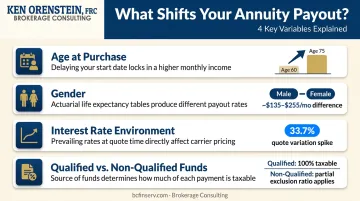
Every year you delay a SPIA purchase increases your payout. The May 2026 data shows the move from age 65 to 70 adds approximately $465/month for males and $385/month for females on a $500,000 premium — a roughly 12%–14% total increase over five years. If other income sources can cover your expenses in the gap, deferring has a measurable payoff.
Gender
Women statistically live longer, so insurers pay them less per month for the same premium. At age 65, the gap between male and female single-life SPIA payouts on $500,000 runs approximately $135–$255/month depending on whether you're comparing average or best available rates.
Interest Rate Environment
Annuity payouts move with interest rates. A CANNEX study analyzing over 55,000 annuity quotes found that payout variation spiked to 33.7% between the highest and lowest quotes on a single day in July 2022, coinciding with rapidly rising bond yields. When rates are higher, insurers can offer more income per dollar. Timing your purchase around the rate environment is one of the few factors you can actually control.
Qualified vs. Non-Qualified Funds
- Qualified funds (IRA, 401k, TSP): 100% of each payment is taxable as ordinary income.
- Non-qualified funds (after-tax): An exclusion ratio applies — each payment is partly tax-free return of principal, partly taxable gain.
Per IRS Publication 939, the exclusion ratio equals your investment divided by your expected total return. On a $500,000 non-qualified SPIA, this can make 20%–40% of each payment tax-free — a real after-tax advantage over an otherwise identical qualified contract.
Riders and Additional Guarantees
Adding features costs income:
- 20-year period certain: Reduces male single-life payouts by roughly 8.7%–12.6% at age 65
- Inflation adjustment riders: Available but uncommon — fixed COLA riders represented only 1.9% of CANNEX quotes as of 2021
- Joint-life structure: Reduces payouts by approximately $390/month vs. male single-life at age 65 (see AARP/ImmediateAnnuities February 2024 data)
Single Life vs. Joint Life vs. Period Certain: Which Payout Option Fits You?
| Structure | Best For | Monthly Impact |
|---|---|---|
| Single Life | Those with other assets or a spouse with separate income | Highest payout; stops at death |
| Joint Life | Couples where the annuity is a primary income source | Approximately $390 less/month vs. male single-life at 65 |
| Period Certain | Those concerned about losing principal to an early death | Moderate reduction; passes remaining payments to beneficiaries |
The survivorship income cliff is a concrete risk that many couples underestimate. When a spouse selects single-life to maximize monthly income and dies first, the surviving spouse loses that income entirely — often at the same time their Social Security benefit drops. For households where $500,000 is the primary guaranteed income source, joint-life structuring is often the better choice even at the cost of lower initial payments.
When evaluating joint-life options, advisors typically offer four survivor benefit tiers: 50%, 66.67%, 75%, or 100% of the original payment continuing to the surviving spouse. Each tier reduces the initial payout by a different amount, so the right choice depends on the survivor's other income sources and expected longevity.
One practical option: split $500,000 across two carriers (two $250,000 contracts) and structure each differently — one single-life for maximum income now, one joint-life or period-certain for survivor protection. This also spreads exposure across state guaranty association limits — most states protect annuity contracts up to $250,000 per insurer, making two separate contracts a natural fit for this threshold.
How to Maximize Your $500,000 Annuity Payout
These strategies consistently produce better monthly payouts:
Shop multiple carriers. The same $500,000 SPIA can pay $100–$200 more per month depending on the carrier. An independent advisor like Ken Orenstein at Brokerage Consulting accesses multiple top insurers — including Aetna, Humana, and TransAmerica — where a captive agent would be limited to one company's rates.
Consider staged purchasing. Splitting $500,000 into two $250,000 contracts purchased 2–3 years apart lets you lock in different rate environments and slightly higher age-based payouts on the second contract. It also preserves flexibility if your income needs shift.
Defer if you have other income. Delaying a SPIA from age 65 to 70 adds approximately $465/month for males on a $500,000 premium. If Social Security, a pension, or savings can cover expenses in the interim, deferral is worth modeling.
Explore annuity laddering. A common allocation framework for $500,000:
- $200,000 into a SPIA → immediate guaranteed income
- $200,000 into a MYGA → tax-deferred growth for 5–7 years, then convert or reinvest
- $100,000 into an FIA with income rider → future income activation at a later age

This structure balances immediate income, liquidity, and long-term guaranteed growth without locking all funds into one product. To build a laddering structure matched to your timeline, contact Ken Orenstein at Brokerage Consulting: (888) 315-3608 for a no-cost consultation.
Common Mistakes to Avoid With a $500,000 Annuity
Three planning errors come up repeatedly with $500,000 annuity decisions. Each one is avoidable with the right guidance upfront.
1. Chasing the Highest Monthly Payout
A single-life SPIA pays the most per month — but it leaves a spouse unprotected and eliminates all liquidity. The right product aligns with your complete retirement income picture, not just a headline payout figure.
2. Overlooking IRMAA Thresholds
Annuity income from qualified accounts (IRA/401k) is fully taxable as ordinary income. For 2026, IRMAA surcharges kick in above $109,000 MAGI for single filers and $218,000 for married filing jointly.
A $500,000 qualified annuity paying $3,000+/month adds over $36,000 in annual taxable income — enough to push some retirees into higher Medicare Part B and Part D premium brackets. IRMAA threshold review should be a standard part of any qualified annuity income consultation.
3. Placing the Full $500,000 With One Carrier
State guaranty association limits vary by location:
- Maryland and Virginia: $250,000 per individual annuity
- New York: up to $500,000
- North Carolina: $300,000
Placing the full $500,000 with a single carrier may exceed your state's coverage limit. Splitting across two carriers is a straightforward risk management step.
Frequently Asked Questions
How much income will a $500,000 annuity pay per month?
Monthly income ranges from roughly $2,700 to over $4,500, depending on age, annuity type, and payout structure. A 65-year-old male purchasing a single-life SPIA can expect approximately $3,115–$3,425/month at current market rates — a common reference point for retirement income planning.
What annuity can I get with $500,000?
The three main options are a SPIA for immediate guaranteed income, a MYGA for fixed tax-deferred growth while preserving principal, and an FIA with income rider for deferred guaranteed lifetime income. The best fit depends on when you need income and whether maintaining access to principal matters.
How much interest does $500,000 earn in a year in a MYGA?
At current top 5-year MYGA rates of 6.15%–6.30%, a $500,000 deposit generates approximately $30,750–$31,500 per year in tax-deferred interest, or roughly $2,563–$2,625/month if withdrawn. If compounded, the balance grows significantly over the term.
What is the best age to buy an annuity?
SPIAs pay more the older you are, but waiting requires other income to bridge the gap. Most financial planners point to the mid-60s to early 70s as the optimal window — old enough to benefit from higher payouts, without exhausting other assets in the interim.
Can a couple retire at 60 with $500,000?
A joint-life SPIA at age 60 pays approximately $2,275–$2,410/month — not enough to cover most households on its own. Combined with Social Security at 62 or later and other savings, $500,000 can anchor a workable plan.
Are $500,000 annuity payments taxable?
Qualified annuity payments (from IRA or 401k money) are fully taxable as ordinary income. Non-qualified payments use an exclusion ratio, so only the gain portion is taxed — the return-of-principal portion of each payment is tax-free.