
This article breaks down exactly what the specified floor is, how it differs between FIAs and RILAs, what happens when it actually triggers, and where the protection ends.
Key Takeaways
- The FIA floor is almost always 0% — your principal is protected from index losses, but you earn zero credited interest in a down year
- RILA floors work differently — they can be set at -10%, -15%, or -20%, meaning you absorb losses up to that threshold
- The floor and the buffer are not the same thing — a common and costly confusion
- Surrender charges operate independently of the floor and can push your account value below your original premium if you exit early
- Rider fees (typically 1.0–1.5% annually) still deduct from your account value regardless of index performance
What the Specified Floor Actually Means
The specified floor is the contractually guaranteed minimum interest rate credited to your annuity in any given crediting period, regardless of how the linked index performs. It's a hard lower boundary on the interest crediting calculation — not a guaranteed return on your investment.
Your insurer links credited interest to an external index like the S&P 500, but you don't own any underlying securities. If the index drops 20% in a given year, the floor kicks in and credited interest is 0% instead of -20%. Your principal and all previously locked-in gains are preserved.
How Insurers Fund the Floor
The floor isn't free. Insurers typically purchase options contracts to finance the principal protection guarantee — a hedging strategy detailed in actuarial industry research. The cost of that hedge is exactly why upside is capped or participation rates are set below 100%. More floor protection = less room for upside.
Floor vs. Guaranteed Minimum Interest Rate (GMIR)
These are two different things, and contracts often include both:
- The floor sets the minimum credited interest from index performance — it controls the crediting calculation
- The GMIR applies to a portion of premiums (often 87.5% at 1–3%) for surrender value calculation purposes — a separate provision for nonforfeiture compliance
Mixing up the two is common in contract reviews. The GMIR affects what you'd receive on surrender; the floor affects what gets credited each period. Both matter, but they're doing different jobs.
FIA Floors vs. RILA Floors: A Critical Difference
FIA floors and RILA floors share the same name but protect your money in very different ways — and confusing the two can lead to a costly surprise.
FIA Floors: The 0% Standard
In Fixed Indexed Annuities, the specified floor is contractually set at 0% in virtually all cases. The worst credited interest outcome in any crediting period is zero — your principal and all previously locked-in credited interest are fully preserved.
One important caveat: the 0% floor applies to indexed interest crediting during accumulation. It does not protect against losses caused by rider fees, early withdrawal penalties, or surrender charges.
RILA Floors: When the Floor Allows Losses
In Registered Index-Linked Annuities (RILAs), the floor operates differently. RILA floors are typically set at a negative value — commonly -10%, -15%, or -20% — meaning you absorb losses up to that threshold, and the insurer covers anything beyond it.
The trade-off is direct: accepting more downside risk gives you access to higher caps or participation rates than an equivalent FIA would offer.
Floor vs. Buffer — Not the Same Thing
Floors and buffers both limit loss exposure, but they protect from opposite ends of the loss spectrum. The table below shows exactly who absorbs what:
| Feature | Who Bears First Losses | Who Bears Deep Losses |
|---|---|---|
| FIA Floor (0%) | Insurer bears all losses | Insurer bears all losses |
| RILA Floor (-10%) | Annuitant bears first 10% | Insurer bears losses beyond 10% |
| RILA Buffer (10%) | Insurer absorbs first 10% | Annuitant bears losses beyond 10% |
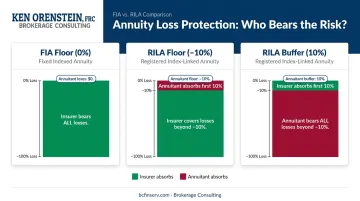
Numerical example:
- Index drops 25% in one year
- With a -10% floor: you lose 10%, insurer covers the remaining 15%
- With a 10% buffer: insurer covers the first 10%, you lose 15%
A floor limits your maximum loss. A buffer absorbs your first losses. They protect from opposite ends of the loss spectrum.
Contractual Floor vs. Effective Floor
That floor vs. buffer distinction matters in the index — but there's a separate gap to watch inside your own contract. The contractual floor is what's written in the policy. Your effective floor may be lower, because annual rider charges still apply.
If a Guaranteed Lifetime Withdrawal Benefit (GLWB) rider costs 1.0–1.5% annually and the floor credits 0% in a down year, your account value still declines by that fee amount. The floor doesn't absorb rider charges — those come out regardless of index performance.
How the Floor Interacts With Other Contract Features
The floor doesn't operate in isolation. Its practical value depends entirely on what surrounds it.
Caps and Participation Rates: The Upside Trade-Off
The more protective the floor, the tighter the upside constraints. An FIA with a 0% floor will generally offer lower caps or participation rates than a RILA with a -15% floor, because the insurer's hedging cost is higher when they're absorbing all downside.
That trade-off is by design. You're paying for principal protection through limited upside participation.
Surrender Charges: The Hidden Risk
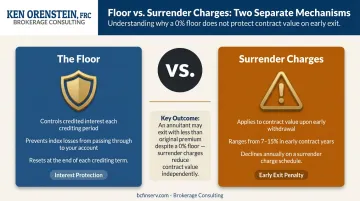
This is the most common misunderstanding buyers carry into consultations. Surrender charges — which can range from 7–15% in early contract years and decline over time — operate completely independently of the floor.
The distinction matters because the floor and surrender charges govern two different things:
- The floor controls how interest is credited at the end of each crediting period
- Surrender charges apply to the contract value when you exit early — regardless of floor protection
- The result: an annuitant can exit with less than their original premium even with a 0% floor in place
Annuities are long-term instruments. The floor's protection is most meaningful when you hold the contract through its accumulation phase.
Crediting Period Resets: The Lock-In Advantage
Credited interest locks in at the end of each crediting period — even when that amount is 0% — and becomes protected principal going forward. Losses in one period cannot claw back gains from prior periods. That's a structural advantage over direct market investing, where a bad year can erase years of accumulated gains.
What's in Your Contract — and What to Verify
The floor is a contractually guaranteed term, not a marketing estimate. It should appear explicitly in the indexed interest crediting or minimum guaranteed interest section of your annuity contract.
What to look for and verify:
- The exact floor value for each index crediting option available
- Whether the floor is guaranteed for the life of the contract or subject to renewal adjustment
- The rate schedule showing floor, cap, participation rate, and spread side-by-side
- Whether annual rider fees apply to the account value or the income base (affects your effective floor)
In most FIA contracts, cap rates and participation rates can change at each crediting period reset, but the floor itself is typically fixed for the life of the contract. Get this confirmed in writing before you finalize placement.
That verification is easier when you're not limited to a single carrier's disclosure. Working with an independent advisor like Ken Orenstein at Brokerage Consulting lets you compare floor terms across multiple carriers before committing. The practice evaluates carrier financial strength using ratings from A.M. Best, Moody's, S&P, and Fitch, which matters because annuity guarantees are ultimately backed by the issuing insurer's claims-paying ability, not a government fund.
When the Floor Triggers: What Actually Happens
When the linked index finishes a crediting period with negative returns, the insurer credits exactly the floor rate — 0% for FIAs — rather than the actual index loss. No new interest is added, but your principal stays intact.
The Long-Term Compounding Cost
If the floor triggers in multiple consecutive years during a prolonged bear market, the annuitant earns zero credited interest throughout that stretch. The account value doesn't shrink from market losses, but it also doesn't grow. Given that U.S. inflation has averaged around 3–4% annually in recent years, extended 0% crediting periods represent real purchasing-power erosion even without nominal losses.
Residual Risks the Floor Doesn't Cover
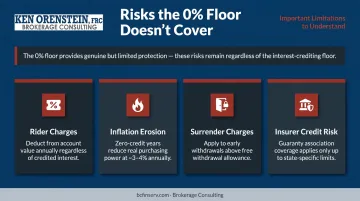
A 0% floor is genuine protection — but it doesn't eliminate all risk. The risks that remain:
- Rider charges deduct from account value annually, regardless of credited interest
- Inflation erosion during zero-credit years reduces real purchasing power
- Surrender charges apply to early exits above the free withdrawal allowance (typically 10% of contract value per year)
- Insurer credit risk — if the issuing company becomes insolvent, guaranty association coverage applies up to state-specific limits
Common Misunderstandings About the Floor
"A 0% floor means I'm guaranteed to earn at least 0% each year"
Not quite. The floor means credited interest from index performance won't go negative — that's its only job. It does not guarantee any positive return.
In a down market year, you earn nothing on that year's index performance. And if you carry rider fees, your account value actually declines slightly even with a 0% credit.
"The floor and the buffer are the same thing"
Confusing them leads to product selection errors. These are three distinct mechanisms:
- FIA floor: An absolute lower limit on credited interest (typically 0%), so no index losses pass through to your account
- RILA buffer: Absorbs the first layer of losses, but losses beyond the buffer are yours to bear
- RILA floor: Caps your maximum loss — it does not set a minimum credit
Each serves a different purpose, and they belong to different product types entirely.
"The floor protects me if I need to exit early"
It doesn't. Surrender charges apply to withdrawals above the free withdrawal allowance during the surrender period, and they operate completely separately from the index crediting floor.
Exiting in year two of a 10-year surrender schedule can leave you with significantly less than your original premium, even if the 0% floor shielded you from every index decline along the way.
Frequently Asked Questions
What is the specified floor for indexed annuities?
For Fixed Indexed Annuities, the floor is almost universally set at 0% — meaning no credited interest loss from index declines. Rider fees and surrender charges are separate and not covered by the floor. RILA floors can be set at negative values such as -10% or -15%, meaning the annuitant absorbs losses up to that level.
What is the difference between a floor and a buffer in an annuity?
A floor (in FIAs) is the absolute minimum credited interest — typically 0% — so no index loss passes through to the annuitant. A buffer (in RILAs) absorbs the first portion of market losses, but the annuitant bears any losses that exceed the buffer threshold.
Does a 0% floor mean I'm guaranteed to earn something each year?
No. A 0% floor means credited interest from index performance cannot go negative — not that you're guaranteed any positive return. In a down market year, the credited interest is simply 0%. If annual rider fees apply, your account value will decline slightly despite the floor.
Can I lose money in a fixed indexed annuity even with a floor?
The 0% floor prevents principal loss from index performance. However, account value can decrease due to annual rider fees charged against the account or surrender charges on early withdrawals. The floor does not cover either of these costs.
What is the floor in a Registered Index-Linked Annuity (RILA)?
In a RILA, the floor is typically set at a negative value — for example, -10% or -15% — meaning the annuitant can lose up to that percentage in a down market. The insurer absorbs any losses beyond the floor.
How does the floor affect my long-term annuity returns?
The floor protects against loss but limits upside through caps or reduced participation rates. In years when the floor triggers at 0%, inflation can still erode purchasing power — a hidden cost even when no nominal loss occurs.