
Introduction
Imagine you've spent 30 years saving diligently, and now your advisor mentions two options for protecting that money in retirement: an annuity and a GIC. Both sound safe. Both involve insurance companies. And both promise guaranteed returns.
So what's the difference—and which one actually belongs in your retirement plan?
That confusion is understandable. Most articles on this topic are written for Canadian readers, where GICs are widely available consumer savings products. For American retirees, the landscape looks very different — GICs in the US are primarily institutional products buried inside employer-sponsored plans, not something you can walk into an office and buy.
What follows breaks down what each product actually does, where the real differences lie, and how to decide which option fits your retirement income strategy.
Key Takeaways
- Annuities are insurance contracts that provide guaranteed income, issued by life insurance companies for a fixed period or for life.
- US GICs are institutional products found inside employer-sponsored plans (401(k)s, pensions), not available to individual investors directly.
- MYGAs (Multi-Year Guarantee Annuities) are the closest consumer equivalent to a GIC for individual American retirees.
- Accumulation annuities grow at a guaranteed fixed rate before converting to income, operating like a GIC but issued under insurance law.
- Neither product is designed for market growth: both prioritize principal protection and guaranteed income over returns.
What Is an Annuity? Types and How They Work
An annuity is a contract between an individual and a life insurance company. You hand over a lump sum; the insurer promises a guaranteed outcome in return. FINRA describes annuities as contracts where the company promises periodic payments, either immediately or at a future date. The critical distinction: this is a contractual guarantee, not an investment product in the traditional sense.
There are two broad categories worth understanding.
Payout Annuities: Income for Life
Payout annuities—including Single Premium Immediate Annuities (SPIAs) and Deferred Income Annuities (DIAs)—are designed for one purpose: generating income you cannot outlive.
The insurer assumes longevity risk fully — no matter how long you live, payments continue, though you typically surrender access to the original principal in exchange.
Payment amounts depend on actuarial inputs including:
- Your age and gender
- Current interest rate environment
- Payout options selected (single life, joint life, period certain)
- Optional riders such as inflation adjustments or survivor benefits
This is not a simple interest calculation—it's an actuarial pricing exercise reflecting mortality probabilities and investment yield assumptions.
Accumulation Annuities: The MYGA
For individual American retirees, the most GIC-like annuity product available is the Multi-Year Guarantee Annuity (MYGA). It locks in a guaranteed interest rate for a defined term—typically 3, 5, 7, or 10 years—with full principal protection and tax-deferred growth.
As of late May 2026, illustrative MYGA rates from CANNEX and Blueprint Income showed 3-year rates around 5.07% and 5-year rates reaching 6.30%—though these figures are date-specific and subject to change.
At maturity, you can withdraw funds, renew, or convert to a payout annuity. That flexibility makes MYGAs a natural bridge between a pure savings vehicle and a retirement income product.
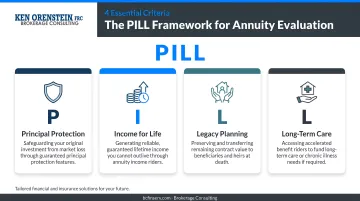
A practical framework for evaluating any annuity is the PILL model. An annuity is worth considering only when it contractually solves for one of these four needs:
A practical framework for evaluating any annuity is the PILL model. An annuity is worth considering only when it contractually solves for one of these four needs:
- Principal protection — guaranteed return of your original deposit
- Income for life — payments you cannot outlive
- Legacy — passing value to beneficiaries
- Long-term care — coverage for extended care costs
If the goal is pure market growth, a different tool is the better fit. Annuities solve specific problems — and they solve those problems well.
What Is a GIC? Understanding the Term in a US Retirement Context
The term "Guaranteed Investment Contract" means something very specific in the US—and it's almost certainly different from what you've read online.
The Stable Value Investment Association defines a GIC as a stable value investment contract, typically a group annuity, issued by an insurance company that pays a specified return for a specific period while offering book value accounting. The key word: group. In US retirement plans, GICs are negotiated between plan sponsors (employers) and insurance companies, not between individuals and insurers.
How US GICs Actually Work
A plan sponsor deposits funds with an insurance company. The insurer guarantees the principal and a fixed return for a defined term. SVIA data shows stable value funds—which commonly use traditional GICs—are present in more than 180,000 plans, cover approximately 25 million participants, and hold roughly $900 billion in assets. They represented 6.5% of 401(k) plan assets at year-end 2022.
That's employer-plan infrastructure—not a consumer savings product.
The Canadian Confusion
If you've been searching "GIC vs. annuity" online, much of what you'll find is written for Canadian readers. In Canada, GICs are consumer deposit products available at virtually any bank, protected by CDIC up to $100,000 CAD per category. Insurance GICs issued by Canadian life insurers (also called accumulation annuities) carry different coverage through Assuris. American retirees reading that content are comparing products they can't actually access.
What Individual US Retirees Can Use Instead
For Americans who want what a GIC delivers—fixed rate, principal protection, no market exposure—the practical options are:
- Bank CDs – FDIC-insured, straightforward, taxable annually
- Treasury securities – Backed by the US government, highly liquid
- MYGAs – Insurance company contracts offering tax-deferred growth and optional income conversion
MYGAs tend to be the strongest fit for retirees seeking a GIC-like experience: unlike CDs, growth compounds tax-deferred until withdrawal, which can meaningfully improve after-tax outcomes over a multi-year accumulation period.
Annuity vs. GIC: Key Differences for Retirement Planning
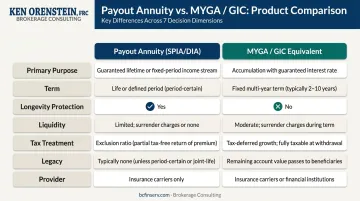
Here's how the two product types compare across the dimensions that matter most:
| Feature | Payout Annuity (SPIA/DIA) | MYGA / GIC Equivalent |
|---|---|---|
| Primary purpose | Lifetime income | Principal preservation + fixed growth |
| Term | Lifetime (or period certain) | Fixed term (3–10 years) |
| Longevity protection | Yes—income guaranteed for life | No—funds are finite |
| Liquidity | Generally none after purchase | Access at maturity; surrender charges apply early |
| Tax treatment | Exclusion ratio on nonqualified payouts | Tax-deferred growth until withdrawal |
| Legacy | Limited unless riders added | Full account value passes to beneficiaries |
| Provider | Life insurance company | Life insurance company (MYGA) or bank (CD) |
Longevity Risk: The Defining Difference
Underestimating how long you'll live is a costly mistake. SOA research found that 67% of retirees and 61% of pre-retirees underestimated average life expectancy. SSA actuarial tables show a 65-year-old male can expect roughly 17 more years on average; a 65-year-old female, about 20 more years.
Consider a simple illustration: $100,000 in a MYGA at 5.5% for 7 years grows to approximately $145,000 at maturity—then stops. A payout annuity funded with the same $100,000 might generate guaranteed income for 25 or 30 years if you live that long. The MYGA wins on flexibility; the payout annuity wins on security if longevity is the concern.
Tax Treatment
Outside of qualified accounts (IRAs, 401(k)s), MYGAs offer tax-deferred growth—interest accumulates without annual taxation, with the bill due only upon withdrawal. Bank CDs generate ordinary income tax annually under IRS Publication 550, even if you reinvest rather than spend the interest.
Inside a qualified account, both MYGAs and GICs grow tax-deferred by default, so the MYGA's tax-deferral advantage disappears.
Legacy and Estate Considerations
Tax treatment also has downstream effects on what you're able to pass on. Income annuities typically surrender remaining capital to the insurer at death—unless a period-certain guarantee or return-of-premium rider is added. Period-certain structures (10-year or 20-year guarantee periods) ensure payments continue to beneficiaries if the annuitant dies early. Cash refund and installment refund options return any unpaid premium balance to heirs.
MYGAs and CDs pass the full remaining account value to named beneficiaries. Retirees with legacy goals often allocate a MYGA to the portion of assets earmarked for heirs, while directing income-need funds toward a payout annuity—letting each product do what it does best.
Which Option Fits Your Retirement Strategy?
Start with two questions before any product is on the table:
- What do you need this money to contractually do? Protect principal? Generate income you cannot outlive? Leave a legacy?
- When do those guarantees need to start? Immediately, or at a future retirement date?
The answers determine which product belongs in the conversation.
When a Payout Annuity Makes Sense
Choose a SPIA or DIA when your primary concern is longevity risk—you want guaranteed income for life regardless of market conditions or how long you live, and capital preservation for heirs is a secondary priority. This is particularly appropriate for retirees without a defined-benefit pension who need to replicate a "paycheck" from their own savings.
When a MYGA or CD Makes Sense
Choose a MYGA or bank CD when you want principal protection and a guaranteed fixed return, but plan to manage income distribution yourself—either through systematic withdrawals or by converting to a payout annuity at a later date. MYGAs add tax-deferred growth; bank CDs add FDIC protection. Both preserve full access to capital at maturity.
The Layered Approach for Federal Employees
Federal employees with FERS pensions and Social Security already in place have an income floor that most private-sector retirees lack. That changes the decision entirely. The relevant question shifts from "how do I generate income?" to "how much additional guaranteed income do I actually need—and for what?"
Ken Orenstein at Brokerage Consulting uses a layered income architecture for federal clients:
- Layer 1 — Social Security
- Layer 2 — FERS pension
- Layer 3 — Supplemental guaranteed income (annuities or MYGAs)
- Layer 4 — Discretionary portfolio assets
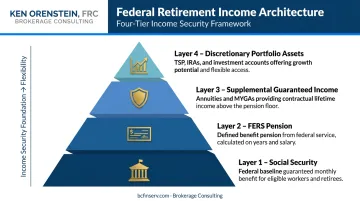
The supplemental annuity or MYGA is sized against the specific gap between existing guaranteed income and total essential expenses—not treated as a replacement for income sources already in place.
For federal employees in the DC/MD/VA corridor evaluating TSP rollover options into annuities or fixed instruments, that gap analysis is where planning starts. No-cost phone, virtual, or in-person consultations are available through Brokerage Consulting at (888) 315-3608 or at bcfinserv.com.
Frequently Asked Questions
What is the difference between an accumulation annuity and a GIC?
An accumulation annuity is an insurance company-issued product that grows at a guaranteed interest rate before converting to income. In Canada, Insurance GICs fall under this classification. In the US, the functional equivalent for individual consumers is a MYGA — the GIC label there typically refers to institutional products inside employer plans, not retail instruments.
What is an accumulation annuity?
An accumulation annuity is an insurance product in its growth phase, earning fixed or indexed interest over a defined term. Unlike a payout annuity that distributes lifetime income right away, it builds value that can be converted to income or withdrawn at maturity.
What do experts like Dave Ramsey say about annuities?
Dave Ramsey has historically been critical of annuities, citing fees and complexity — but his position focuses on high-cost variable and indexed products, not all annuity types equally. Blanket opinions don't substitute for evaluating specific products against individual retirement needs; a no-fee MYGA with a defined surrender schedule is fundamentally different from a variable annuity with layered rider costs.
Are GICs available to individual investors in the US?
Traditional GICs are not widely available to US retail investors—they are institutional products negotiated between employers and insurance companies inside 401(k) or pension plans. Individual investors looking for the same features should evaluate MYGAs, bank CDs, or Treasury securities instead.
Is an annuity or a GIC better for generating retirement income?
The right choice depends on the goal. If guaranteed lifetime income is the priority, a payout annuity is the better fit. If capital preservation and flexibility matter more, a MYGA or CD equivalent is more appropriate. Most retirees benefit from combining both: a payout annuity for income floor security and a MYGA or CD for liquidity and legacy.
Can I hold both an annuity and a MYGA in my retirement portfolio?
Yes — and it's a practical strategy. Fund a payout annuity with enough to cover essential expenses for life, then keep the remainder in MYGAs or CDs for liquidity, emergencies, and legacy purposes.