Introduction
According to Allianz Life's 2024 Annual Retirement Study, 63% of Americans worry more about running out of money than dying — up from 57% just two years prior. That fear is driving more retirees to look at annuities, but traditional products come with a familiar trade-off: guaranteed income usually means handing over control of your assets.
Contingent deferred annuities (CDAs) take a different approach. Rather than converting your portfolio into an insurer's account, a CDA acts as emergency income insurance. It sits alongside your existing investments and only pays out if your portfolio is fully depleted while you're still alive.
This guide breaks down exactly how CDAs work, how they compare to other annuity products, and whether the CDA structure belongs in your retirement plan.
Key Takeaways
- CDAs guarantee lifetime income only if your investment portfolio is fully depleted — not before
- You retain ownership and control of your assets — the insurer doesn't hold your money
- CDAs protect against longevity risk, not day-to-day income needs
- Annual fees typically range from 0.85% to 1.95% depending on the product and portfolio risk level
- Best suited for self-directed investors who want a financial backstop, not a primary income source
What Is a Contingent Deferred Annuity?
A CDA is an insurance contract between a policyholder and a life insurance company. The insurer agrees to provide guaranteed lifetime income — activated only after a designated investment portfolio, held outside the insurer's account, is fully depleted through withdrawals, market losses, or fees.
The "Contingent" Part Matters
Most annuities begin paying on a set schedule. A CDA's trigger is uncertain by design. The National Association of Insurance Commissioners (NAIC) defines it as a contract where the insurer's obligation activates when designated investments "not owned or held by the insurer" are depleted due to permitted withdrawals, market performance, or charges.
That conditionality is what makes a CDA structurally different from nearly every other annuity product on the market.
How the Income Amount Is Set
At contract inception, the insurer evaluates your portfolio and sets a guaranteed income amount. With Midland National's Constance product (one of the most accessible CDAs on the market), the process works like this:
- Your initial coverage base equals total contributions
- The base is reviewed annually for potential step-ups, capped at 250% of contributions
- On the "Lock-In Date," the coverage amount is calculated by multiplying the coverage base by a payment percentage tied to the younger covered person's age
Prudential's ActiveIncome CDA, launched in early 2026 on Franklin Templeton's Canvas platform, follows the same logic: Annual Income Amount equals the Income Base multiplied by a locked-in Income Percentage.
What Triggers the Payout
Both current primary products (Constance and ActiveIncome) use account depletion to zero as the trigger. If permitted withdrawals and market performance reduce your account value to zero while you're still living, the insurer begins making lifetime income payments.
Unlike a SPIA or a traditional variable annuity, most CDA policyholders may never receive a single payment. That's not a flaw. It means the portfolio held up — which is precisely what the coverage was designed to protect against. Think of it the same way you think of homeowner's insurance: the best outcome is never filing a claim.
How a Contingent Deferred Annuity Works
Contract Setup and Ongoing Monitoring
When you sign a CDA, the insurer reviews your portfolio's asset allocation, balance, and expected withdrawal rate. These factors determine:
- The guaranteed income amount
- Which investment options are approved under your contract
- Your annual fee tier
The insurer then monitors the covered account over time. Contributions can increase the benefit; excess withdrawals reduce it proportionately and permanently. Policyholders must stay within approved investment parameters or risk losing benefits.
Three Risks You Still Carry
CDAs shift longevity risk to the insurer, but policyholders retain meaningful personal responsibility:
- Investment risk — You manage your own assets. A poorly diversified or overly aggressive portfolio can deplete faster than projected
- Distribution risk — Withdrawing above your approved percentage reduces future guaranteed income. A large unexpected withdrawal (medical emergency, home repair) can permanently lower your benefit base
- Non-trigger risk — If your portfolio never reaches zero, you never receive a payment. Years of fees with no payout may seem costly in isolation, but a portfolio that never depletes is the ideal outcome the product is designed to protect against
Fee Structure
CDA fees are charged annually as a percentage of the covered portfolio, regardless of whether the benefit ever triggers. Current verified ranges:
| Product | Fee Range |
|---|---|
| Midland National Constance (Core) | 0.85% – 1.20% |
| Midland National Constance (CorePlus) | 1.25% – 1.75% |
| Midland National Constance (CorePlus X) | 1.45% – 1.95% |
| Prudential ActiveIncome | 1.00% flat |
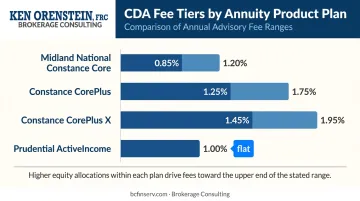
Higher equity allocations typically incur higher fees, since more market exposure means more insurer risk. These fees are charged on top of any underlying investment management fees.
The Insurer's Financial Strength Is the Guarantee
A CDA guarantee is only as strong as the company backing it. AM Best's Financial Strength Rating represents an independent assessment of an insurer's ability to meet its ongoing policy obligations. Before purchasing any CDA, verifying the issuing carrier's AM Best, S&P, and Fitch ratings is a required step, not an afterthought.
At Brokerage Consulting, every annuity evaluation includes a carrier financial strength review across AM Best, Moody's, S&P, and Fitch — because a guarantee is only worth what the issuing insurer can actually pay.
CDA vs. Other Annuity Products
CDAs occupy a specific niche. Understanding where they fit relative to other products clarifies when they make sense.
CDA vs. Variable Annuity with GLWB
Both offer market participation and a guaranteed lifetime income floor. The key structural difference: in a variable annuity with a Guaranteed Lifetime Withdrawal Benefit (GLWB), your assets are held within the insurance company's account. In a CDA, you retain full ownership of your externally held portfolio.
VA/GLWB structures bundle the guarantee and investment management under one contract. CDAs separate them, giving the policyholder more flexibility and more control — but also more responsibility to manage independently.
Variable annuities also typically carry higher all-in costs. Mortality & expense charges, administrative fees, and sub-account expenses can push total VA costs above 3% annually. CDA fees are assessed only on the covered portfolio, without M&E charges.
CDA vs. Single-Premium Immediate Annuity (SPIA)
A SPIA converts a lump sum into income regardless of market conditions — it pays in every scenario, from day one. A CDA only pays in the worst-case scenario: full portfolio depletion combined with extended longevity.
That narrowness makes CDAs far less expensive to maintain. A SPIA requires a large, irrevocable upfront commitment. A CDA requires only the ongoing annual fee — your portfolio stays intact and investable for as long as it lasts.
SPIAs offer certainty from day one. CDAs offer a safety net you may never need — but one that costs a fraction of the alternative.
CDA vs. Fixed and Fixed Indexed Annuities
Fixed and fixed indexed annuities (FIAs) protect principal from market losses and credit guaranteed interest or index-linked growth. The limitation is that asset flexibility is restricted to approved options, and upside participation is capped through participation rates and spreads.
CDAs allow full market participation with no principal protection within the covered portfolio. The covered assets can — and sometimes do — lose value. That's a meaningful difference for risk-averse clients.
At a glance — how CDAs compare:
- vs. VA/GLWB: CDAs keep assets external and typically cost less; VAs bundle everything under one contract
- vs. SPIA: SPIAs pay income immediately in all scenarios; CDAs only activate after full portfolio depletion
- vs. FIA: FIAs protect principal with capped upside; CDAs allow full market participation with no principal floor
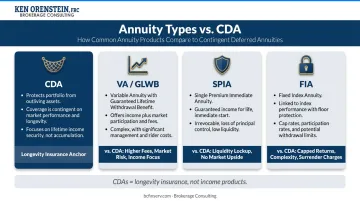
Bottom line: CDAs aren't income products. They're longevity insurance — specifically protecting against the scenario where both lifespan and market performance work against you simultaneously.
Pros and Cons of Contingent Deferred Annuities
Advantages
- Income continues indefinitely if the portfolio depletes during your lifetime
- You retain full control of the assets; the insurer never holds your money
- No large lump-sum commitment upfront, unlike a SPIA
- Contracts can typically be canceled during the accumulation or withdrawal phase (though you forfeit fees paid and any future benefit)
- The portfolio stays fully invested, so you still participate in market growth
Disadvantages
- Annual fees apply whether or not the income trigger is ever reached
- Staying within approved investment options and withdrawal limits is mandatory — exceeding them can reduce or eliminate the benefit
- Most policyholders never collect: if the portfolio holds up, no income benefit is received. NAIC explicitly notes that canceling a CDA means losing fees paid and the investment gains those fees could have generated
- Availability is limited — several states including New York, Illinois, Kansas, Maryland, Minnesota, Montana, Oregon, South Carolina, and Washington currently don't permit these products. The Interstate Insurance Product Regulation Commission has not adopted a uniform CDA standard, so issuers must file separately in each state
A Balanced Perspective
For most policyholders, the CDA trigger never fires — and that's actually the good outcome. It means the portfolio survived. The fees paid bought protection against a specific worst case: outliving your money. Whether that protection was worth the cost depends on your risk tolerance, portfolio size, and how long you live. It's a hedge, not a bet.
Is a Contingent Deferred Annuity Right for You?
The Ideal CDA Candidate
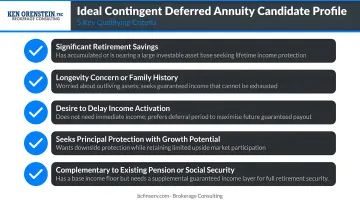
CDAs work best for a specific type of retiree:
- Comfortable managing their own investment portfolio
- Approaching or recently entering retirement
- Wants to remain invested in the market for growth potential
- Needs a backstop against outliving savings — not a primary income source from day one
- Has sufficient assets to absorb ongoing annual fees without meaningfully impairing the portfolio
When a CDA May Not Fit
- Clients who want an advisor or insurer to manage their investments within a bundled product may prefer a VA/GLWB structure
- Clients requiring immediate, predictable income starting within 30 days are better served by a SPIA or FIA with an activated income rider
- Shorter life expectancy — The longevity protection value diminishes if lifespan is expected to be average or below
- State restrictions apply — Several states restrict or prohibit specific CDA products. Clients in New York, for example, face limited or no CDA availability under currently filed products
The Role of Professional Guidance
CDAs are genuinely complex. Fees vary by coverage tier and portfolio allocation. Approved investment options differ by contract. Insurer financial strength matters enormously given the decades-long payout commitment.
The product also doesn't fit neatly into most retirement income plans on its own — it works best alongside complementary vehicles such as Social Security optimization, pension income, or FIAs handling the base guaranteed income layer.
That complexity is exactly why professional guidance matters. At Brokerage Consulting, the annuity evaluation process covers insurer financial strength review, income rider comparison, and full-spectrum suitability analysis. Whether a CDA belongs alongside or instead of a more traditional guaranteed income vehicle depends on the complete retirement picture — including income layering, tax treatment, and carrier stability.
Frequently Asked Questions
What is a contingent deferred annuity?
A CDA is an insurance contract that guarantees lifetime income payments, but only if your designated investment portfolio — which you continue to own and manage — is fully depleted through withdrawals or market losses while you're still alive. It functions as a safety net, not a primary income source.
How is a CDA different from a variable annuity with a GLWB?
Both offer market participation and a lifetime income guarantee, but with one key structural difference: in a VA/GLWB, the insurance company holds your assets; in a CDA, you retain full ownership of your externally held portfolio. That ownership brings more control — and more responsibility for managing withdrawals and investment decisions.
What fees are associated with contingent deferred annuities?
Fees vary by product and portfolio risk tier. Midland National's Constance ranges from 0.85% to 1.95% annually depending on coverage plan; Prudential's ActiveIncome charges 1.00% annually. These fees are charged on top of any underlying investment management costs, whether or not the benefit is ever triggered.
Who is a contingent deferred annuity best suited for?
CDAs work best for self-directed investors approaching or in early retirement who want market growth potential with a guaranteed income floor as protection against outliving their savings. They should be comfortable managing their own portfolio within approved parameters.
Are contingent deferred annuities available in all states?
No. Constance is currently unavailable in New York, Illinois, Kansas, Maryland, Minnesota, Montana, Oregon, South Carolina, and Washington. Availability varies by product, so always verify your state before evaluating a specific CDA.
Can you lose money with a contingent deferred annuity?
Yes. The investment portfolio tied to a CDA is fully subject to market risk — you manage it and bear the losses. Poor performance or excessive withdrawals can deplete the portfolio faster than projected. Fees paid over the life of the contract may never produce a direct benefit if the portfolio never fully depletes.