
That's an expensive blind spot. The right questions, asked before signing, can save you thousands of dollars and prevent years of regret.
This guide covers the essential questions to ask about annuity fees, growth mechanics, income options, guarantees, death benefits, and the person selling you the product.
TL;DR: Key Takeaways
- Get a full fee breakdown before signing: surrender charges, rider fees, and mortality and expense charges all affect your return
- Understand how your money grows — confirm whether the advertised rate is introductory or ongoing
- Know all your income options: annuitization, withdrawals, and income riders each work differently
- Confirm what your death benefit actually covers, and whether it shrinks if you take withdrawals
- Find out how your advisor is compensated — and whether they're acting as a fiduciary
Questions About Fees and Costs
Fee structures differ significantly by annuity type. A fixed annuity may carry no explicit fees. A variable annuity can layer several charges that erode long-term returns. Before signing anything, you need a complete picture.
Mortality and Expense (M&E) Fees
M&E fees are charges the insurance company levies to cover administrative costs and the risk of paying guaranteed income. These are standard in variable annuities.
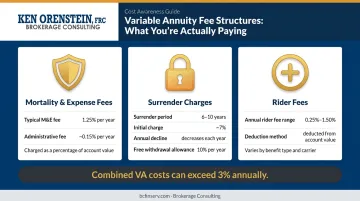
According to the SEC's Variable Annuities Guide, M&E charges typically run 1.25% of account value per year, with additional administrative charges often running $25–$30 annually or around 0.15%.
Combined with subaccount expenses and rider fees, all-in variable annuity costs can exceed 3% per year — a significant drag on returns over a 20-year retirement.
Surrender Charges
Most deferred annuities lock your money in for a surrender period. Withdraw more than the free withdrawal allowance during this window and you'll pay a penalty.
Key facts to know:
- Surrender periods commonly run 6–10 years for many deferred products
- First-year surrender charges often start around 7% and decline annually
- Most contracts allow a free withdrawal of up to 10% of account value per year without penalty
- Mark your surrender period end date on a calendar — it matters
Rider Fees
Optional riders (guaranteed income riders, enhanced death benefit riders) come with their own annual fees, typically deducted directly from account value. According to Investopedia's 2025 benchmark, annual rider fees typically range from 0.25% to 1.50% of annuity value.
These fees reduce the balance available to grow. Always ask: does the benefit this rider provides actually justify what it costs?
Commission Transparency
Rider costs are visible in your contract. Commissions usually aren't. Agent commissions are built into the annuity contract rather than charged as a separate line item — you won't see them on a statement, but they influence pricing and product selection.
Ask directly: "How are you compensated for selling me this product?"
Hesitation or a vague answer is a red flag. A straightforward advisor will tell you clearly. At Brokerage Consulting, Ken Orenstein discloses upfront that annuity brokerage services are commission-based, paid by the issuing carrier rather than the client, and that all fees, caps, and surrender charges are reviewed in full before any placement decision is made.
Questions About How Your Money Grows
The advertised rate is not always the rate you'll earn long-term. Understanding the growth mechanics of your specific annuity type is critical — the same premium can produce very different outcomes depending on how interest is credited.
Fixed Annuities: Guaranteed Rate vs. Current Rate
Fixed annuities carry two distinct interest rates:
- Current (introductory) rate — what the insurer advertises, often higher
- Guaranteed minimum rate — the floor the contract guarantees over its lifetime
As the NAIC Buyer's Guide notes, only the guaranteed minimum is truly guaranteed. California's Department of Insurance specifically warns that some annuities use a higher first-year teaser rate that resets — and typically goes down — after year one.
Example: A fixed annuity advertised at 5.25% for the first year might reset to 3.5% in year two, with a guaranteed floor of 2%. Always ask what the renewal rate looks like after year one.
Fixed Index Annuities: Caps, Spreads, and Participation Rates
Fixed index annuities (FIAs) credit interest based on a market index like the S&P 500, but growth is limited by one or more of these mechanisms:
| Mechanism | What It Means |
|---|---|
| Cap rate | The maximum interest that can be credited in a given period |
| Participation rate | The percentage of index gain credited to your account (e.g., 75% participation = 75% of index gain) |
| Spread/margin | A fixed percentage deducted from the index gain before crediting |
Your principal is protected from market losses, which is a meaningful safety net. FINRA notes that FIA minimum guarantees typically apply to at least 87.5% of premium paid. Your principal is protected from market losses, which is a meaningful safety net. FINRA notes that FIA minimum guarantees typically apply to at least 87.5% of premium paid. In strong market years, though, you'll capture only a fraction of the index's return.
Ask for the current cap, participation rate, and spread — and ask how often the insurer can change them.
Variable Annuities: Subaccount Performance and Downside Risk
Variable annuities tie growth to underlying investment subaccounts, so account value can rise or fall with the market. Before committing:
- Request the prospectus and review subaccount expense ratios
- Understand any Guaranteed Lifetime Withdrawal Benefit (GLWB) or GMIB riders that offset market risk
- Approach multi-index "hybrid" products carefully — limited performance history makes them hard to evaluate against a standard benchmark
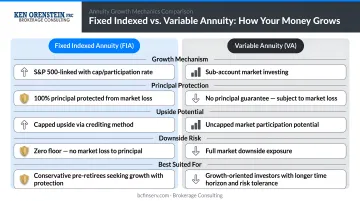
All-in VA costs can exceed 3% annually once M&E charges, rider fees, and subaccount expenses are combined — a threshold that meaningfully erodes net returns over time.
Questions About Income Payouts and Withdrawals
Many people buy annuities without a clear picture of how — or when — they can actually access their money. There are multiple distinct income methods, and each has different consequences for your account's long-term value and tax treatment.
Annuitization vs. Systematic Withdrawals
These are two different approaches:
- Annuitization converts your account balance into an irrevocable stream of periodic payments — guaranteed for life, but you permanently surrender access to the remaining principal
- Systematic withdrawals let you draw from the account as needed, preserving flexibility, but with no lifetime income guarantee
Neither is universally better. The right choice depends on your income gap, longevity concerns, and whether you have other guaranteed income sources.
Income Riders: How Payments Are Calculated
Many annuities offer income riders that establish a separate "income account value" — a figure that grows at a fixed rate and determines your future income eligibility. This is separate from the actual cash value of the contract.
Ask these questions before adding any income rider:
- How is the income amount calculated?
- What roll-up rate applies during the accumulation phase (common rates: 5%, 6%, or 7%)?
- What happens to future payments if I take early withdrawals?
- Does this rider continue for my spouse if I die first?
Free Withdrawal Provisions and Early Withdrawal Penalties
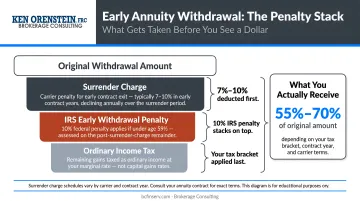
Most deferred annuities allow a free withdrawal of up to 10% of account value per year without triggering surrender charges. Beyond that threshold, penalties apply.
Two additional penalties can stack:
- Surrender charges from the insurance contract
- IRS 10% early withdrawal penalty for withdrawals before age 59½, per IRS Publication 575
Both apply on top of ordinary income taxes. Withdrawals before 59½ can be very costly.
Don't overlook the free-look period. Most states provide a window — typically 10–30 days after delivery, though California gives seniors 30 days — during which you can cancel the contract for a full refund. Use this time to re-read the terms carefully before committing.
How Annuity Income Fits With Your Other Retirement Sources
Annuity income doesn't exist in isolation. It interacts with Social Security, pensions, TSP distributions, and your investment portfolio in ways that affect your total tax burden.
For federal employees, this coordination requires particular care. A retirement income plan that accounts for FERS or CSRS pension income, Social Security, guaranteed annuity income, and discretionary portfolio assets together often looks very different from one built around a single income source. Adding an annuity on top of an existing FERS pension plus Social Security can push combined income into brackets that trigger taxation on up to 85% of Social Security benefits, per IRS Publication 915.
Run the full income projection before purchasing — the annuity's impact on your tax bracket may be just as important as the payout rate itself.
Questions About Protection, Death Benefits, and Guarantees
The word "guaranteed" appears throughout annuity marketing — but what's actually guaranteed, and by whom, varies significantly.
Who Backs the Guarantee?
Annuity guarantees are backed by the financial strength of the issuing insurance company — not the federal government. Unlike FDIC insurance on bank deposits, there is no federal backstop for annuities.
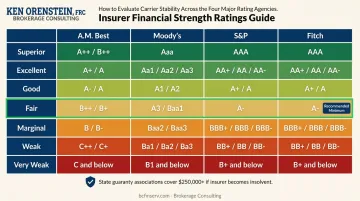
State guaranty associations provide a safety net if an insurer becomes insolvent, with NOLHGA reporting that member associations offer $250,000 or more in annuity benefit protection — though limits vary by state.
Before purchasing, ask for the insurer's A.M. Best financial strength rating. Look for at least A- (Excellent) on the A.M. Best scale. A thorough review should cross-check ratings from A.M. Best, Moody's, S&P, and Fitch — not just one agency — to get the full picture of carrier stability.
What Does the Death Benefit Actually Include?
Standard annuities include a basic death benefit — typically the greater of account value or premiums paid, minus withdrawals. Enhanced death benefit riders can lock in peak values or provide step-up provisions, but carry additional fees.
Ask specifically:
- Does this death benefit decrease if I take income withdrawals?
- Does it terminate at a certain age (many end at 85)?
- What does the beneficiary actually receive — lump sum or periodic payments?
Beneficiary and Spousal Continuance Options
Clarify who can be named as beneficiary and how the death benefit is paid. For married couples, spousal continuance — where the surviving spouse takes over the contract as owner — allows the surviving spouse to maintain the contract's tax-deferred status and avoid a taxable distribution event.
Key questions to clarify with your advisor:
- Who can be named as primary and contingent beneficiary?
- Is spousal continuance available, and does the contract require an election at purchase?
- Can the beneficiary choose between lump-sum and installment payments?
For federal retirees coordinating survivor benefits with FERS or CSRS elections, annuity beneficiary provisions should be reviewed alongside the federal pension survivor benefit decision, since both affect what a surviving spouse receives.
Questions to Ask About Your Advisor
The quality of an annuity experience is often determined less by the product than by the person recommending it. Before signing, vet both.
How Is the Advisor Compensated, and Are They a Fiduciary?
Two different standards apply in the annuity world:
- Fiduciary standard — requires the advisor to act in your best interest; applies to SEC-registered investment advisers and variable annuity recommendations under Regulation Best Interest
- Suitability/best interest standard — requires the product to be suitable for you, but permits the advisor's compensation to influence which product they recommend
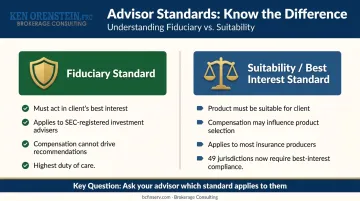
As of August 2025, NAIC reports that 49 jurisdictions have implemented annuity producer best-interest model regulations — meaning most insurance producers must now act in the consumer's best interest and satisfy care, disclosure, and conflict-of-interest obligations.
That regulatory shift toward transparency matters — and it shapes how Ken Orenstein structures his practice. Investment advisory services are delivered through Brookstone Capital Management, a registered investment advisor, where fiduciary duty applies. For annuity products, he operates as a commission-based independent broker representing multiple carriers, with that compensation structure disclosed upfront.
Is an Annuity Actually the Right Tool for Your Goals?
Annuities are not the right fit for everyone. They make the most sense for:
- Conservative investors who want guaranteed income and have low market-risk tolerance
- Clients with a clear income gap to fill in retirement
- Those with longer time horizons to let deferred products accumulate
- Retirees who've already secured one income floor and want to add another
If an agent can't clearly explain why this specific annuity fits your age, income needs, liquidity needs, and existing retirement assets — that's a significant red flag.
Who Will Service This Contract Going Forward?
Annuities are long-term commitments. Before signing, ask:
- Who is my point of contact if I have questions after purchase?
- What happens if you leave the firm?
- What is the insurance company's direct customer service number?
Ongoing access matters as much as the initial advice. Ken Orenstein can be reached directly at (888) 315-3608 or by email for questions about existing contracts — not just at the point of sale.
Frequently Asked Questions
What questions should I ask before buying an annuity?
Focus on five areas: all fees and surrender charges, how your money grows (and what limits apply), income payout options, what the death benefit actually covers, and how your advisor is compensated. This article covers each area in detail.
How much does a $100,000 annuity pay every month?
It depends on age, annuity type, payout period, and current interest rates. According to Kiplinger's May 2025 data, a $100,000 immediate life-only annuity for a 65-year-old pays approximately $629/month for males and $599/month for females. Those figures move up or down as rate environments change.
Can you lose money in an annuity?
Fixed and fixed index annuities protect principal from market loss. Variable annuities expose you to market risk and can decline in value. Any annuity surrendered early during the surrender period can result in a net loss due to penalty charges.
What is a surrender charge period?
The surrender charge period is the timeframe during which early withdrawals beyond the free withdrawal allowance trigger a penalty fee. Penalties typically start high and step down each year — surrender periods run 6–10 years for most deferred annuities.
What is the difference between a fixed and variable annuity?
Fixed annuities grow at a guaranteed interest rate with no market risk. Variable annuities are tied to investment subaccounts and can rise or fall in value. Fixed index annuities fall in between — offering limited market upside with principal protection.
How are annuity payouts taxed?
Tax treatment depends on funding source. Qualified annuities (pre-tax money) are fully taxable as ordinary income upon withdrawal; non-qualified annuities (after-tax money) are taxed only on earnings. Either way, withdrawals before age 59½ may trigger a 10% IRS early withdrawal penalty on top of regular income taxes.