
The knowledge gap is real. Many employees don't know exactly how contributions reduce their taxes, how investment growth compounds inside the account, or what withdrawal rules apply when retirement arrives. That uncertainty leads to missed savings opportunities and, sometimes, costly mistakes.
This guide walks through exactly how a TSA works — from your first paycheck deduction through retirement distributions — so you can make informed decisions about one of the most valuable benefits your employer offers.
Key Takeaways
- A TSA (403(b) plan) is a tax-advantaged retirement account for employees of public schools, nonprofits, and religious organizations
- Contributions come out of your paycheck before income taxes are calculated, reducing your taxable income immediately
- Earnings grow tax-deferred inside the account — no taxes owed on gains until you withdraw
- Withdrawals in retirement are taxed as ordinary income; withdrawing before age 59½ adds a 10% IRS penalty
- Annual IRS contribution limits apply, with catch-up options for workers over 50 and those with 15+ years of service at a qualifying employer
What Is a Tax-Sheltered Annuity (TSA)?
A tax-sheltered annuity is the common name for a retirement savings plan governed by IRC Section 403(b). It allows eligible employees to invest pre-tax salary dollars into either annuity contracts or mutual fund custodial accounts, with all investment gains growing tax-deferred until withdrawal.
Congress created the 403(b) framework in 1958 through the Technical Amendments Act to give workers at schools, churches, and nonprofits a structured, tax-advantaged path to retirement savings. These organizations historically couldn't compete with private-sector salaries or offer the 401(k) structures available in the corporate world.
What a TSA Is (and Isn't)
Common misconceptions about TSAs include:
- The word "annuity" reflects the original investment vehicle from 1958, not an insurance policy you'd buy for coverage
- Non-qualified annuities use after-tax dollars outside a retirement plan; TSA contributions go in pre-tax
- Modern 403(b) plans are not limited to annuities — mutual fund custodial accounts are also permitted
The IRS identifies three permitted account types under a 403(b):
- Annuity contracts issued by insurance companies (fixed or variable growth)
- Custodial accounts invested in mutual funds
- Retirement income accounts for church employees (which may use either structure)
How Does a Tax-Sheltered Annuity Work?
A TSA follows a clear sequence: enrollment and contributions, tax-deferred investment growth, IRS compliance rules, and eventually retirement distributions. Each stage has specific federal guidelines governing it.
Enrollment and Contributions
Participation begins when an eligible employee selects a TSA provider, completes a Salary Reduction Agreement (SRA), and authorizes payroll to deduct a set dollar amount from each paycheck before federal and state income taxes are applied.
The tax mechanics matter here. Because contributions come out pre-tax, your W-2 taxable wages are reduced — which means less income tax withheld each pay period. However, FICA taxes (Social Security and Medicare) still apply to your full gross salary; the TSA contribution doesn't reduce those.
Here's how that looks in practice:
| Without TSA | With TSA ($500/month) | |
|---|---|---|
| Monthly Gross Pay | $5,000 | $5,000 |
| TSA Contribution | $0 | $500 |
| Taxable Income (federal) | $5,000 | $4,500 |
| Estimated Federal Tax (22%) | $1,100 | $990 |
| Tax Savings per Month | — | $110 |
| Net Take-Home Reduction | — | $390 (not $500) |
That $500 contribution only reduces take-home pay by $390 — the $110 in immediate tax savings offsets the rest. Pre-tax deferrals cost less out-of-pocket than most employees expect.
Tax Deferral and Investment Growth
Once contributions reach the 403(b) account, all earnings — interest, dividends, capital gains — compound inside the account without annual taxation. This eliminates the "tax drag" that reduces returns in a standard taxable account every year.
The long-term impact adds up. Fidelity modeled a $250,000 bond fund investment over 20 years at a 6% annual pre-tax return with a 35.8% marginal tax rate. The tax-advantaged account produced an ending balance nearly $270,000 greater than the taxable account — entirely because annual tax drag was eliminated.
That compounding advantage extends further when employers contribute matching funds to the 403(b). Those contributions are also pre-tax and grow tax-deferred — that's additional compensation working inside the same account.
IRS Contribution Limits and Compliance Rules
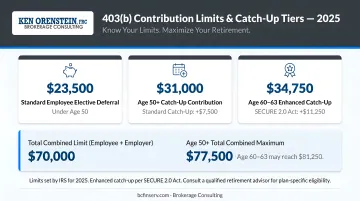
The IRS controls how much you can contribute each year. For 2025, per IRS Notice 2024-80:
- Standard elective deferral limit: $23,500
- Age 50+ catch-up: Additional $7,500 (total $31,000)
- Age 60–63 catch-up (SECURE 2.0): Additional $11,250 instead of the standard catch-up (total $34,750)
403(b) plans also have a catch-up provision unavailable in 401(k) plans: the 15-year service rule. Employees with at least 15 years of service at the same qualifying organization may contribute additional amounts above the standard catch-up, subject to a formula:
- Up to $3,000 per year
- Lifetime maximum of $15,000 (minus any prior 15-year catch-up contributions)
- Cannot exceed $5,000 × years of service minus all prior elective deferrals
One other compliance requirement: the universal availability rule. If an employer offers a 403(b) to any employee, it must make the plan available to all employees — with limited exceptions for employees working fewer than 20 hours per week and student workers.
Withdrawals and Retirement Income
At age 59½, withdrawals can begin without penalty. All distributions — whether from original contributions or accumulated earnings — are taxed as ordinary income in the year received.
Accessing funds before that threshold, however, carries significant costs. Early withdrawals (before 59½) trigger a 10% IRS additional tax on top of ordinary income taxes. Exceptions exist for:
- Death or total and permanent disability
- Terminal illness
- Separation from service at age 55 or older
- Substantially equal periodic payments (72(t) distributions)
- Qualified domestic relations orders
- Certain emergency personal expense distributions
Required Minimum Distributions (RMDs) begin at age 73 under the SECURE 2.0 Act changes. The IRS calculates each year's minimum based on your account balance and life expectancy tables.
Missing an RMD carries a steep penalty: a 25% excise tax on the shortfall, reduced to 10% if you correct it within the IRS correction window.
Who Is Eligible for a Tax-Sheltered Annuity?
Not everyone can participate in a 403(b) plan. Eligibility depends on two factors: the type of organization sponsoring the plan and the employee's role within it.
Eligible Employers
The IRS restricts 403(b) sponsorship to three categories:
- Public schools, colleges, and universities
- 501(c)(3) tax-exempt charitable organizations
- Churches and church-affiliated organizations
For-profit companies are not permitted to offer a 403(b) plan under any circumstances.
Eligible Employees
Within qualifying organizations:
- Full-time employees generally qualify immediately upon hire
- Part-time employees working 20+ hours per week typically qualify, though employer matching may not apply
- Employees working fewer than 20 hours per week, student workers, and federal work-study participants are generally excluded
One category that surprises many people: self-employed ministers. The IRS treats them as employed by a qualifying tax-exempt organization for 403(b) purposes, making them eligible to participate even without a traditional employer-employee relationship.
Advantages and Limitations of a TSA
Core Advantages
- Immediate tax reduction: Pre-tax contributions lower your taxable income dollar-for-dollar in the year you contribute
- Accelerated compounding: No annual tax on earnings means the full return reinvests each year
- Tax bracket arbitrage: If you're in a lower bracket at retirement than during your working years, you pay less tax on every dollar you withdraw
- 15-year service catch-up: A 403(b)-exclusive provision that can substantially increase contribution room for long-tenured employees
- Roth option: Many 403(b) plans offer a designated Roth account where contributions are after-tax but qualified withdrawals — including all earnings — are completely tax-free, which can be advantageous for younger employees expecting a higher bracket at retirement
Key Limitations
- Restricted investment menu: Options are limited to providers selected by your employer — often fewer choices than a self-directed brokerage account
- Fee risk: Annuity contracts within 403(b) plans can carry administrative fees, management fees, and surrender charges that erode net returns over time
- Illiquidity: Early withdrawal penalties make the account a long-term commitment, not an emergency fund
These trade-offs — tax timing, fees, and liquidity constraints — interact differently depending on your income, timeline, and other retirement accounts. Ken Orenstein at Brokerage Consulting offers no-cost initial consultations to work through those decisions, including annuity contract review, tax-efficient portfolio design, and multi-account retirement income planning. Reach his office at (888) 315-3608, or connect by phone, virtual, or in-person appointment.
TSA vs. 401(k): Key Differences
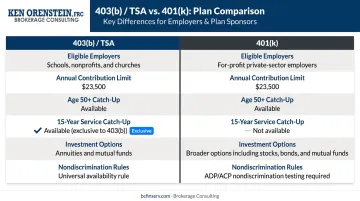
Both plans offer pre-tax contributions, tax-deferred growth, and the same 2025 elective deferral limit of $23,500. But several meaningful differences set them apart.
| Feature | 403(b) / TSA | 401(k) |
|---|---|---|
| Eligible employers | Public schools, 501(c)(3) nonprofits, churches | For-profit private-sector companies |
| 2025 contribution limit | $23,500 | $23,500 |
| Age 50+ catch-up | $7,500 | $7,500 |
| 15-year service catch-up | Yes (403(b)-exclusive) | No |
| Investment options | Annuity contracts, mutual fund custodial accounts | Broader — can include individual stocks, index funds |
| Nondiscrimination testing | Universal availability rule | ADP and ACP nondiscrimination tests |
| ERISA coverage | May be exempt for certain voluntary programs | Generally subject to ERISA |
The investment menu gap has real practical weight. 401(k) plans tend to offer more flexibility in fund selection, while your employer's contracted providers shape the 403(b) menu. The selection may be narrower — so it's worth reviewing exactly what you're invested in and what you're paying for it before assuming the defaults are your best option.
That contribution flexibility matters even more for certain public-sector employees. Some workers at public institutions qualify for both a 403(b) and a 457(b) deferred compensation plan simultaneously. The IRS treats these as separate limits, meaning a qualifying employee could defer up to $23,500 into each plan — nearly doubling their annual pre-tax retirement contribution capacity.
Frequently Asked Questions
What is a tax-sheltered annuity plan?
A tax-sheltered annuity (TSA), also called a 403(b) plan, is a tax-advantaged retirement savings plan for employees of public schools, certain nonprofits, and religious organizations. Contributions are made pre-tax and invested in annuity contracts or mutual funds, with earnings growing tax-deferred until withdrawal.
Who is a tax-sheltered annuity plan available to?
TSAs are available to employees of public educational institutions, 501(c)(3) nonprofits, and churches — covering full-time staff, part-time employees working 20+ hours per week, and self-employed ministers. For-profit employers are not eligible to offer a 403(b).
How much can you contribute to a tax-sheltered annuity each year?
For 2025, the standard elective deferral limit is $23,500. Employees 50 and older can add $7,500 (or $11,250 for those ages 60–63), and employees with 15+ years at the same qualifying organization may qualify for an additional $3,000 catch-up under a 403(b)-exclusive rule.
What happens if you withdraw from a TSA before age 59½?
Early withdrawals are subject to a 10% IRS additional tax plus ordinary income tax on the full amount withdrawn. Exceptions include permanent disability, death, terminal illness, separation from service at 55 or older, and qualifying domestic relations orders.
Can you participate in both a 403(b) and a 457(b) plan?
Yes, if your employer offers both. The IRS treats the contribution limits as completely separate, so eligible employees can defer up to the annual limit into each plan simultaneously — significantly increasing total pre-tax retirement savings capacity.
Is a tax-sheltered annuity the same as a 401(k)?
Both offer pre-tax contributions and tax-deferred growth at identical annual limits. The key difference is eligibility: 403(b) plans are restricted to public education, nonprofit, and religious employers, while 401(k) plans serve for-profit companies — and only the 403(b) includes a 15-year service catch-up provision.